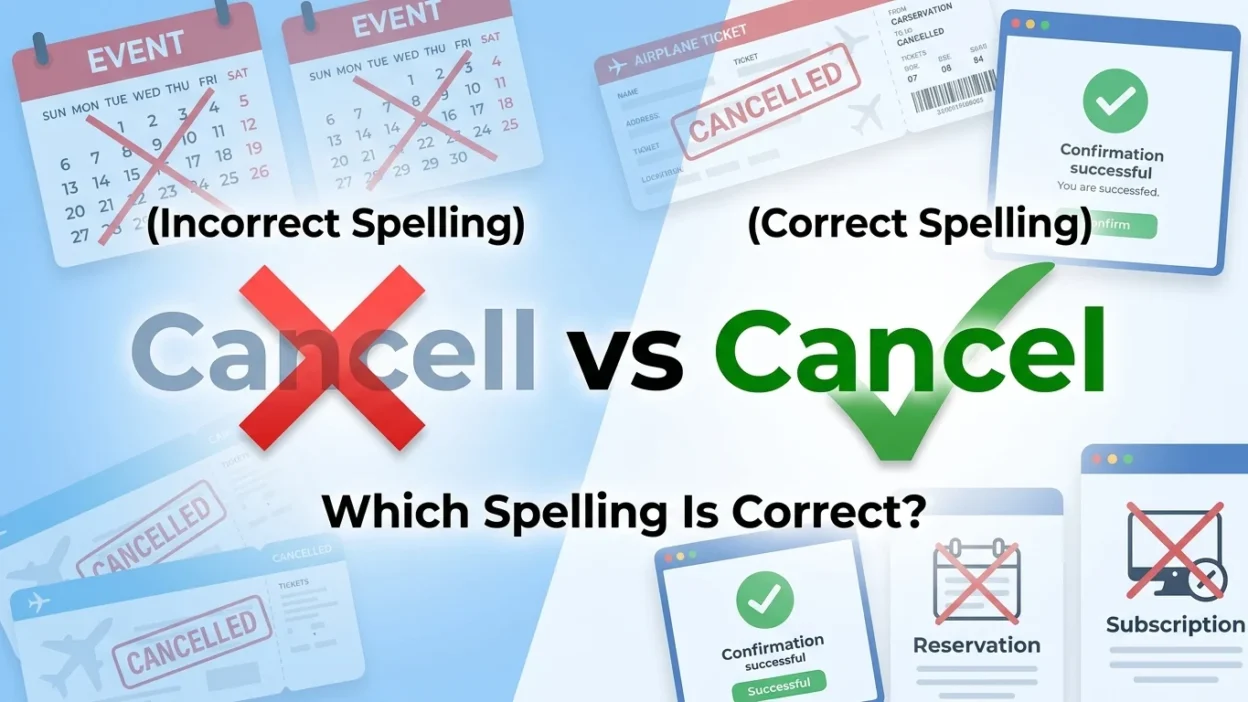
If you have ever typed “cancell” and wondered whether it should actually be “cancel,” you are not alone. English spelling can be confusing, especially when some words use double letters while others do not. Because forms like cancelled and cancelling contain double “l,” many people mistakenly assume the base word should be spelled “cancell.”
The good news is that the answer is simple. “Cancel” is the correct spelling of the base verb, while “cancell” is considered a spelling mistake. Understanding this difference will help you write more confidently in emails, business documents, school assignments, and everyday communication.
Quick Answer
“Cancel” is the correct spelling.
“Cancell” is incorrect in standard English.
Correct Example
- We may need to cancel the meeting.
Incorrect Example
- We may need to cancell the meeting.
What Does Cancel Mean?
Cancel is a verb that means:
- to call off something
- to decide that an event will not happen
- to stop or terminate an arrangement
- to invalidate something
It is commonly used in everyday conversations, business communication, travel, and technology.
Examples of Cancel in Sentences
- They decided to cancel the event due to bad weather.
- Please cancel my subscription.
- The airline had to cancel several flights.
- She canceled her appointment.
- We may cancel the order if it arrives late.
Is Cancell a Real Word?
No, “cancell” is not a correct English word.
It is usually a spelling error caused by confusion with related forms such as:
- cancelled
- cancelling
The standard dictionary form is always:
- cancel
Why Do People Write “Cancell”?
Many writers become confused because some forms of the word contain a double “l.”
For example:
British English
- cancelled
- cancelling
American English
- canceled
- canceling
However, the base verb remains:
- cancel
in both varieties of English.
Cancel vs Cancell Comparison Table
| Feature | Cancel | Cancell |
|---|---|---|
| Correct spelling | Yes | No |
| Standard English word | Yes | No |
| Dictionary approved | Yes | No |
| Used in professional writing | Yes | No |
| Grammar accepted | Yes | No |
Correct Word Structure
cancel=cancell
Common Mistakes With Cancel
Adding an Extra “L”
Incorrect:
- I need to cancell my reservation.
Correct:
- I need to cancel my reservation.
Confusing Base and Derived Forms
Writers often see:
- cancelled
- cancelling
and assume the base word should also contain two “l” letters.
However, the correct base spelling is:
- cancel
Typing Errors
Fast typing can easily result in an extra letter being added.
Different Uses of Cancel
Events
Example:
- Organizers had to cancel the concert.
Subscriptions
Example:
- You can cancel your membership online.
Travel
Example:
- The airline canceled the flight.
Business
Example:
- The company decided to cancel the project.
Common Phrases Using Cancel
Cancel an Appointment
Meaning: decide not to attend a scheduled meeting.
Example:
- She had to cancel her appointment.
Cancel an Order
Meaning: stop a purchase request.
Example:
- Customers may cancel orders within 24 hours.
Cancel a Subscription
Meaning: end a recurring service.
Example:
- He canceled his streaming subscription.
Cancel Plans
Meaning: decide not to continue with arrangements.
Example:
- Rain forced them to cancel their plans.
Synonyms for Cancel
Depending on context, similar words include:
- call off
- terminate
- revoke
- stop
- abandon
Example
- They decided to call off and cancel the event.
Opposites of Cancel
Antonyms include:
- continue
- proceed
- approve
- confirm
- maintain
Example
- The organizers decided to proceed rather than cancel.
American vs British English Differences
The base verb is the same in both varieties:
- cancel
However, differences appear in some derived forms.
| American English | British English |
|---|---|
| canceled | cancelled |
| canceling | cancelling |
| cancel | cancel |
Regardless of the variety, the base form is always:
- cancel
Never:
- cancell
Why Correct Spelling Matters
Correct spelling improves:
- professionalism
- readability
- communication clarity
- credibility
- writing confidence
Misspellings like “cancell” may:
- distract readers
- create confusion
- make writing appear less polished
Tips to Remember the Correct Spelling
Remember the Base Form
Correct:
- cancel
Not:
- cancell
Think of Related Words
Examples:
- cancel a meeting
- cancel a reservation
- cancel an order
All use a single “l.”
Practice Full Sentences
Example:
- We decided to cancel the trip.
FAQs
Which spelling is correct: cancell or cancel?
Cancel is the correct spelling.
Is cancell a real word?
No. It is considered a spelling mistake in standard English.
Why do people write cancell?
Usually because they confuse the base word with forms like cancelled and cancelling.
What does cancel mean?
It means to call off, terminate, stop, or invalidate something.
Is cancel used in British and American English?
Yes. Both use cancel as the base form.
Why does British English use “cancelled”?
British English often doubles the final “l” before adding endings such as -ed and -ing.
What are synonyms for cancel?
Common synonyms include call off, terminate, revoke, and stop.
How can I remember the correct spelling?
Remember:
- cancel = one “l”
- cancelled/cancelling may use two “l” letters in British English
Final Summary
The difference between cancell vs cancel is straightforward. “Cancel” is the correct spelling of the base verb in both American and British English, while “cancell” is a common spelling mistake. The confusion often comes from related forms such as cancelled and cancelling, which may contain double “l” letters.
If you are writing emails, business reports, travel documents, blog posts, or academic assignments, using “cancel” correctly helps your writing appear professional, accurate, and trustworthy. Small spelling details can make a significant difference in effective communication.
Actionable Takeaway
Whenever you mean to call off, stop, or terminate something, always write:
- cancel
Not:
- cancell
A simple memory trick:
- cancel = one “l”
Keeping this rule in mind will help you avoid a very common English spelling mistake.