If you’ve ever wondered whether “past” or “passed” is the correct word, you’re not alone. These two words sound the same but have different meanings and grammatical functions.
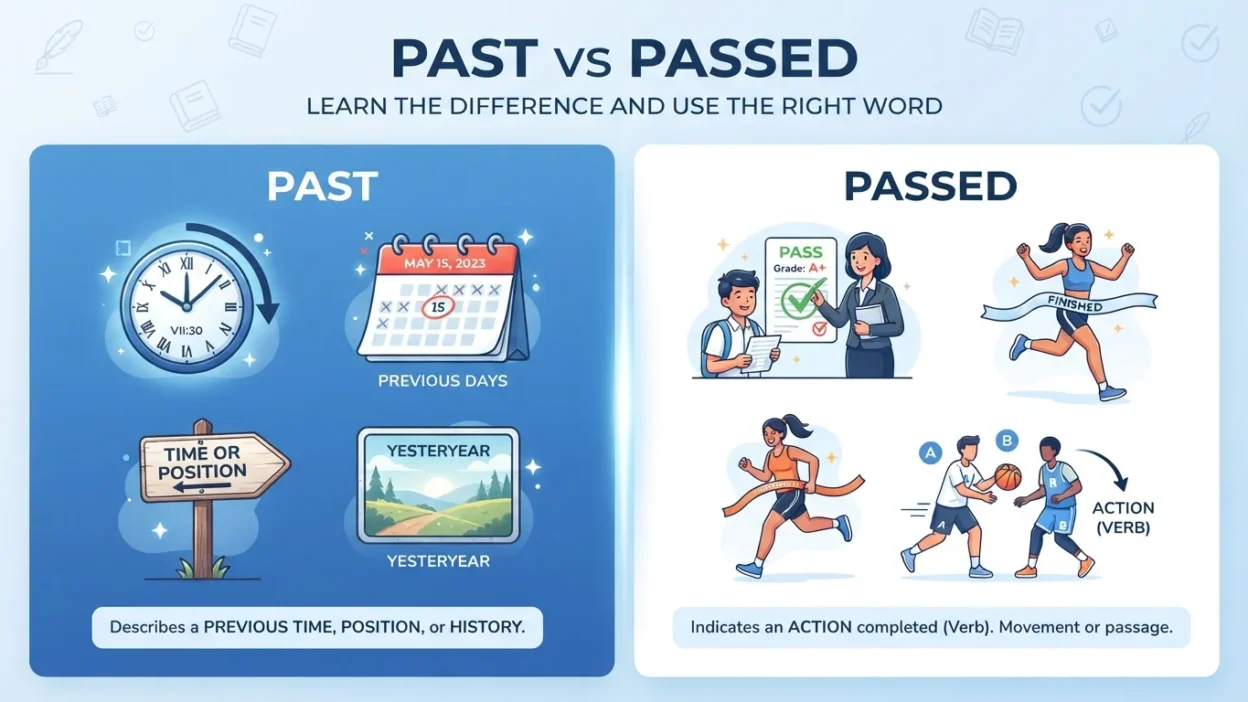
Past usually refers to time gone by, a previous position, or beyond a point, while passed is the past tense and past participle of the verb pass, meaning to move by, go beyond, hand over, or succeed.
Understanding the difference between past vs passed will help you avoid one of the most common grammar mistakes in English.
Quick Answer
- Past = A noun, adjective, adverb, or preposition referring to earlier time or a position beyond something.
- Passed = The past tense of pass, meaning moved by, handed over, succeeded, or went beyond.
Correct Examples
- We can’t change the past.
- She passed the driving test.
What Does “Past” Mean?
Past is not a verb. It can function as a:
- noun
- adjective
- adverb
- preposition
It generally refers to:
- an earlier time
- something that has already happened
- a position beyond another object
Examples of Past in Sentences
- We should learn from the past.
- The store is just past the traffic light.
- It’s half past three.
- His past experiences made him stronger.
- She walked past the library.
What Does “Passed” Mean?
Passed is the past tense and past participle of the verb pass.
It means:
- moved by
- went beyond
- handed something to someone
- completed successfully
- approved
- died (a polite expression: “passed away”)
Examples of Passed in Sentences
- He passed the exam with excellent marks.
- We passed the museum on our way home.
- She passed me the salt.
- The bill passed in Parliament.
- My grandfather passed away peacefully.
Past vs Passed Comparison Table
| Feature | Past | Passed |
|---|---|---|
| Part of speech | Noun, adjective, adverb, preposition | Verb |
| Refers to earlier time | ✅ Yes | ❌ No |
| Means moved beyond | ❌ No | ✅ Yes |
| Means succeeded | ❌ No | ✅ Yes |
| Standard English | ✅ Yes | ✅ Yes |
Word Comparison
When to Use Past
Use past when referring to:
- previous time
- history
- location beyond something
- time expressions
Examples
- Forget the past and move forward.
- It’s ten minutes past noon.
- Drive past the school and turn left.
When to Use Passed
Use passed when describing an action involving the verb pass.
Examples
- She passed all her classes.
- The train passed the station.
- He passed the ball to his teammate.
- They passed the law unanimously.
Common Mistakes
Using Past Instead of Passed
Incorrect:
- She past the exam.
Correct:
- She passed the exam.
Using Passed Instead of Past
Incorrect:
- We drove passed the park.
Correct:
- We drove past the park.
Common Phrases
Past
- the past
- past midnight
- walk past
- past experience
- half past
Passed
- passed away
- passed the test
- passed by
- passed the ball
- passed through
Synonyms
Synonyms for Past
- previous
- earlier
- former
- beyond
- gone by
Synonyms for Passed
- moved beyond
- went by
- handed
- completed
- succeeded
American vs British English Differences
There is no significant difference.
Both American and British English use past and passed according to the same grammar rules.
Why Correct Word Choice Matters
Using the correct word helps:
- improve grammar
- avoid confusion
- strengthen professional writing
- communicate ideas accurately
Because past and passed are homophones (words that sound alike), they are often confused in writing.
Tips to Remember the Difference
Past = Time or Position
Think of past as referring to:
- history
- earlier time
- beyond a place
Passed = Action
If the sentence describes an action, especially one that could be replaced with moved, went, handed, or succeeded, use passed.
Easy Memory Trick
- Passed = Verb (Action)
- Past = Time or Place
(FAQs)
What is the difference between past and passed?
Past refers to earlier time or a position beyond something, while passed is the past tense of pass and describes an action.
Which is correct: “passed the exam” or “past the exam”?
The correct phrase is passed the exam because passed is the verb.
Is “walked past” correct?
Yes. Past is the correct preposition after walked.
Example:
- We walked past the museum.
Is “passed away” correct?
Yes. Passed away is a common and polite expression meaning died.
Can “past” be a verb?
No. Past is never used as a verb.
Is there a difference between British and American English?
No. Both varieties follow the same usage rules.
How can I remember the difference?
Think:
- Passed = Action (verb)
- Past = Time or place
Final Summary
The difference between past vs passed is straightforward. Past refers to time gone by or a position beyond something, while passed is the past tense of pass and describes an action such as moving by, handing over, or succeeding.
Whenever you’re unsure, ask yourself: Is this an action? If yes, use passed. If not, past is usually the correct choice.
Actionable Takeaway
Use:
- past ✅ for time, history, or location.
- passed ✅ for actions involving the verb pass.
Memory trick:
- Passed = Verb
- Past = Time or Place