If you’ve ever wondered whether “deep seated” or “deep seeded” is the correct phrase, you’re not alone. Because the two expressions sound similar, many people mistakenly write deep seeded. However, only deep seated is considered correct in standard English.
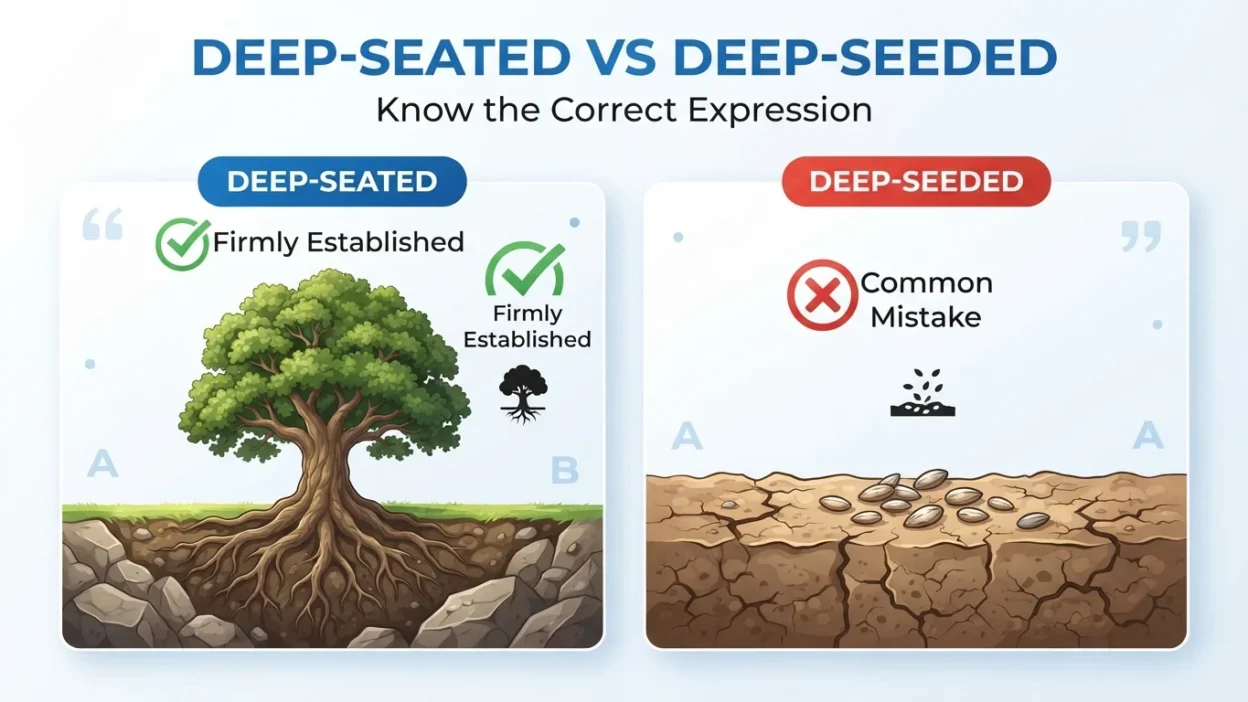
Deep seated means firmly established, deeply rooted, or difficult to change, while deep seeded is generally regarded as a misspelling or a mistaken blend with the phrase deep rooted.
Quick Answer
- Deep seated = Correct; means firmly established or deeply ingrained.
- Deep seeded = Incorrect in standard English.
Correct Examples
- She has a deep seated fear of heights.
- The conflict stems from deep seated political differences.
Incorrect Example
- She has a deep seeded fear of heights. ❌
What Does “Deep Seated” Mean?
Deep-seated is an adjective meaning:
- firmly established
- deeply ingrained
- difficult to change
- rooted in a person’s thoughts, emotions, or beliefs
The word seated originally meant fixed firmly in place, not related to sitting in a chair.
Examples of Deep Seated in Sentences
- He has a deep seated distrust of authority.
- The company faces deep seated financial problems.
- Their disagreement comes from deep seated cultural differences.
- She overcame her deep seated anxiety.
- The reforms addressed deep seated social issues.
Why Is “Deep Seeded” Incorrect?
Deep seeded is a common mistake caused by confusion with phrases such as:
- deep rooted
- seeded with ideas
- planting the seeds
Because something deeply established may seem like it was “seeded,” people often substitute seeded for seated. However, dictionaries and style guides recognize deep seated as the correct idiom.
Deep-Seated vs Deep Seeded Comparison Table
| Feature | Deep Seated | Deep Seeded |
|---|---|---|
| Correct spelling | ✅ Yes | ❌ No |
| Standard English | ✅ Yes | ❌ No |
| Means firmly established | ✅ Yes | ❌ No |
| Accepted in formal writing | ✅ Yes | ❌ No |
| Dictionary approved | ✅ Yes | ❌ No |
Word Comparison
When to Use Deep Seated
Use deep-seated when describing:
- beliefs
- fears
- emotions
- habits
- social or political problems
- long standing attitudes
Examples
- She has a deep seated love of music.
- The country faces deep seated economic challenges.
- His deep seated resentment affected their friendship.
Common Mistakes
Using Deep Seeded Instead of Deep Seated
Incorrect:
- They have deep seeded disagreements.
Correct:
- They have deep seated disagreements.
Mixing It with “Deep Rooted”
Both deep seated and deep rooted are correct, but they are different expressions.
- deep seated beliefs ✅
- deep rooted traditions ✅
Common Phrases
- deep seated fear
- deep seated belief
- deep seated problem
- deep seated prejudice
- deep seated resentment
- deep seated concern
Synonyms
Synonyms for Deep Seated
- deeply rooted
- ingrained
- entrenched
- established
- firmly fixed
- longstanding
American vs British English Differences
There is no difference.
Both American and British English use deep seated as the correct expression.
Deep seeded is considered an error in both varieties.
Why Correct Usage Matters
Using the correct phrase helps:
- improve credibility
- avoid common writing mistakes
- strengthen professional and academic writing
- communicate clearly
Since deep seated is the accepted idiom, using deep-seeded may distract readers or make your writing appear less polished.
Tips to Remember the Difference
Deep Seated = Firmly Fixed
Think of seated as meaning firmly placed or securely established.
Don’t Think About Seeds
Although seeded may sound logical, it is not the standard expression.
Easy Memory Trick
- Deep seated = Deeply established
- Deep seeded = Common mistake
(FAQs)
Which is correct: deep seated or deep seeded?
Deep seated is the correct expression. Deep seeded is a common misspelling.
What does deep seated mean?
It means firmly established, deeply ingrained, or difficult to change.
Is deep seeded a real phrase?
It is widely used by mistake, but it is not considered correct in standard English.
Why do people say deep seeded?
Because it sounds similar to deep seated and is influenced by the phrase deep rooted.
Can I use deep rooted instead of deep seated?
Yes. In many contexts, deep rooted is a suitable synonym, though the two expressions are not always interchangeable.
Is deep seated formal English?
Yes. It is appropriate in both formal and informal writing.
Is there a difference between British and American English?
No. Both use deep seated as the standard form.
How can I remember the correct phrase?
Think:
- Deep seated = Firmly seated in place
- Deep seeded = Incorrect
Final Summary
The difference between deep seated vs deep seeded is simple. Deep seated is the correct expression meaning firmly established or deeply ingrained, while deep seeded is a common misspelling that should be avoided in standard English.
Whenever you’re writing about long standing beliefs, fears, emotions, or problems, always choose deep seated.
Actionable Takeaway
Use:
- deep seated ✅ for ideas, beliefs, emotions, and problems that are firmly established.
Never use:
- deep seeded ❌
Memory trick:
- Deep seated = Correct
- Deep seeded = Common mistake