If you’ve ever wondered whether “discrete” or “discreet” is the correct word, you’re not alone. These two words are among the most commonly confused in English because they look and sound very similar. However, they have completely different meanings.
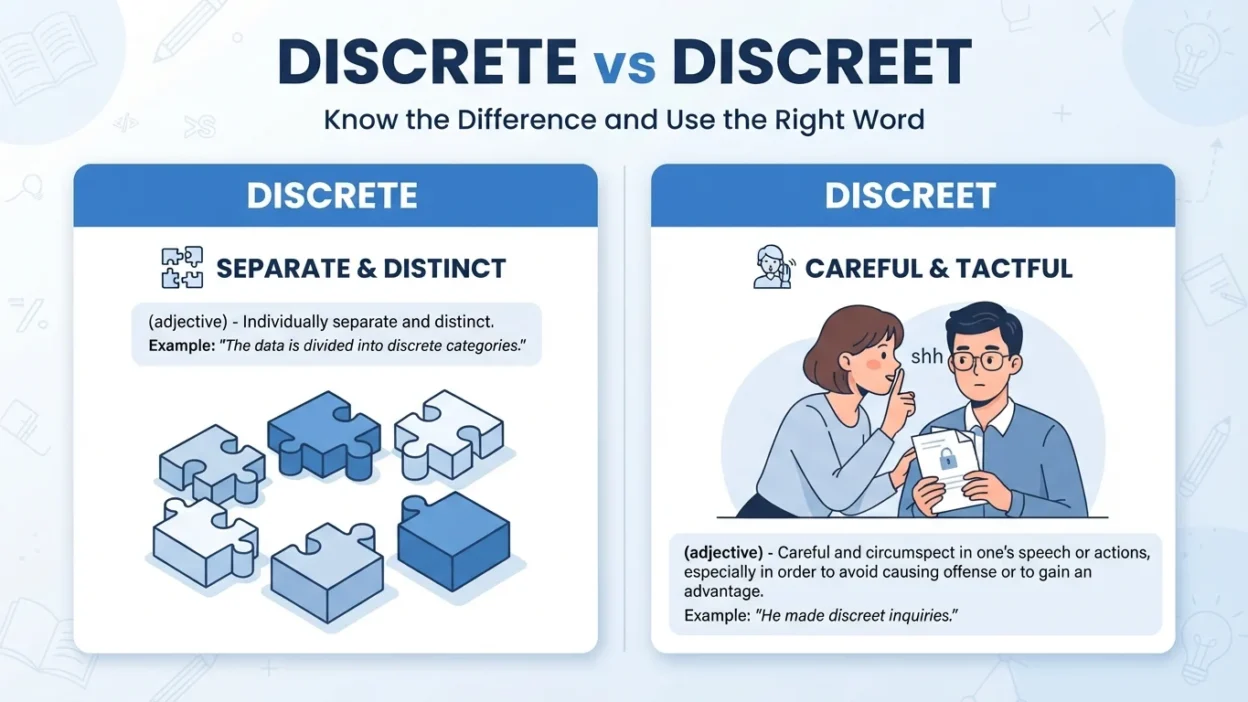
Discrete means separate, distinct, or individually separate, while discreet means careful, tactful, or intentionally avoiding attention. Knowing the difference between discrete vs discreet will help you use each word confidently in both professional and everyday writing.
Quick Answer
- Discrete = Separate, distinct, or individually separate.
- Discreet = Careful, tactful, or intentionally unobtrusive.
Correct Examples
- The report divides the data into discrete categories.
- She was discreet about discussing the confidential project.
What Does “Discrete” Mean?
Discrete is an adjective meaning:
- separate
- distinct
- individual
- not connected to other parts
It is commonly used in:
- mathematics
- science
- technology
- statistics
- business
Examples of Discrete in Sentences
- The survey measured five discrete variables.
- The project consists of several discrete phases.
- Each department operates as a discrete unit.
- The data is divided into discrete categories.
- The software contains discrete modules.
What Does “Discreet” Mean?
Discreet is an adjective meaning:
- careful in speech or actions
- tactful
- prudent
- intentionally avoiding attention or publicity
It is often used when talking about:
- people
- conversations
- confidential information
- behavior
Examples of Discreet in Sentences
- Please be discreet when discussing the merger.
- The hotel offers discreet service for celebrities.
- He handled the situation in a discreet manner.
- She gave me a discreet smile.
- The lawyer remained discreet about the case.
Discrete vs Discreet Comparison Table
| Feature | Discrete | Discreet |
|---|---|---|
| Means separate or distinct | ✅ Yes | ❌ No |
| Means careful or tactful | ❌ No | ✅ Yes |
| Common in mathematics | ✅ Yes | ❌ No |
| Refers to behavior | ❌ No | ✅ Yes |
| Standard English | ✅ Yes | ✅ Yes |
Word Comparison
When to Use Discrete
Use discrete when referring to:
- separate items
- individual parts
- independent units
- distinct categories
Examples
- The report contains three discrete sections.
- The experiment measured discrete events.
- Each task was treated as a discrete assignment.
When to Use Discreet
Use discreet when referring to:
- tactful communication
- confidential behavior
- privacy
- careful actions
Examples
- Be discreet with sensitive information.
- She made a discreet inquiry.
- The company handled customer complaints discreetly.
Common Mistakes
Using Discreet Instead of Discrete
Incorrect:
- The graph shows discreet values.
Correct:
- The graph shows discrete values.
Using Discrete Instead of Discreet
Incorrect:
- He was very discrete about the surprise party.
Correct:
- He was very discreet about the surprise party.
Common Phrases
Discrete
- discrete variables
- discrete categories
- discrete components
- discrete units
- discrete events
Discreet
- discreet service
- discreet conversation
- discreet inquiry
- discreet behavior
- discreet assistance
Synonyms
Synonyms for Discrete
- separate
- distinct
- individual
- independent
- detached
Synonyms for Discreet
- tactful
- careful
- prudent
- diplomatic
- cautious
American vs British English Differences
There is no significant difference.
Both American and British English use discrete and discreet with the same meanings.
Why Correct Word Choice Matters
Using the correct word helps:
- improve precision
- avoid misunderstandings
- strengthen professional writing
- demonstrate strong vocabulary skills
Because these words differ by only one letter, they are frequently confused in writing.
Tips to Remember the Difference
Discrete = Separate
Notice that discrete ends with -ete, like separate. Both involve the idea of things being distinct.
Discreet = Keep a Secret
The double “ee” in discreet can remind you of keeping a secret between two people.
Easy Memory Trick
- Discrete = Distinct
- Discreet = Diplomatic
(FAQs)
What is the difference between discrete and discreet?
Discrete means separate or distinct, while discreet means careful, tactful, or intentionally unobtrusive.
Which word is used in mathematics?
Discrete is commonly used in mathematics and statistics, such as discrete data or discrete variables.
Is discreet related to secrecy?
Yes. Discreet often describes someone who is careful about sharing private or confidential information.
Can I say “discreet categories”?
No. If you’re talking about separate categories, use discrete categories.
Which is correct: “be discreet” or “be discrete”?
If you mean be careful or tactful, the correct phrase is be discreet.
Is there a difference between British and American English?
No. Both varieties use these words the same way.
How can I remember the difference?
Think:
- Discrete = Distinct
- Discreet = Secret
Final Summary
The difference between discrete vs discreet is straightforward. Discrete refers to things that are separate or distinct, while discreet describes someone who is careful, tactful, or good at keeping information private.
Choosing the right word will make your writing clearer, more accurate, and more professional.
Actionable Takeaway
Use:
- discrete ✅ for separate or individual things.
- discreet ✅ for careful, tactful, or confidential behavior.
Memory trick:
- Discrete = Distinct
- Discreet = Secret