Many English learners struggle with laying vs lying because the verbs lay and lie have similar forms but different meanings. The confusion becomes even greater because the past tense of lie is lay, making these verbs easy to mix up.
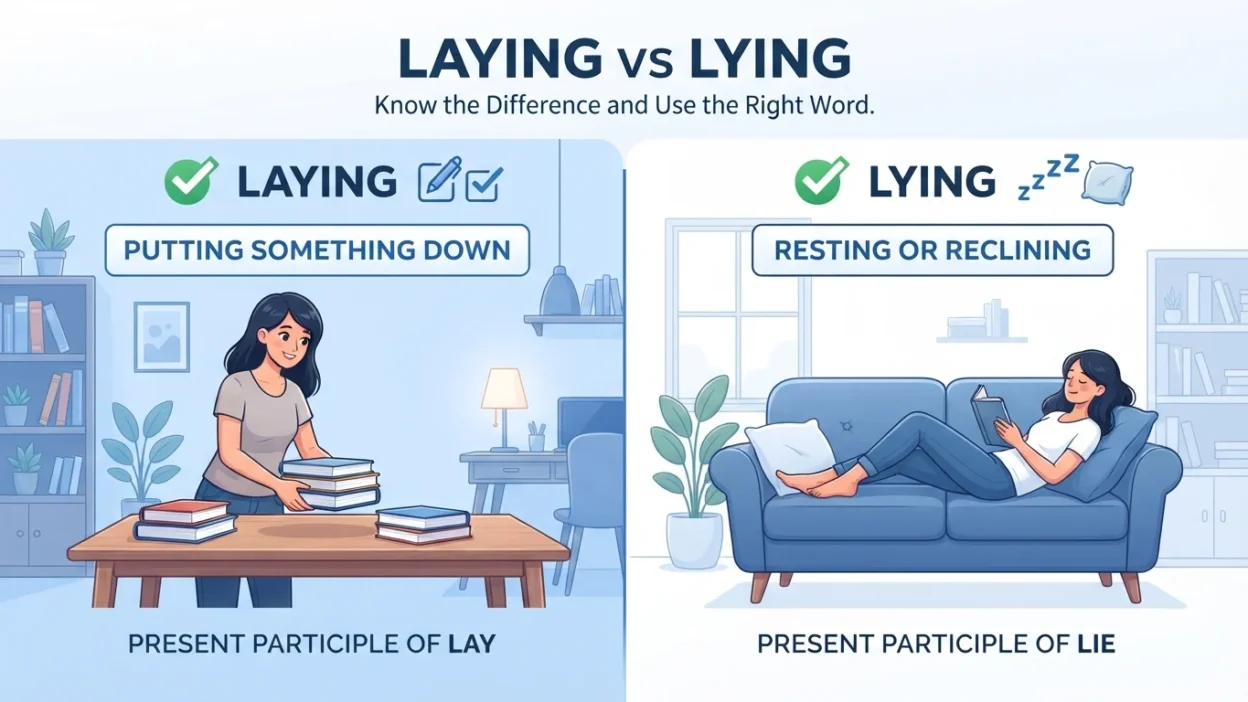
The key difference is simple: laying means placing or putting something down and always requires a direct object, while lying means resting or reclining and does not take a direct object.
Quick Answer
- Laying = Putting or placing something down (requires an object).
- Lying = Resting, reclining, or being in a horizontal position (no object).
Correct Examples
- She is laying the books on the table.
- The cat is lying on the sofa.
What Does “Laying” Mean?
Laying is the present participle of lay.
It means:
- to put something down
- to place something somewhere
- to set or position an object
Since lay is a transitive verb, it always needs a direct object—something that is being placed.
Examples of Laying in Sentences
- She is laying the plates on the table.
- The worker is laying bricks for the wall.
- They are laying fresh carpet in the office.
- The hen is laying eggs.
- He is laying the foundation for the new building.
What Does “Lying” Mean?
Lying is the present participle of lie (meaning to recline or rest).
It means:
- to rest in a flat or reclining position
- to remain in a place
- to be positioned somewhere
Unlike lay, lie does not take a direct object.
Examples of Lying in Sentences
- The dog is lying under the tree.
- She is lying on the couch.
- My phone is lying on the desk.
- He was lying awake all night.
- The keys are lying beside the laptop.
Note: In this article, lying refers to reclining or resting, not lying meaning telling an untruth.
Laying vs Lying Comparison Table
| Feature | Laying | Lying |
|---|---|---|
| Comes from | Lay | Lie (recline) |
| Means placing something | ✅ Yes | ❌ No |
| Means resting or reclining | ❌ No | ✅ Yes |
| Requires a direct object | ✅ Yes | ❌ No |
| Standard English | ✅ Yes | ✅ Yes |
Word Comparison
When to Use Laying
Use laying when you are:
- placing something
- putting something down
- arranging an object
- setting something in position
Examples
- She is laying the dishes on the table.
- They’re laying new flooring.
- The gardener is laying mulch around the plants.
When to Use Lying
Use lying when someone or something is:
- resting
- reclining
- positioned somewhere
- stretched out
Examples
- The baby is lying in the crib.
- Your jacket is lying on the chair.
- He spent the afternoon lying on the beach.
Common Mistakes
Using Laying Instead of Lying
Incorrect:
- I’m laying on the bed.
Correct:
- I’m lying on the bed.
(You’re resting, not placing something.)
Using Lying Instead of Laying
Incorrect:
- She’s lying the book on the desk.
Correct:
- She’s laying the book on the desk.
(The book is the object being placed.)
Common Phrases
Laying
- laying bricks
- laying carpet
- laying eggs
- laying the foundation
- laying the table
Lying
- lying down
- lying in bed
- lying on the floor
- lying awake
- lying still
Verb Forms
| Verb | Base Form | Present Participle | Past Tense | Past Participle |
|---|---|---|---|---|
| Lay | lay | laying | laid | laid |
| Lie (recline) | lie | lying | lay | lain |
Notice: The past tense of lie is lay, which is one reason these verbs are often confused.
Synonyms
Synonyms for Laying
- placing
- putting
- setting
- positioning
- arranging
Synonyms for Lying
- resting
- reclining
- lounging
- stretching out
- relaxing
American vs British English Differences
There is no significant difference.
Both American and British English follow the same grammar rules for lay and lie.
Why Correct Word Choice Matters
Using the correct verb helps:
- improve grammatical accuracy
- avoid confusion
- strengthen professional writing
- communicate actions clearly
Tips to Remember the Difference
Laying = Place Something
Ask yourself:
“What am I laying?”
If there’s an object, laying is probably correct.
Lying = Resting
If no object follows and someone is simply resting, use lying.
Easy Memory Trick
- Laying = Placing
- Lying = Resting
(FAQs)
What is the difference between laying and lying?
Laying means placing something down and requires a direct object. Lying means resting or reclining and does not require an object.
Which is correct: “laying in bed” or “lying in bed”?
Lying in bed is correct because you’re resting, not placing something.
Is “the hen is laying eggs” correct?
Yes. The hen is laying eggs because eggs are the object being produced.
Why is this pair so confusing?
Because the past tense of lie is lay, while the present participle of lay is laying.
Is “I’m laying on the couch” correct?
In standard English, I’m lying on the couch is correct.
Do British and American English use these words differently?
No. Both follow the same grammatical distinction.
How can I remember the difference?
Think:
- Laying = Placing something
- Lying = Resting
Final Summary
The difference between laying vs lying comes down to whether there is a direct object. Laying means placing or putting something somewhere, while lying means resting or being in a horizontal position.
A simple test is to ask, “What is being placed?” If there’s an object, use laying. If not, lying is usually the correct choice.
Actionable Takeaway
Use:
- laying ✅ when placing or putting something down.
- lying ✅ when resting or reclining.
Memory trick:
- Laying = Place
- Lying = Rest