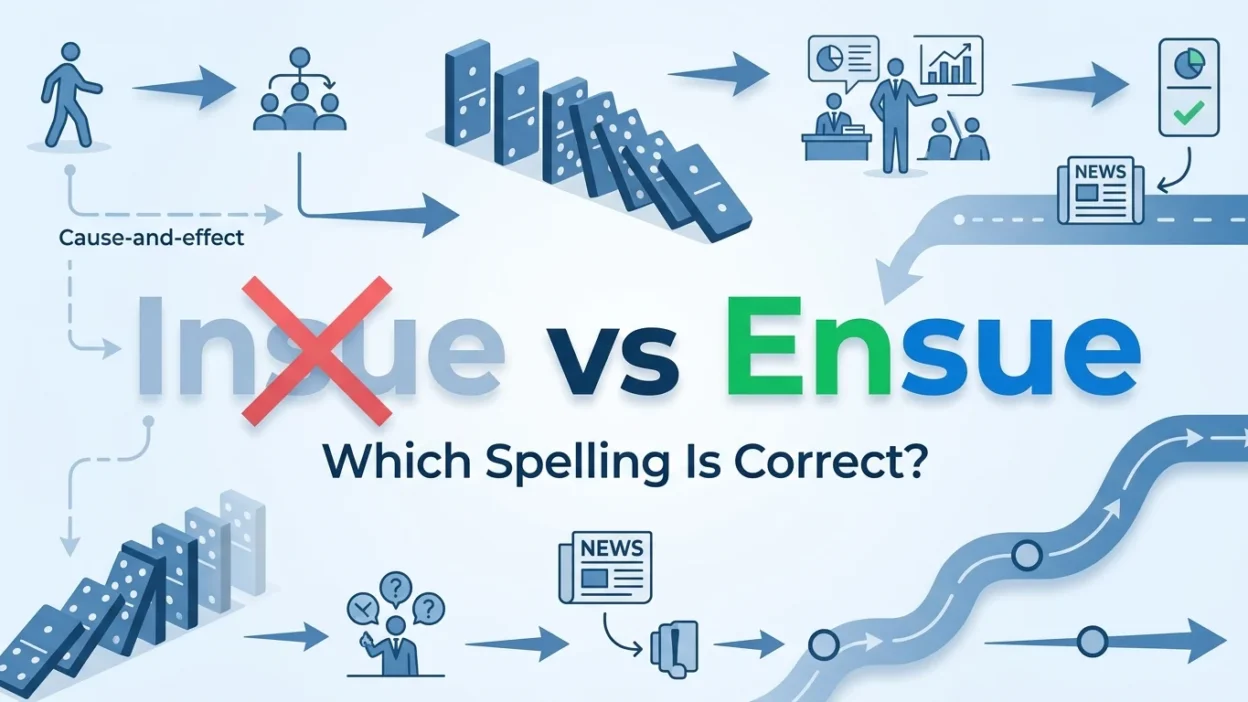
If you’ve ever written “insue” and wondered whether it should actually be “ensue,” you’re not alone. These words sound similar when spoken, which makes them easy to confuse in writing. Many people accidentally use insue because it seems like a reasonable spelling based on pronunciation.
However, in standard English, “ensue” is the correct word, while “insue” is a misspelling. Understanding the difference can help you write more confidently and avoid a common grammar mistake in professional, academic, and everyday communication.
Quick Answer
“Ensue” is the correct spelling.
“Insue” is incorrect in modern English.
Correct Example
- A heated debate may ensue after the announcement.
Incorrect Example
- A heated debate may insue after the announcement.
What Does Ensue Mean?
Ensue is a verb that means:
- to happen afterward
- to occur as a result of something
- to follow as a consequence
It is often used to describe events that happen after a particular action or situation.
Examples of Ensue in Sentences
- Chaos ensued after the power outage.
- Several questions may ensue from this decision.
- Laughter ensued when the joke was told.
- A legal dispute could ensue if the contract is broken.
- Protests ensued following the announcement.
Is Insue a Real Word?
No, “insue” is not recognized as a standard English word.
It is simply a spelling mistake of:
- ensue
Most dictionaries, grammar guides, and style manuals only recognize:
- ensue
Why Do People Write “Insue”?
There are several reasons this mistake occurs:
- the pronunciation can be misleading
- the prefix “in-” is common in English words
- writers may not be familiar with the word’s spelling
- typing errors can easily switch letters
Despite these factors, the correct spelling is always:
- ensue
Insue vs Ensue Comparison Table
| Feature | Ensue | Insue |
|---|---|---|
| Correct spelling | Yes | No |
| Standard English word | Yes | No |
| Dictionary approved | Yes | No |
| Professional writing | Yes | No |
| Grammar accepted | Yes | No |
Correct Word Structure
ensue=insue
Common Mistakes With Ensue
Replacing “En” With “In”
Incorrect:
- Confusion may insue after the update.
Correct:
- Confusion may ensue after the update.
Spelling Based on Sound
Because the first syllable sounds soft, some writers incorrectly assume it begins with:
- in
However, the correct spelling starts with:
- en
Typing Errors
Fast typing often leads to letter substitutions and spelling mistakes.
Different Uses of Ensue
After an Event
Example:
- Celebration ensued after the victory.
As a Consequence
Example:
- Serious complications may ensue if the issue is ignored.
In News and Journalism
Example:
- Protests ensued throughout the city.
In Legal Contexts
Example:
- Litigation could ensue if negotiations fail.
Common Phrases Using Ensue
Chaos Ensued
Meaning: disorder followed.
Example:
- Chaos ensued after the alarm sounded.
Debate Ensued
Meaning: discussion or argument followed.
Example:
- A lengthy debate ensued among committee members.
Conflict Ensued
Meaning: disagreement followed.
Example:
- Conflict ensued over resource allocation.
Laughter Ensued
Meaning: people began laughing afterward.
Example:
- Laughter ensued after his funny remark.
Synonyms for Ensue
Depending on context, similar words include:
- follow
- result
- occur
- arise
- happen
Example
- Several problems followed and ensued after the change.
Opposites of Ensue
Antonyms include:
- precede
- prevent
- avoid
- stop
- halt
Example
- Quick action helped prevent problems that might otherwise have ensued.
American vs British English Differences
There is no spelling difference between American English and British English.
Both use:
- ensue
Neither uses:
- insue
Why Correct Spelling Matters
Correct spelling improves:
- professionalism
- readability
- communication clarity
- credibility
- writing quality
Misspellings like “insue” can:
- distract readers
- reduce trust
- make writing appear less polished
Tips to Remember the Correct Spelling
Remember “En” Comes First
Correct:
- ensue
Not:
- insue
Think of “Event Then Ensue”
Both words begin with:
- e
This can serve as a simple memory aid.
Practice Full Sentences
Example:
- Additional costs may ensue if repairs are delayed.
FAQs
Which spelling is correct: insue or ensue?
Ensue is the correct spelling.
Is insue a real word?
No. It is considered a spelling mistake in standard English.
What does ensue mean?
It means to happen afterward or occur as a consequence.
Why do people write insue?
Usually because of pronunciation confusion or typing errors.
Is ensue used in British and American English?
Yes. Both varieties use ensue.
What are synonyms for ensue?
Common synonyms include follow, occur, happen, arise, and result.
Can ensue be used in formal writing?
Yes. It is commonly used in legal, academic, business, and journalistic writing.
How can I remember the correct spelling?
Remember:
- ensue starts with en
Think:
- event → ensue
Final Summary
The difference between insue vs ensue is simple. “Ensue” is the correct English verb meaning to happen afterward or occur as a consequence of something. “Insue” is a common misspelling and should be avoided in formal and informal writing.
Whether you’re writing essays, business reports, emails, legal documents, or blog posts, using ensue correctly helps your writing appear accurate, professional, and trustworthy. Small spelling improvements can make a big difference in communication quality.
Actionable Takeaway
Whenever you mean to happen as a result or consequence, always write:
- ensue
Not:
- insue
A simple memory trick:
- event → ensue
Both start with e, making the correct spelling easier to remember.