English spelling can sometimes be confusing, especially when double letters are involved. One common mistake people make is writing “posses” instead of “possess.” Since many English words use only one ending “s,” it is understandable why this spelling error happens.
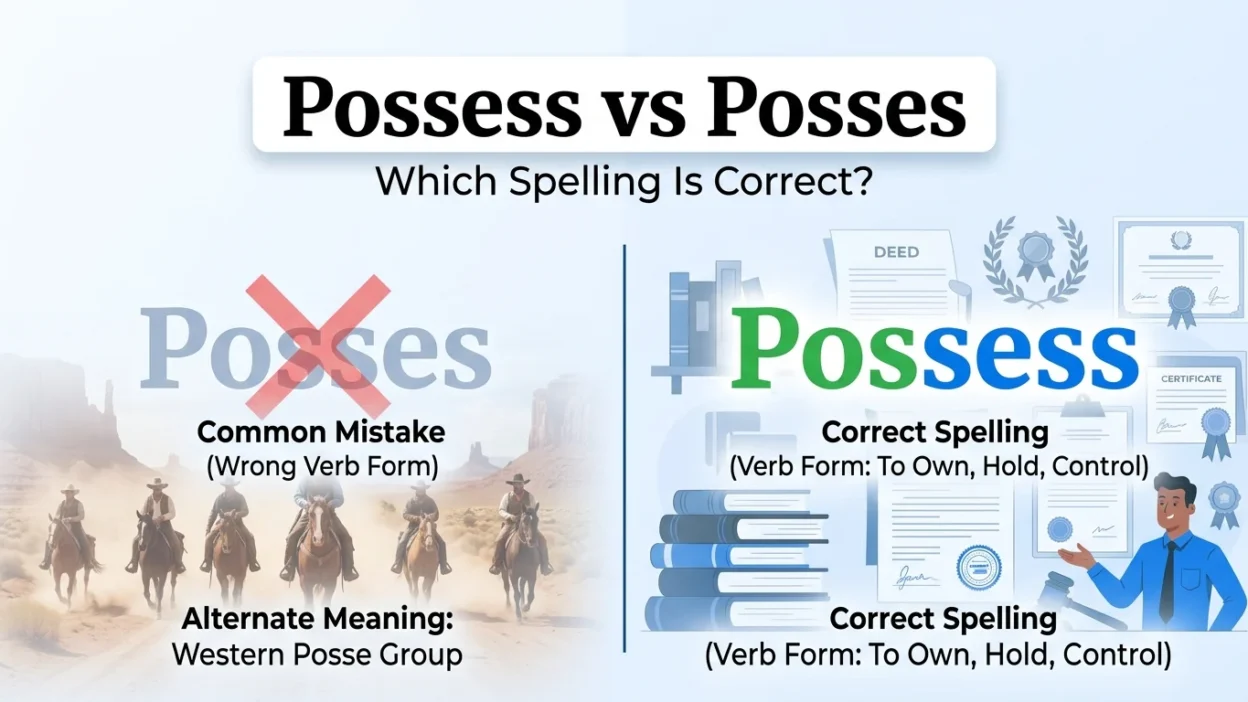
The correct spelling is “possess.” Meanwhile, “posses” is generally incorrect when you mean ownership or control. However, “posses” can sometimes appear as the plural form of “posse,” which refers to a group of people. Understanding the difference can help improve your grammar, writing accuracy, and communication clarity.
Quick Answer
“Possess” is the correct spelling when referring to ownership, control, or having something.
“Posses” is incorrect in that context but may be correct as the plural of:
- posse
Correct Example
- She possesses excellent leadership skills.
Incorrect Example
- She posses excellent leadership skills.
What Does Possess Mean?
The verb “possess” means:
- to own something
- to have control over something
- to contain or show a quality
It is commonly used in:
- business
- education
- legal writing
- everyday communication
Examples of Possess in Sentences
- They possess strong communication skills.
- He possesses a large collection of books.
- The company possesses valuable technology.
- She possesses great patience.
- Few people possess such talent.
What Does Posses Mean?
“Posses” is usually the plural form of:
- posse
A “posse” refers to:
- a group of people
- a team gathered for a purpose
Examples of Posses
- Several posses searched the area.
- Old western movies often featured posses.
So while “posses” is technically a real word, it is not the correct spelling of:
- possess
Possess vs Posses Comparison Table
| Feature | Possess | Posses |
|---|---|---|
| Correct for ownership meaning | Yes | No |
| Standard English verb | Yes | No |
| Dictionary word | Yes | Yes |
| Meaning | To own or have | Plural of posse |
| Grammar approved for “have” meaning | Yes | No |
Correct Word Structure
possess=posses
Why Does Possess Have Double “S”?
The correct verb spelling includes:
- ss
because of the word’s historical Latin origin and standard English spelling pattern.
Related forms also keep the double “s”:
- possession
- possessed
- possessing
Related Word Forms
| Word Type | Correct Form |
|---|---|
| Verb | possess |
| Noun | possession |
| Adjective | possessive |
| Verb form | possessing |
All forms maintain the:
- ss
pattern.
Common Mistakes With Possess
Forgetting the Final “S”
Incorrect:
- They posses valuable experience.
Correct:
- They possess valuable experience.
Confusing Possess and Posse
Some writers mistakenly shorten:
- possess
into:
- posses
because the words look similar.
Fast Typing Errors
Typing quickly can accidentally remove one:
- s
Different Uses of Possess
Ownership
Example:
- He possesses several rare paintings.
Personal Qualities
Example:
- Great leaders possess confidence.
Legal Context
Example:
- Citizens may legally possess property.
Spiritual or Literary Use
Example:
- Ancient stories described spirits possessing people.
Synonyms for Possess
Depending on context, similar words include:
- own
- have
- hold
- control
- contain
Example
- She owns and possesses many valuable books.
Opposites of Possess
Antonyms include:
- lack
- lose
- surrender
- give up
Example
- Some people lack the skills they wish to possess.
American vs British English Differences
There is no spelling difference between American English and British English for this word.
Both use:
- possess
Neither uses:
- posses
for the meaning:
- to own or have
Why Correct Spelling Matters
Correct spelling improves:
- professionalism
- readability
- communication clarity
- grammar accuracy
- writing confidence
Misspellings like “posses” may:
- distract readers
- reduce credibility
- create confusion
Common Phrases Using Possess
Possess Skills
Meaning: to have abilities or talents.
Example:
- Successful managers possess leadership skills.
Possess Knowledge
Meaning: to have understanding or expertise.
Example:
- Experts possess deep technical knowledge.
Possess Property
Meaning: legally own something.
Example:
- Citizens may possess private property.
Possess Great Strength
Meaning: have strong ability or power.
Example:
- The athlete possesses great strength.
Tips to Remember the Correct Spelling
Remember the Double “SS”
Correct:
- possess
Not:
- posses
Connect It With Possession
Both words use:
- ss
Examples:
- possess
- possession
Practice Full Sentences
Example:
- She possesses excellent communication skills.
FAQs
Which spelling is correct: possess or posses?
“Possess” is correct when referring to ownership or having something.
Is posses a real word?
Yes, but only as the plural form of “posse,” not as the verb meaning “to own.”
What does possess mean?
It means to own, have, control, or contain something.
Why do people spell possess incorrectly?
Usually because they accidentally remove the final “s” or confuse it with “posse.”
Is possess used in British and American English?
Yes. Both varieties use “possess.”
What are synonyms for possess?
Common synonyms include own, hold, have, and control.
What is the noun form of possess?
The noun form is:
- possession
How can I remember the correct spelling?
Remember:
- possess and possession both use double “ss”
Final Summary
The difference between possess vs posses is important because the words have different meanings. “Possess” is the correct verb meaning to own, have, or control something, while “posses” is only correct as the plural of “posse.” Using the wrong spelling can create confusion and weaken writing clarity.
Whether you are writing essays, emails, legal documents, blog posts, or professional content, using “possess” correctly helps your writing appear polished, accurate, and trustworthy. Small spelling improvements like this can significantly strengthen communication and professionalism.
Actionable Takeaway
Whenever referring to ownership, qualities, or control, always write:
- possess
Not:
- posses
Remember the easy spelling connection:
- possess → possession
Both words use:
- double “ss”
This simple reminder will help you avoid a very common English spelling mistake.