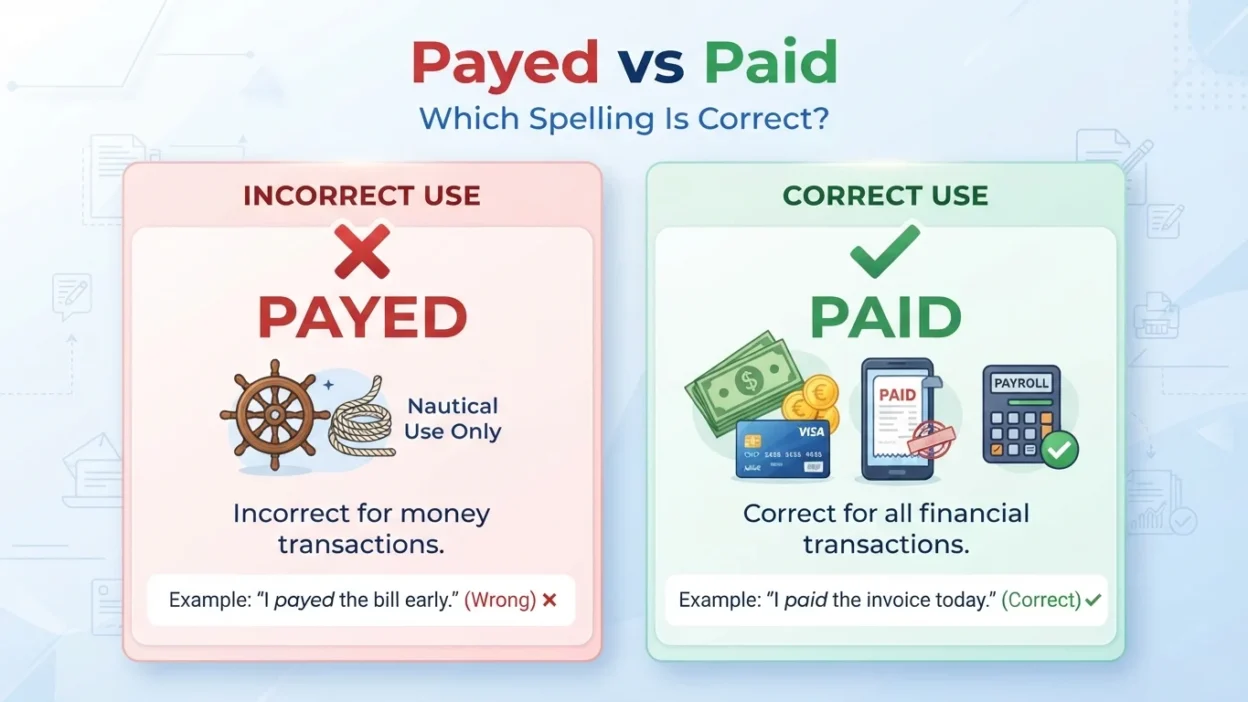
If you’ve ever wondered whether “payed” or “paid” is the correct spelling, you’re not alone. Many English learners and native speakers mistakenly write payed as the past tense of pay. However, in almost all situations, paid is the correct form.
Paid is the standard past tense and past participle of pay. Payed is a rare spelling used only in specialized nautical contexts, such as when referring to letting out rope or sealing a ship’s hull.
Quick Answer
- Paid = Correct for money, wages, bills, and most everyday uses.
- Payed = Rare; used only in nautical contexts.
Correct Examples
- I paid the electricity bill yesterday.
- She paid for dinner.
Specialized Example
- The sailors payed out the rope before docking.
What Does Paid Mean?
Paid is the past tense and past participle of the verb pay.
It means:
- gave money for something
- settled a debt or bill
- received wages
- gave attention or respect
Examples of Paid in Sentences
- I paid the rent this morning.
- She paid for the groceries.
- They paid their employees on Friday.
- He paid close attention during the lecture.
- We paid our respects at the memorial.
What Does Payed Mean?
Payed is a valid word, but it is not the standard past tense of pay.
It is used only in nautical terminology, where it means:
- to let out a rope, cable, or chain
- to coat a ship’s seams with tar or pitch (called paying the seams)
Examples of Payed in Sentences
- The crew payed out the anchor rope.
- The sailors payed the deck seams with tar.
Unless you’re writing about ships or sailing, you almost certainly want paid.
Payed vs Paid Comparison Table
| Feature | Paid | Payed |
|---|---|---|
| Correct past tense of pay | ✅ Yes | ❌ No (except nautical use) |
| Used for money and bills | ✅ Yes | ❌ No |
| Used in everyday English | ✅ Yes | ❌ Rare |
| Used in nautical contexts | ❌ No | ✅ Yes |
| Standard English | ✅ Yes | ⚠️ Specialized only |
Word Comparison
When to Use Paid
Use paid whenever you’re referring to:
- paying money
- salaries and wages
- bills
- purchases
- attention or respect
- rewards or consequences
Examples
- She paid the invoice.
- They paid cash for the car.
- He paid careful attention.
- The company paid bonuses to employees.
When to Use Payed
Use payed only in maritime or nautical writing.
Examples
- The sailors payed out the cable.
- The crew payed the ship’s seams with waterproof material.
For everyday writing, payed is almost always incorrect.
Common Mistakes
Using Payed for Money
Incorrect:
- I payed the bill.
Correct:
- I paid the bill.
Assuming Payed Is Always Wrong
While uncommon, payed is a legitimate word in specialized nautical contexts.
Common Phrases
Paid
- paid in full
- paid attention
- paid off
- paid a visit
- paid the price
Payed
- payed out rope
- payed the seams
- payed out cable
Synonyms
Synonyms for Paid
Depending on the context:
- settled
- compensated
- rewarded
- reimbursed
- purchased
Synonyms for Payed (Nautical)
- released
- let out
- coated
- sealed
American vs British English Differences
There is no difference in general usage.
Both American and British English use:
- paid for ordinary situations.
Both recognize payed only in specialized nautical contexts.
Why Correct Spelling Matters
Using the correct spelling helps:
- improve readability
- demonstrate good grammar
- strengthen professionalism
- avoid confusion
- build credibility
Writing “I payed my bills” is a common spelling mistake that may distract readers.
Tips to Remember the Difference
Think of the Irregular Verb
Just like:
- say → said
- lay → laid
Remember:
- pay → paid
Remember the Nautical Exception
Unless you’re talking about ships, ropes, or sealing a hull, use paid.
Practice With Sentences
- I paid for lunch.
- She paid the membership fee.
- The crew payed out the anchor chain.
(FAQs)
Which is correct: payed or paid?
Paid is correct for almost every situation.
Is payed a real word?
Yes, but only in specialized nautical contexts.
Can I write “I payed the bill”?
No. The correct sentence is “I paid the bill.”
Why is paid spelled differently?
Pay is an irregular verb, so its past tense is paid, not payed.
What does payed mean?
In nautical language, it means to let out a rope or to seal a ship’s seams.
Is payed accepted in British and American English?
Yes, but only for nautical meanings. For everyday English, both use paid.
What is the past tense of pay?
The correct past tense is paid.
How can I remember the correct spelling?
Think:
- Pay → Paid
- Say → Said
- Lay → Laid
These irregular verbs don’t simply add -ed.
Final Summary
The difference between payed vs paid is straightforward. Paid is the correct past tense and past participle of pay in everyday English. Payed is a rare, specialized term used only in nautical contexts.
For nearly all writing if you’re talking about money, wages, bills, or attention paid is the correct spelling.
Actionable Takeaway
Whenever you’re writing about money, bills, salaries, or payments, use:
- paid ✅
Use payed only when discussing ships, ropes, or nautical operations.
Memory trick:
- Pay → Paid
- Say → Said
- Lay → Laid
If it isn’t about sailing, it’s almost certainly paid.