If you’ve ever wondered whether “inpatient” or “impatient” is the correct word, you’re not alone. Although these words look and sound similar, they have completely different meanings.
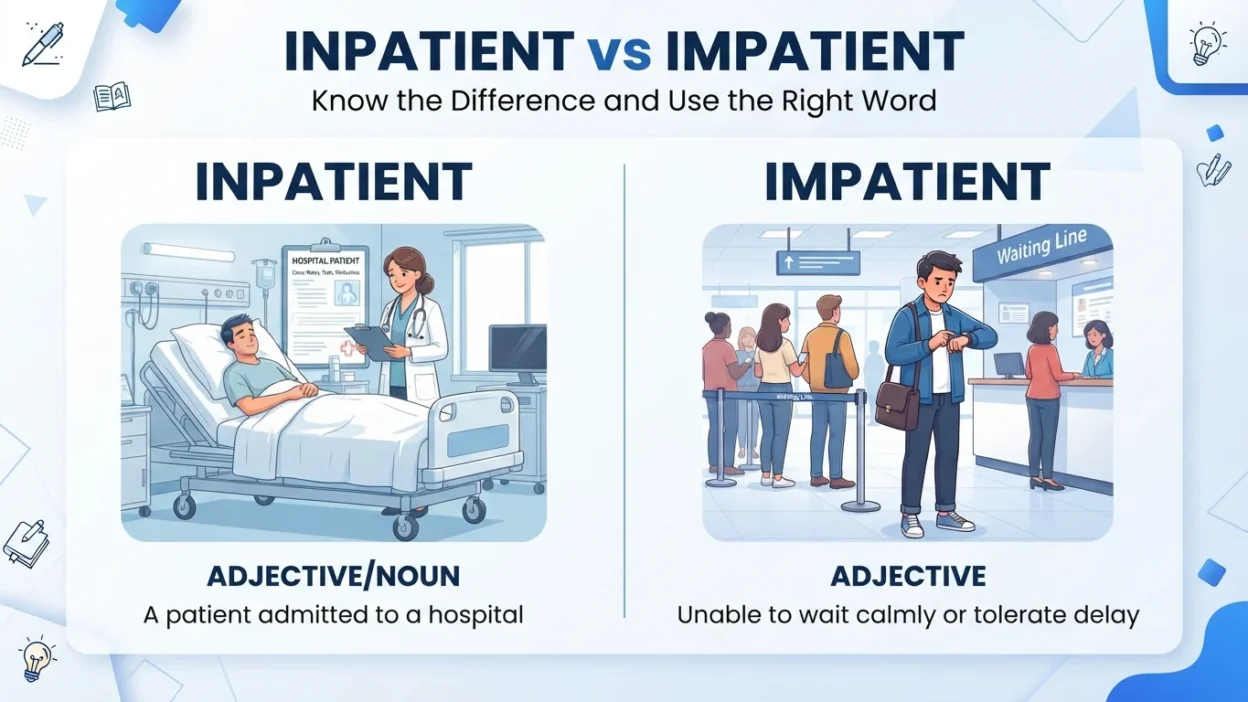
Inpatient refers to a person who stays in a hospital for medical treatment, while impatient describes someone who becomes easily irritated or unable to wait calmly. Understanding the difference between inpatient vs impatient will help you avoid common spelling and vocabulary mistakes.
Quick Answer
- Inpatient = A hospital patient admitted for treatment.
- Impatient = Unable or unwilling to wait calmly.
Correct Examples
- The doctor examined the inpatient during morning rounds.
- She became impatient while waiting in line.
What Does Inpatient Mean?
Inpatient is a noun or adjective used in healthcare.
It refers to:
- a person admitted to a hospital for at least one overnight stay
- medical care received while staying in a hospital
Examples of Inpatient in Sentences
- The inpatient recovered after surgery.
- The hospital admitted three new inpatients today.
- She received inpatient treatment for her condition.
- Inpatient care is often required after major operations.
- The doctor visited each inpatient in the ward.
What Does Impatient Mean?
Impatient is an adjective describing a person who:
- cannot wait calmly
- becomes irritated by delays
- wants something to happen quickly
Examples of Impatient in Sentences
- The children became impatient during the long trip.
- He was impatient for the meeting to begin.
- She grew impatient with the slow internet connection.
- Don’t be impatient; your turn is coming.
- They became impatient after waiting for an hour.
Inpatient vs Impatient Comparison Table
| Feature | Inpatient | Impatient |
|---|---|---|
| Hospital-related | ✅ Yes | ❌ No |
| Describes a person’s mood | ❌ No | ✅ Yes |
| Refers to medical care | ✅ Yes | ❌ No |
| Means unable to wait | ❌ No | ✅ Yes |
| Standard English | ✅ Yes | ✅ Yes |
Word Comparison
When to Use Inpatient
Use inpatient when referring to:
- someone admitted to a hospital
- hospital stays
- medical treatment requiring overnight care
Examples
- The inpatient remained under observation.
- She received inpatient rehabilitation.
- Inpatient services are available at the medical center.
When to Use Impatient
Use impatient when describing:
- frustration
- eagerness
- inability to wait
- irritation caused by delays
Examples
- He became impatient after several unanswered emails.
- The audience grew impatient when the event started late.
- She was impatient to hear the results.
Common Mistakes
Using Inpatient Instead of Impatient
Incorrect:
- I became inpatient while waiting.
Correct:
- I became impatient while waiting.
Using Impatient Instead of Inpatient
Incorrect:
- The doctor checked every impatient.
Correct:
- The doctor checked every inpatient.
Common Phrases
Inpatient
- inpatient care
- inpatient treatment
- inpatient services
- inpatient unit
- admitted as an inpatient
Impatient
- become impatient
- impatient with
- impatient for
- grow impatient
- impatient waiting
Synonyms
Synonyms for Inpatient
- hospital patient
- admitted patient
- resident patient
Synonyms for Impatient
- restless
- eager
- irritated
- anxious
- intolerant of delay
American vs British English Differences
There is no significant difference.
Both American and British English use:
- inpatient for a hospital patient.
- impatient for someone who cannot wait calmly.
Note: In British English, you may also see the hyphenated form in patient, while inpatient is more common in American English.
Why Correct Word Choice Matters
Using the correct word helps:
- improve clarity
- avoid misunderstandings
- strengthen professional writing
- communicate accurately, especially in healthcare contexts
Tips to Remember the Difference
Inpatient = In the Hospital
Think:
- Inpatient = In the hospital
Impatient = No Patience
Notice that impatient begins with im-, meaning not.
- Impatient = Not patient = Can’t wait
Easy Memory Trick
- Inpatient = Hospital
- Impatient = No patience
(FAQs)
What is the difference between inpatient and impatient?
Inpatient refers to a hospital patient admitted for treatment, while impatient means unable or unwilling to wait calmly.
Which is correct: inpatient or impatient?
Both are correct, but they are used in completely different contexts.
What is inpatient care?
Inpatient care is medical treatment provided to patients who stay in a hospital, usually overnight or longer.
Can a person be impatient?
Yes. An impatient person becomes frustrated or restless when they have to wait.
Is “I was inpatient while waiting” correct?
No. The correct sentence is:
- I was impatient while waiting.
Is there a spelling difference between British and American English?
The meaning is the same, but British English sometimes uses in-patient, while American English generally uses inpatient.
How can I remember the difference?
Think:
- Inpatient = In the hospital
- Impatient = No patience
Can “inpatient” be an adjective?
Yes. For example:
- inpatient treatment
- inpatient services
Final Summary
The difference between inpatient vs impatient is simple. Inpatient refers to a person receiving treatment in a hospital, while impatient describes someone who is unable or unwilling to wait calmly.
Using the correct word will make your writing clearer, more accurate, and more professional.
Actionable Takeaway
Use:
- inpatient ✅ for hospital patients and medical care.
- impatient ✅ when describing someone who can’t wait calmly.
Memory trick:
- Inpatient = In the hospital
- Impatient = No patience