If you’ve ever wondered whether “farther” or “further” is the correct word, you’re not alone. These two words are closely related and are often used interchangeably, but they have slightly different meanings.
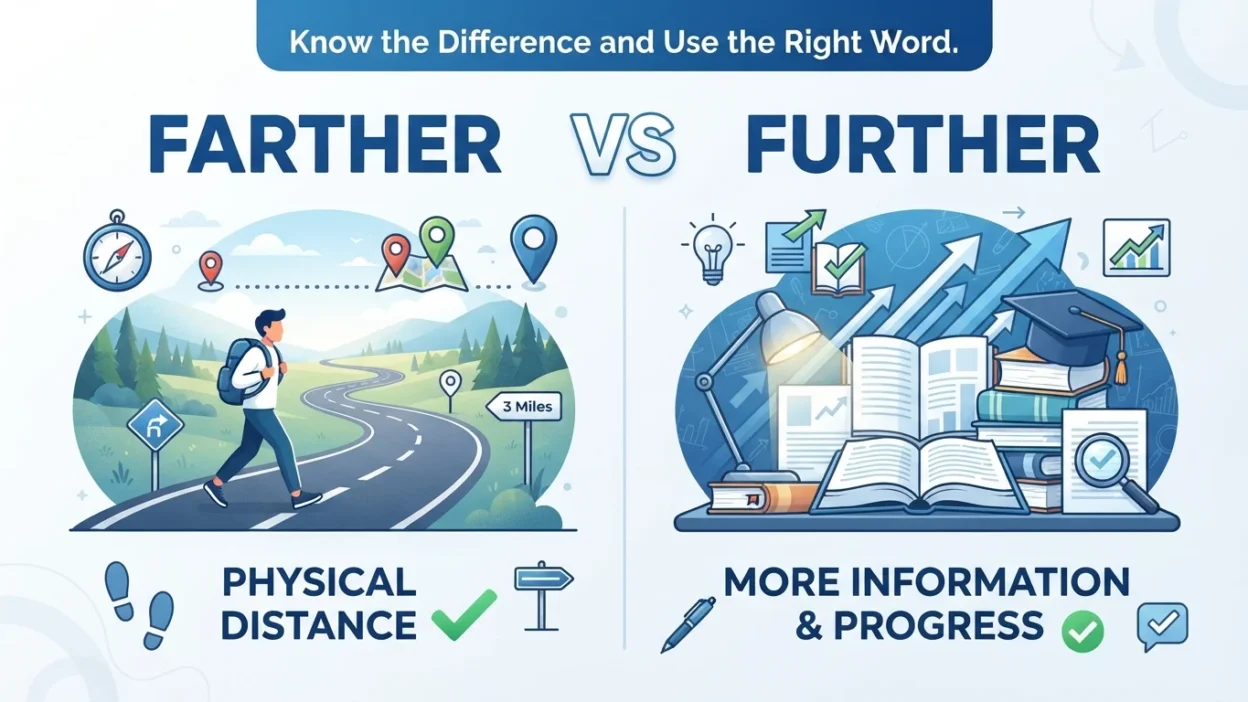
In general, farther refers to physical distance, while further refers to figurative distance, additional information, or a greater degree. Although many modern style guides accept some overlap, following this distinction makes your writing clearer and more precise.
Quick Answer
- Farther = Physical distance.
- Further = Figurative distance, additional amount, or advancement.
Correct Examples
- We walked farther than we expected.
- For further information, visit our website.
What Does Farther Mean?
Farther is an adjective or adverb used to describe a greater physical distance.
It answers questions like:
- How much farther?
- How far away?
Examples of Farther in Sentences
- The park is farther than I remembered.
- We drove farther into the countryside.
- She threw the ball farther than anyone else.
- The store is farther down the road.
- Can you walk any farther?
What Does Further Mean?
Further is an adjective, adverb, and verb. It usually refers to:
- a greater degree
- additional information
- continued progress
- figurative or abstract distance
As a verb, further means to promote or advance.
Examples of Further in Sentences
- We need further discussion before making a decision.
- For further details, contact customer support.
- His research further improved the project.
- She wanted to further her education.
- Nothing could be further from the truth.
Farther vs Further Comparison Table
| Feature | Farther | Further |
|---|---|---|
| Physical distance | ✅ Yes | Sometimes |
| Figurative distance | ❌ Rare | ✅ Yes |
| Means “additional” | ❌ No | ✅ Yes |
| Can be a verb | ❌ No | ✅ Yes |
| Formal writing | ✅ Yes | ✅ Yes |
Word Comparison
When to Use Farther
Use farther when talking about measurable physical distance.
Examples
- The beach is farther from town.
- We cycled farther than yesterday.
- He ran farther than his teammates.
When to Use Further
Use further when referring to:
- more information
- additional time or effort
- progress
- abstract concepts
- advancement
Examples
- We need further investigation.
- Further updates will be announced soon.
- She decided to further her career.
Common Mistakes
Using Farther for Additional Information
Incorrect:
- For farther details, contact us.
Correct:
- For further details, contact us.
Using Further for Physical Distance
Less precise:
- The cabin is further down the road.
Preferred:
- The cabin is farther down the road.
Note: Many native speakers use further for physical distance, and most dictionaries consider it acceptable. However, many style guides recommend farther for measurable distances.
Common Phrases
Farther
- farther away
- farther down the road
- go farther
- walk farther
- farther than expected
Further
- further information
- further discussion
- until further notice
- further research
- further education
Synonyms
Synonyms for Farther
- more distant
- farther away
- at a greater distance
Synonyms for Further
- additional
- extra
- more
- advanced
- continued
American vs British English Differences
Both American and British English recognize the traditional distinction:
- Farther = physical distance.
- Further = figurative distance or “more.”
However, further is commonly used for both meanings in everyday speech, especially in British English.
Why Correct Word Choice Matters
Choosing the correct word helps:
- improve clarity
- strengthen professionalism
- avoid ambiguity
- enhance readability
- follow style guide recommendations
Tips to Remember the Difference
Farther = Far
Notice that farther contains far, making it easier to remember that it refers to physical distance.
Further = More
Think of further whenever you mean:
- additional
- extra
- beyond
- advancement
Practice With Sentences
- We walked farther than planned.
- For further assistance, call our support team.
(FAQs)
What is the difference between farther and further?
Farther refers to physical distance, while further usually refers to additional information, advancement, or figurative distance.
Which is correct: farther or further?
Both are correct, but they are used in different contexts.
Can further refer to physical distance?
Yes. Many dictionaries accept this usage, although farther is generally preferred for measurable distances.
Is farther only used for distance?
Yes. It is primarily used for physical distance.
Can further be used as a verb?
Yes. For example:
- She hopes to further her career.
Which word should I use in formal writing?
Use:
- farther for physical distance.
- further for additional information, progress, or abstract ideas.
Is there a difference between American and British English?
The distinction exists in both, but further is more commonly used for both meanings in British English and informal speech.
How can I remember the difference?
Think:
- Farther = Far (distance)
- Further = Further information (more)
Final Summary
The difference between farther vs further is mainly about distance versus degree. Use farther for measurable physical distance and further for additional information, advancement, or figurative distance.
Although further is increasingly used in both contexts, following the traditional distinction will make your writing clearer and more precise.
Actionable Takeaway
Use:
- farther ✅ for physical distance.
- further ✅ for additional information, progress, or abstract ideas.
Memory trick:
- Farther = Far = Physical distance
- Further = Further information = More or additional