
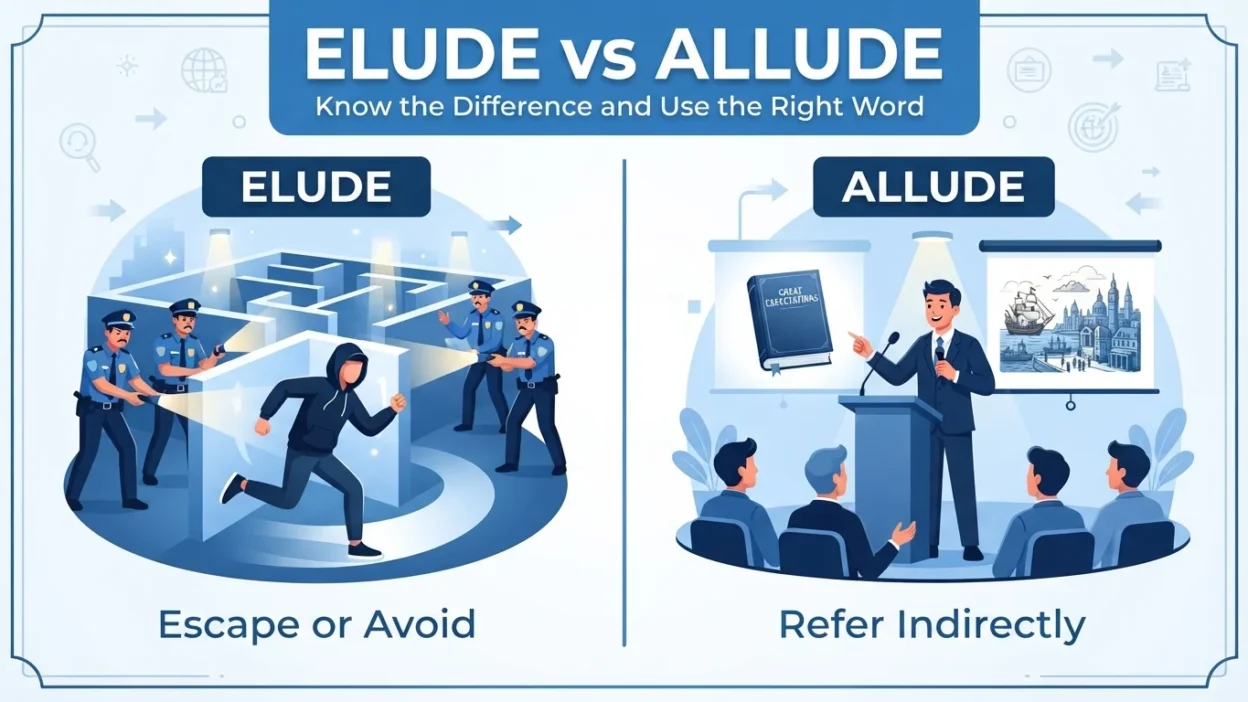
If you’ve ever wondered if “elude” or “allude” is the correct word, you’re not alone. These two verbs look and sound similar, but they have completely different meanings.
Elude means to escape, avoid, or be difficult to understand, while allude means to refer to something indirectly. Understanding the difference between elude vs allude will help you use each word confidently and avoid common grammar mistakes.
Quick Answer
- Elude = Escape, avoid, or remain beyond understanding.
- Allude = Refer to something indirectly.
Correct Examples
- The thief managed to elude the police.
- The speaker alluded to recent events without mentioning them directly.
What Does Elude Mean?
Elude is a verb meaning:
- to escape from someone or something
- to avoid capture
- to be difficult to remember or understand
It often describes something that cannot be caught, achieved, or fully understood.
Examples of Elude in Sentences
- The suspect eluded the police for several days.
- The answer continues to elude researchers.
- Sleep eluded me last night.
- Success did not elude her for long.
- The meaning of the poem eluded many readers.
What Does Allude Mean?
Allude is a verb meaning:
- to mention or refer to something indirectly
- to hint at something without stating it explicitly
Writers and speakers often allude to historical events, literature, or famous people.
Examples of Allude in Sentences
- The author alluded to Greek mythology.
- She alluded to a disagreement but gave no details.
- His speech alluded to recent economic changes.
- The movie alludes to classic fairy tales.
- He never directly accused anyone but alluded to the problem.
Elude vs Allude Comparison Table
| Feature | Elude | Allude |
|---|---|---|
| Means “escape” | ✅ Yes | ❌ No |
| Means “refer indirectly” | ❌ No | ✅ Yes |
| Used for avoiding capture | ✅ Yes | ❌ No |
| Used in speeches or writing | Sometimes | ✅ Yes |
| Standard English | ✅ Yes | ✅ Yes |
Word Comparison
When to Use Elude
Use elude when referring to:
- escaping
- avoiding capture
- being difficult to obtain
- being hard to understand or remember
Examples
- The solution eluded scientists for years.
- The criminal eluded authorities.
- Happiness seemed to elude him.
When to Use Allude
Use allude when referring to:
- indirect references
- hints
- subtle mentions
- implied meanings
Examples
- The professor alluded to a famous novel.
- She alluded to the company’s future plans.
- His remarks alluded to earlier discussions.
Common Mistakes
Using Elude Instead of Allude
Incorrect:
- She eluded to the problem.
Correct:
- She alluded to the problem.
Using Allude Instead of Elude
Incorrect:
- The suspect alluded the police.
Correct:
- The suspect eluded the police.
Common Phrases
Elude
- elude capture
- elude the police
- elude understanding
- elude detection
- elude memory
Allude
- allude to
- allude indirectly
- allude to history
- allude to a book
- allude to an event
Synonyms
Synonyms for Elude
- escape
- evade
- avoid
- dodge
- slip past
Synonyms for Allude
- refer to
- hint at
- imply
- mention indirectly
- suggest
American vs British English Differences
There is no difference in spelling or meaning.
Both American and British English use:
- elude for escaping or avoiding.
- allude for indirect references.
Why Correct Word Choice Matters
Choosing the correct word helps:
- improve clarity
- avoid confusion
- strengthen professional writing
- communicate ideas accurately
- demonstrate a strong vocabulary
Tips to Remember the Difference
Elude = Escape
Think of elude as evade both involve escaping or avoiding.
Allude = Hint
Notice that allude is commonly followed by to:
- allude to a story
- allude to an event
Easy Memory Trick
- Elude = Escape
- Allude = Hint
Frequently Asked Questions (FAQs)
What is the difference between elude and allude?
Elude means to escape or avoid, while allude means to refer to something indirectly.
Which is correct: “allude to” or “elude to”?
The correct phrase is allude to. Elude to is incorrect.
Can someone elude the police?
Yes. Elude is commonly used to describe escaping from authorities.
Can a writer allude to a historical event?
Yes. Writers often allude to famous people, events, or works of literature.
Does elude mean “be difficult to understand”?
Yes. For example:
- The answer eluded me.
Is allude always followed by “to”?
Almost always. The standard construction is allude to something.
Is there a difference between British and American English?
No. Both varieties use these words in the same way.
How can I remember the difference?
Think:
- Elude = Escape
- Allude = Allude to (hint at)
Final Summary
The difference between elude vs allude is straightforward. Elude means to escape, avoid, or remain beyond understanding, while allude means to refer to something indirectly without stating it directly.
Using the correct word will make your writing clearer, more accurate, and more professional.
Actionable Takeaway
Use:
- elude ✅ when you mean escape or avoid.
- allude ✅ when you mean hint at or refer to indirectly.
Memory trick:
- Elude = Escape
- Allude = Allude to (hint at)