If you’ve ever wondered whether “laid off” or “layed off” is the correct phrase, you’re not alone. Because the verb lay has an irregular past tense, many people mistakenly write layed off. However, only one form is correct in standard English.
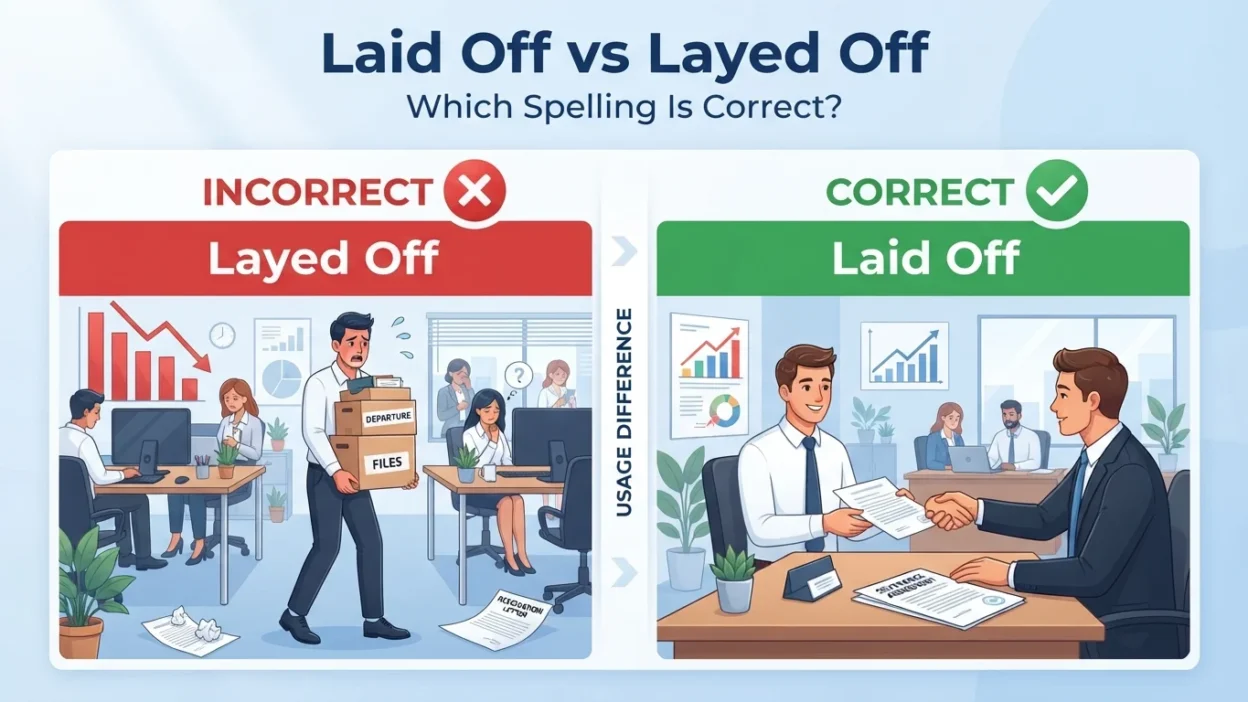
The correct phrase is “laid off.” “Layed off” is a misspelling and should never be used. Whether you’re talking about job losses, temporary furloughs, or reducing staff, laid off is always the correct choice.
Quick Answer
- Laid off = Correct.
- Layed off = Incorrect.
Correct Example
- The company laid off 50 employees last month.
Incorrect Example
- The company layed off 50 employees last month.
What Does “Laid Off” Mean?
Laid off is the past tense of the phrasal verb lay off, which means:
- to terminate an employee’s job, usually for business or economic reasons
- to temporarily suspend employment
- to stop using or doing something (in some contexts)
Unlike being fired for misconduct, being laid off usually happens because of circumstances beyond the employee’s control.
Examples of Laid Off in Sentences
- Hundreds of workers were laid off during the recession.
- She was laid off after the company restructured.
- The factory laid off several employees due to declining sales.
- Many businesses laid off staff during the pandemic.
- He was laid off but found a new job a few months later.
Is “Layed Off” Correct?
No. “Layed off” is not correct English.
The verb lay is irregular.
Its forms are:
- Present: lay
- Past: laid
- Past participle: laid
There is no form spelled layed.
Why Is It “Laid Off”?
The verb lay follows an irregular pattern, similar to other English verbs that change spelling in the past tense.
Examples:
- lay → laid
- pay → paid
- say → said
Because the past tense is laid, the correct phrase is laid off.
Laid Off vs Layed Off Comparison Table
| Feature | Laid Off | Layed Off |
|---|---|---|
| Correct spelling | ✅ Yes | ❌ No |
| Standard English | ✅ Yes | ❌ No |
| Dictionary approved | ✅ Yes | ❌ No |
| Professional writing | ✅ Yes | ❌ No |
| Business communication | ✅ Yes | ❌ No |
Word Comparison
Common Uses of “Laid Off”
Employment
Example:
- The airline laid off hundreds of workers.
Temporary Workforce Reduction
Example:
- Several employees were laid off until business improved.
Business Restructuring
Example:
- The company laid off staff after merging with another firm.
Informal Meaning
Lay off can also mean to stop doing something.
Example:
- You should lay off the junk food.
Common Mistakes
Adding “-ed” to Lay
Incorrect:
- She was layed off yesterday.
Correct:
- She was laid off yesterday.
Confusing Lay and Lie
Remember:
- Lay (put something down) → laid
- Lie (recline) → lay (past tense), lain (past participle)
These are different verbs with different forms.
Common Phrases
You’ll often hear:
- laid off from work
- laid off employees
- laid off due to budget cuts
- temporarily laid off
- recently laid off
Examples
- He was laid off from his job.
- Many workers were temporarily laid off.
Synonyms for Laid Off
Depending on the context, you can also use:
- dismissed
- let go
- furloughed (temporary)
- terminated (formal)
- made redundant (common in British English)
Example
- She was let go because of company downsizing.
American vs British English Differences
Both American and British English use laid off, but there are slight differences in related terminology:
American English
- laid off
- furloughed
British English
- laid off
- made redundant
The spelling laid off is correct in both.
Why Correct Spelling Matters
Using the correct spelling helps:
- improve professionalism
- avoid grammar mistakes
- communicate clearly
- strengthen credibility
- produce polished writing
Using layed off may make your writing appear careless or inaccurate.
Tips to Remember the Correct Spelling
Think of “Paid”
Just as:
- pay → paid
Think:
- lay → laid
Remember the Verb Forms
- lay
- laid
- laid
There is never layed.
Practice With Sentences
- The company laid off 30 workers.
- She was laid off after the project ended.
(FAQs)
Which is correct: laid off or layed off?
Laid off is the correct spelling.
Is “layed off” a real phrase?
No. It is a misspelling.
What does “laid off” mean?
It means an employee has lost their job, usually because of business reasons rather than poor performance.
Why is it “laid” instead of “layed”?
Because lay is an irregular verb whose past tense is laid.
Is being laid off the same as being fired?
Not exactly. Being laid off usually results from economic or organizational reasons, while being fired often relates to performance or misconduct.
Is “laid off” used in both American and British English?
Yes. Both use laid off, although British English also commonly uses made redundant.
Can “lay off” have another meaning?
Yes. It can also mean to stop doing something, as in “Lay off the sweets.”
How can I remember the correct spelling?
Think:
- pay → paid
- lay → laid
If paid doesn’t become payed (except in limited nautical contexts), laid doesn’t become layed either.
Final Summary
The difference between laid off vs layed off is simple. Laid off is the correct past tense of lay off and is used when someone loses a job because of business or economic reasons. Layed off is a spelling mistake and should never be used.
Whether you’re writing a news article, business report, or everyday message, laid off is always the correct form.
Actionable Takeaway
Whenever you mean lost a job due to business reasons, write:
- laid off ✅
Never write:
- layed off ❌
Memory trick:
- Pay → Paid
- Lay → Laid
No extra -ed is needed.