
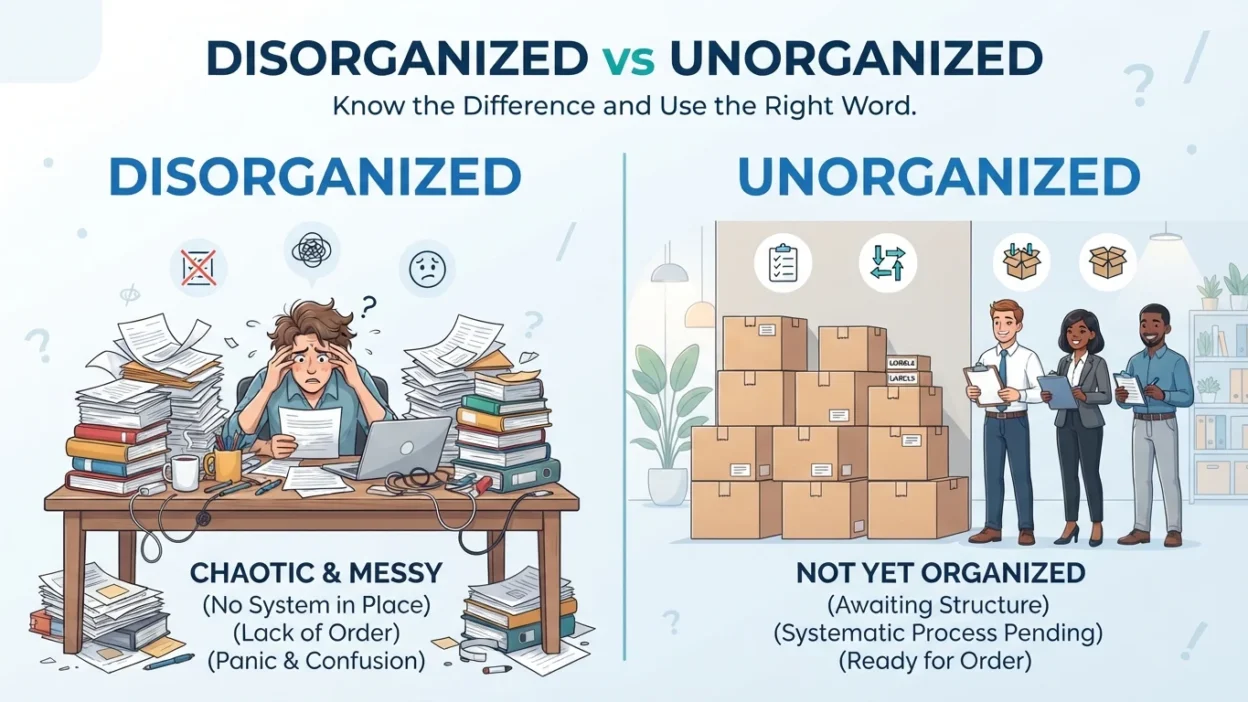
If you’ve ever wondered whether “disorganized” or “unorganized” is the correct word, you’re not alone. Both words describe a lack of organization, but they are not always interchangeable.
Disorganized usually means messy, chaotic, or poorly arranged, while unorganized generally means not yet organized or not formally structured. In most everyday situations, disorganized is the more natural and commonly used word.
Quick Answer
- Disorganized = Messy, chaotic, or lacking order.
- Unorganized = Not organized yet or not formally organized.
Correct Examples
- My desk is completely disorganized.
- The workers formed an unorganized group before choosing a leader.
What Does Disorganized Mean?
Disorganized is an adjective meaning:
- lacking order
- messy or untidy
- poorly planned
- difficult to manage because of confusion
It is commonly used to describe people, places, ideas, schedules, or systems.
Examples of Disorganized in Sentences
- Her office is very disorganized.
- The event was disorganized and started late.
- He is intelligent but disorganized.
- The files became disorganized after the move.
- A disorganized plan often leads to mistakes.
What Does Unorganized Mean?
Unorganized is an adjective meaning:
- not yet organized
- not formally arranged
- lacking an official structure
It is often used when something has simply not been organized, rather than being messy or chaotic.
Examples of Unorganized in Sentences
- The volunteers were still unorganized before the meeting.
- The area remained unorganized after development plans were canceled.
- The employees worked as an unorganized group.
- The records were unorganized because they had not been sorted yet.
- Several unorganized teams joined the event.
Disorganized vs Unorganized Comparison Table
| Feature | Disorganized | Unorganized |
|---|---|---|
| Means messy or chaotic | ✅ Yes | ❌ Usually No |
| Means not yet organized | Sometimes | ✅ Yes |
| Common in everyday English | ✅ Very common | Less common |
| Describes poor planning | ✅ Yes | ❌ Usually No |
| Standard English | ✅ Yes | ✅ Yes |
Word Comparison
When to Use Disorganized
Use disorganized when referring to:
- messy workspaces
- confusing plans
- untidy rooms
- poor time management
- chaotic situations
Examples
- His notes were disorganized.
- The conference was disorganized.
- She keeps a disorganized schedule.
When to Use Unorganized
Use unorganized when referring to:
- something that has not been arranged
- groups without formal structure
- items that have not yet been sorted
Examples
- The volunteers were unorganized before training.
- The files remained unorganized until Friday.
- It was an unorganized association with no official leadership.
Common Mistakes
Using Unorganized Instead of Disorganized
Less natural:
- My bedroom is unorganized.
Preferred:
- My bedroom is disorganized.
Using Disorganized for Something Simply Not Yet Organized
Less precise:
- The new committee was disorganized before it officially formed.
Preferred:
- The new committee was unorganized before it officially formed.
Common Phrases
Disorganized
- disorganized office
- disorganized schedule
- disorganized thinking
- disorganized workspace
- disorganized event
Unorganized
- unorganized group
- unorganized workforce
- unorganized records
- unorganized team
- unorganized materials
Synonyms
Synonyms for Disorganized
- messy
- chaotic
- untidy
- confused
- disorderly
Synonyms for Unorganized
- unsorted
- unstructured
- informal
- unarranged
- not yet organized
American vs British English Differences
There is no major difference.
Both American and British English use disorganized and unorganized with similar meanings.
However, disorganized is far more common in everyday speech and writing in both varieties of English.
Why Correct Word Choice Matters
Choosing the right word helps:
- improve clarity
- describe situations more accurately
- strengthen professional writing
- avoid awkward wording
Tips to Remember the Difference
Disorganized = Disorder
Think of disorganized as meaning out of order or chaotic.
Unorganized = Not Organized Yet
Think of unorganized as meaning still waiting to be organized.
Easy Memory Trick
- Disorganized = Disorder
- Unorganized = Not Yet Organized
(FAQs)
What is the difference between disorganized and unorganized?
Disorganized means messy or lacking order, while unorganized means not yet organized or not formally structured.
Which word is more common?
Disorganized is much more common in everyday English.
Can I say “My desk is unorganized”?
It’s understandable, but My desk is disorganized sounds more natural and is the preferred choice.
Is unorganized a real word?
Yes. It is a standard English word, although it is less common than disorganized.
What does disorganized mean?
It means lacking order, structure, or planning.
What does unorganized mean?
It means not organized yet or not officially arranged.
Is there a difference between American and British English?
No significant difference. Both varieties generally prefer disorganized in everyday contexts.
How can I remember the difference?
Think:
- Disorganized = Disorder
- Unorganized = Not Yet Organized
Final Summary
The difference between disorganized vs unorganized is mainly about chaos versus lack of organization. Disorganized describes something that is messy, confusing, or poorly arranged, while unorganized refers to something that has not yet been organized or lacks a formal structure.
For most everyday situations, disorganized is the better and more natural choice.
Actionable Takeaway
Use:
- disorganized ✅ for messy, chaotic, or poorly planned situations.
- unorganized ✅ for things that have not yet been organized or formally structured.
Memory trick:
- Disorganized = Disorder
- Unorganized = Not Yet Organized