If you’ve ever wondered if “passed away” or “past away” is the correct expression, you’re not alone. These phrases are often confused because passed and past sound alike. However, only passed away is correct in standard English.
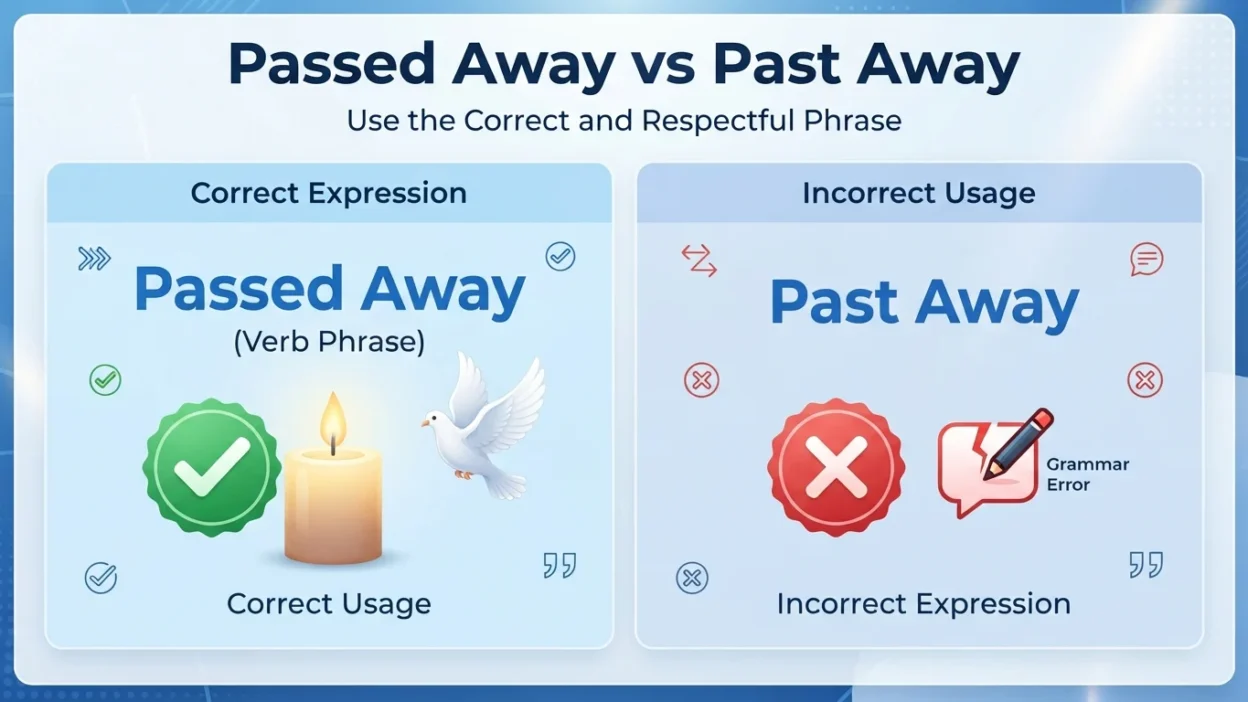
Passed away is a polite and respectful euphemism meaning to die, while past away is a grammatical error and should not be used.
Quick Answer
- Passed away = Correct; a polite expression meaning died.
- Past away = Incorrect.
Correct Examples
- Her grandfather passed away peacefully last night.
- We were saddened to hear that the beloved teacher passed away.
Incorrect Example
- Her grandfather past away last night. ❌
What Does “Passed Away” Mean?
Passed away is an idiomatic expression meaning:
- died
- departed this life
It is commonly used because it sounds gentler and more respectful than simply saying died.
Examples of Passed Away in Sentences
- His grandmother passed away at the age of 92.
- The famous actor passed away after a long illness.
- Our neighbor passed away peacefully.
- She passed away surrounded by her family.
- We honored those who passed away during the ceremony.
Why Is “Past Away” Incorrect?
Past is not a verb. It usually refers to:
- an earlier time
- a position beyond something
The phrase passed away requires the verb passed, which is the past tense of pass.
Because past cannot function as the verb in this expression, past away is always incorrect.
Passed Away vs Past Away Comparison Table
| Feature | Passed Away | Past Away |
|---|---|---|
| Correct spelling | ✅ Yes | ❌ No |
| Standard English | ✅ Yes | ❌ No |
| Means “died” | ✅ Yes | ❌ No |
| Suitable for formal writing | ✅ Yes | ❌ No |
| Dictionary approved | ✅ Yes | ❌ No |
Word Comparison
When to Use Passed Away
Use passed away when referring respectfully to someone’s death.
Examples
- The family announced that their father passed away peacefully.
- Several veterans who passed away were remembered during the service.
- Her beloved pet passed away after many happy years.
Common Mistakes
Using “Past Away”
Incorrect:
- My uncle past away last year.
Correct:
- My uncle passed away last year.
Confusing “Past” and “Passed”
Remember:
- Passed = verb (action)
- Past = noun, adjective, adverb, or preposition (time or position)
Common Phrases
- passed away peacefully
- recently passed away
- sadly passed away
- unexpectedly passed away
- passed away after a long illness
Synonyms
Synonyms for Passed Away
- died
- departed
- passed on
- lost one’s life
- breathed one’s last (literary)
American vs British English Differences
There is no significant difference.
Both American and British English use passed away as the standard and respectful expression.
Why Correct Usage Matters
Using the correct phrase helps:
- show respect in sensitive situations
- improve grammatical accuracy
- avoid embarrassing mistakes
- communicate clearly and compassionately
Because this expression is often used in condolences and formal announcements, correct spelling is especially important.
Tips to Remember the Difference
Passed = Action
The expression uses the verb passed, meaning to depart or to move on.
Past = Time
Past relates to time or position, so it doesn’t belong in this phrase.
Easy Memory Trick
- Passed away = Correct
- Past away = Incorrect
Frequently Asked Questions (FAQs)
Which is correct: passed away or past away?
Passed away is correct. Past away is incorrect.
What does passed away mean?
It is a polite expression meaning died.
Why is past away wrong?
Because past is not a verb. The phrase requires the verb passed, the past tense of pass.
Is passed away appropriate in formal writing?
Yes. It is commonly used in obituaries, news reports, and condolence messages.
Can I simply say “died”?
Yes. Died is direct and grammatically correct, while passed away is a softer, more respectful alternative.
Is there a difference between British and American English?
No. Both use passed away in the same way.
How can I remember the correct phrase?
Think:
- Passed = Verb
- Past = Time or Place
Final Summary
The difference between passed away vs past away is simple. Passed away is the correct expression meaning to die, while past away is a common spelling mistake that should always be avoided.
Whenever you’re referring respectfully to someone’s death, always use passed away.
Actionable Takeaway
Use:
- passed away ✅ when referring respectfully to someone’s death.
Never use:
- past away ❌
Memory trick:
- Passed = Verb (Correct)
- Past = Time or Place (Incorrect in this phrase)