If you’ve ever wondered if “saw” or “seen” is the correct word, you’re not alone. These two words both come from the verb see, but they are used differently in English grammar.
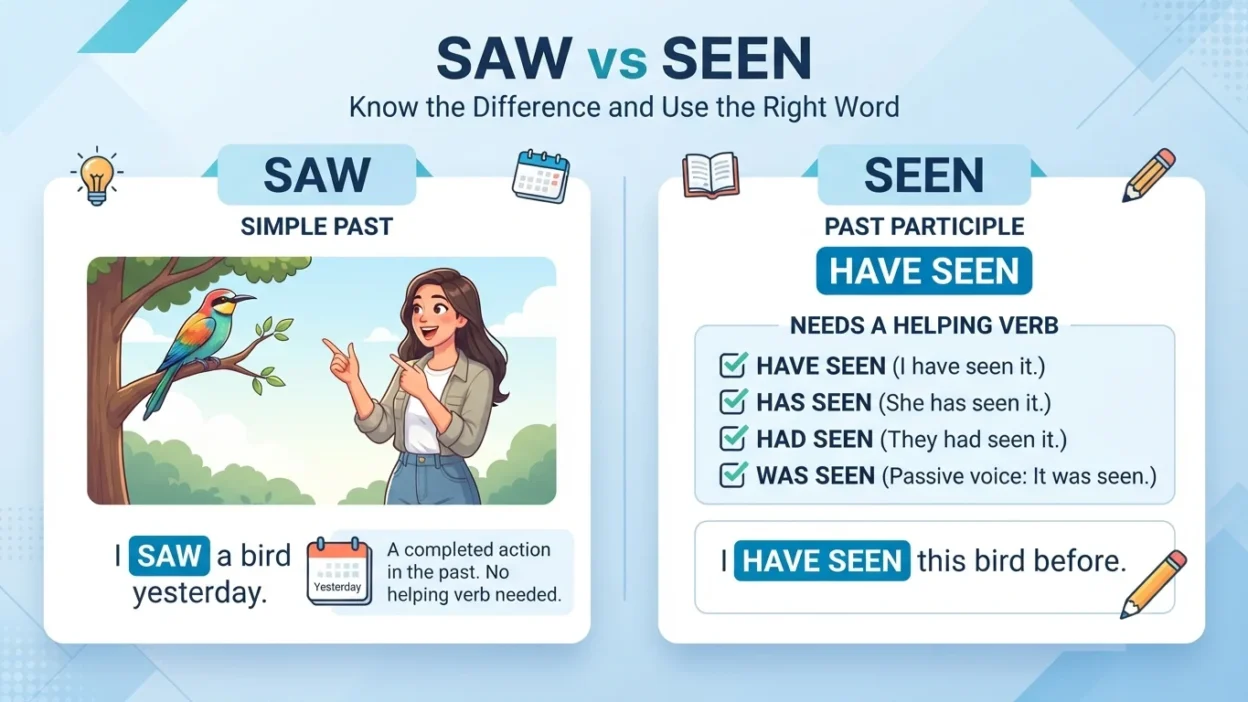
Saw is the simple past tense of see, while seen is the past participle and must be used with a helping verb such as have, has, had, is, was, were, or been.
Understanding the difference between saw vs seen will help you avoid one of the most common grammar mistakes in English.
Quick Answer
- Saw = Simple past tense of see.
- Seen = Past participle of see, used with a helping verb.
Correct Examples
- I saw a rainbow yesterday.
- I have seen that movie before.
What Does “Saw” Mean?
Saw is the simple past tense of the verb see.
Use saw when talking about something you observed or noticed in the past without a helping verb.
Examples of Saw in Sentences
- I saw a shooting star last night.
- She saw her teacher at the supermarket.
- We saw dolphins during our holiday.
- He saw the mistake immediately.
- They saw the concert together.
What Does “Seen” Mean?
Seen is the past participle of see.
It cannot stand alone as the main verb. It must be used with a helping (auxiliary) verb such as:
- have
- has
- had
- was
- were
- be
- been
Examples of Seen in Sentences
- I have seen that film three times.
- She has seen the report.
- They had seen the warning signs.
- The document was seen by everyone.
- Have you ever seen the Northern Lights?
Saw vs Seen Comparison Table
| Feature | Saw | Seen |
|---|---|---|
| Verb form | Simple past | Past participle |
| Used without a helping verb | ✅ Yes | ❌ No |
| Used with have, has, or had | ❌ No | ✅ Yes |
| Refers to a past action | ✅ Yes | ✅ Yes |
| Standard English | ✅ Yes | ✅ Yes |
Word Comparison
When to Use Saw
Use saw when:
- describing a completed action in the past
- no helping verb is present
Examples
- We saw a beautiful sunset.
- I saw your message yesterday.
- She saw a fox in the garden.
- They saw the accident happen.
When to Use Seen
Use seen when:
- it follows a helping verb
- forming perfect tenses or the passive voice
Examples
- I have seen that play before.
- She has seen the results.
- They had seen enough.
- The suspect was seen leaving the building.
Common Mistakes
Using Seen Without a Helping Verb
Incorrect:
- I seen him yesterday.
Correct:
- I saw him yesterday.
Using Saw With a Helping Verb
Incorrect:
- I have saw that movie.
Correct:
- I have seen that movie.
Common Phrases
Saw
- saw yesterday
- saw the movie
- saw a friend
- saw the news
- saw the accident
Seen
- have seen
- has seen
- had seen
- was seen
- ever seen
Synonyms
Synonyms for Saw
- observed
- noticed
- witnessed
- spotted
- viewed
Synonyms for Seen
(Used with helping verbs)
- observed
- witnessed
- noticed
- viewed
- encountered
American vs British English Differences
There is no significant difference.
Both American and British English use:
- saw as the simple past tense.
- seen as the past participle requiring a helping verb.
Why Correct Word Choice Matters
Using saw and seen correctly helps you:
- improve grammar accuracy
- sound more fluent
- avoid common English mistakes
- write more professionally
Many English learners mistakenly use seen without a helping verb, but standard English requires an auxiliary verb before seen.
Tips to Remember the Difference
Saw = Past Action
Use saw by itself for something that happened in the past.
Example:
- I saw a deer this morning.
Seen = Needs a Helper
If you use seen, make sure a helping verb comes before it.
Example:
- I have seen a deer before.
Easy Memory Trick
- Saw = Stands Alone
- Seen = Needs a Helping Verb
(FAQs)
What is the difference between saw and seen?
Saw is the simple past tense of see, while seen is the past participle and must be used with a helping verb such as have, has, or had.
Which is correct: “I saw him” or “I seen him”?
The correct sentence is:
- I saw him.
Which is correct: “I have saw” or “I have seen”?
The correct phrase is:
- I have seen.
Can seen be used without a helping verb?
No. In standard English, seen always requires a helping verb.
Is “I seen it” grammatically correct?
No. The correct forms are:
- I saw it.
- I have seen it.
Is there a difference between British and American English?
No. Both varieties follow the same grammar rules for saw and seen.
How can I remember the difference?
Think:
- Saw = Simple past
- Seen = Needs have, has, had, or another helping verb
Final Summary
The difference between saw vs seen is straightforward. Saw is the simple past tense of see and is used on its own to describe a completed action in the past. Seen is the past participle and must always be used with a helping verb, such as have, has, had, or was.
Whenever you’re describing something you observed in the past without an auxiliary verb, use saw. If you’re using a perfect tense or passive construction, use seen.
Actionable Takeaway
Use:
- saw ✅ by itself for past actions.
- seen ✅ only with a helping verb.
Memory trick:
- Saw = Stands Alone
- Seen = Needs a Helper