If you’ve ever wondered if “foreword” or “forward” is the correct word, you’re not alone. These two words sound exactly alike but have completely different meanings and uses.
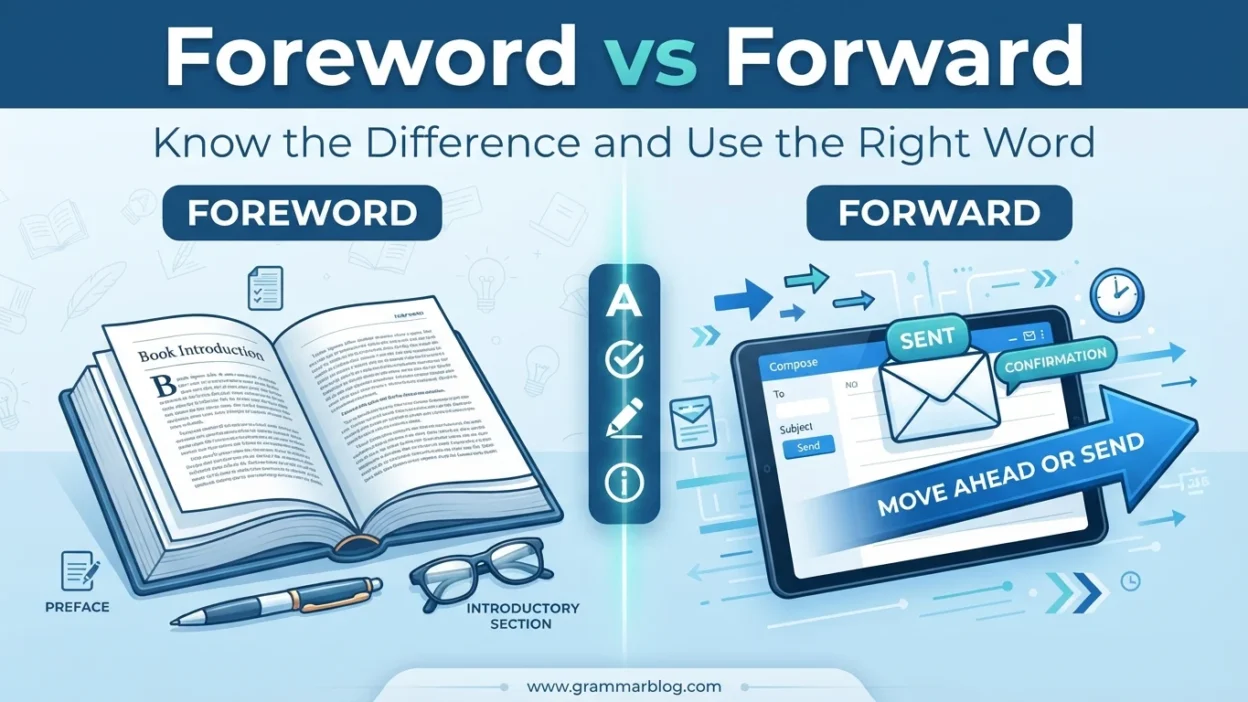
Foreword is a noun referring to an introductory section at the beginning of a book, while forward can be an adjective, adverb, verb, or noun meaning ahead, onward, or to send something to another person.
Understanding the difference between foreword vs forward will help you avoid a common spelling mistake.
Quick Answer
- Foreword = An introduction at the beginning of a book.
- Forward = Ahead, onward, or to send something.
Correct Examples
- The author thanked her mentor in the foreword.
- Please forward this email to the team.
What Does “Foreword” Mean?
Foreword is a noun.
It refers to:
- an introductory section of a book
- a short piece written before the main content
- a preface often written by someone other than the author
A foreword typically explains the importance of the book or introduces the author.
Examples of Foreword in Sentences
- The foreword was written by a Nobel Prize winner.
- I always read the foreword before starting a new book.
- The editor contributed a thoughtful foreword.
- Her foreword explains how the project began.
- The latest edition includes a new foreword.
What Does “Forward” Mean?
Forward has several grammatical uses.
It can mean:
- toward the front
- onward
- progressing
- to send something to another person
- moving ahead
Examples of Forward in Sentences
- Please forward the report to your manager.
- She stepped forward to volunteer.
- We look forward to seeing you.
- The company is moving forward with its plans.
- He leaned forward to hear better.
Foreword vs Forward Comparison Table
| Feature | Foreword | Forward |
|---|---|---|
| Part of speech | Noun | Noun, verb, adjective, adverb |
| Means book introduction | ✅ Yes | ❌ No |
| Means ahead or onward | ❌ No | ✅ Yes |
| Means send something | ❌ No | ✅ Yes |
| Standard English | ✅ Yes | ✅ Yes |
Word Comparison
When to Use Foreword
Use foreword when referring to:
- the introductory section of a book
- an opening statement written before the main text
Examples
- The professor wrote the foreword for the textbook.
- The foreword gives readers helpful background information.
- Don’t skip the foreword it explains the author’s inspiration.
When to Use Forward
Use forward when referring to:
- movement ahead
- sending a message or document
- progress
- direction
Examples
- Please forward my email to the client.
- She walked forward confidently.
- We look forward to your response.
- The project is moving forward as planned.
Common Mistakes
Using Forward Instead of Foreword
Incorrect:
- I loved the forward of the novel.
Correct:
- I loved the foreword of the novel.
Using Foreword Instead of Forward
Incorrect:
- Can you foreword this message?
Correct:
- Can you forward this message?
Common Phrases
Foreword
- write a foreword
- read the foreword
- book foreword
- author’s foreword
- foreword by
Forward
- move forward
- look forward to
- forward an email
- step forward
- push forward
Synonyms
Synonyms for Foreword
- introduction
- preface (similar but not identical)
- opening remarks
- introductory note
Synonyms for Forward
- ahead
- onward
- advance
- send
- transmit
American vs British English Differences
There is no significant difference.
Both American and British English use foreword and forward with the same meanings.
Why Correct Word Choice Matters
Using the correct word helps:
- improve clarity
- avoid spelling mistakes
- strengthen professional writing
- ensure readers understand your meaning
Because foreword and forward are homophones, they are frequently confused in writing.
Tips to Remember the Difference
Foreword = Before the Words
Think of foreword as:
- fore (before)
- word (writing)
It comes before the words of the main book.
Forward = Ahead
Think of forward as moving forward or sending something onward.
Easy Memory Trick
- Foreword = Book introduction
- Forward = Ahead or send
(FAQs)
What is the difference between foreword and forward?
Foreword is an introduction at the beginning of a book, while forward refers to movement ahead or sending something.
Which is correct: foreword or forward in a book?
The correct word is foreword.
Can forward be used as a verb?
Yes. For example:
- Please forward this document.
Is foreword the same as a preface?
Not exactly. A foreword is often written by someone other than the author, while a preface is usually written by the author.
Why are foreword and forward confused?
They are pronounced the same but have different spellings and meanings.
Is there a difference between British and American English?
No. Both use these words in the same way.
How can I remember the difference?
Think:
- Foreword = Before the book’s words
- Forward = Ahead or send
Final Summary
The difference between foreword vs forward is straightforward. Foreword is the introductory section of a book, while forward refers to moving ahead, progressing, or sending something to another person.
If you’re talking about the beginning of a book, use foreword. For movement, progress, or email sharing, use forward.
Actionable Takeaway
Use:
- foreword ✅ for a book’s introduction.
- forward ✅ for movement, progress, or sending something.
Memory trick:
- Foreword = Before the words
- Forward = Ahead or send