If you’ve ever wondered if “boys” or “boy’s” is the correct form, you’re not alone. The confusion comes from the apostrophe.
Although the words look similar, they have different meanings and grammatical functions.
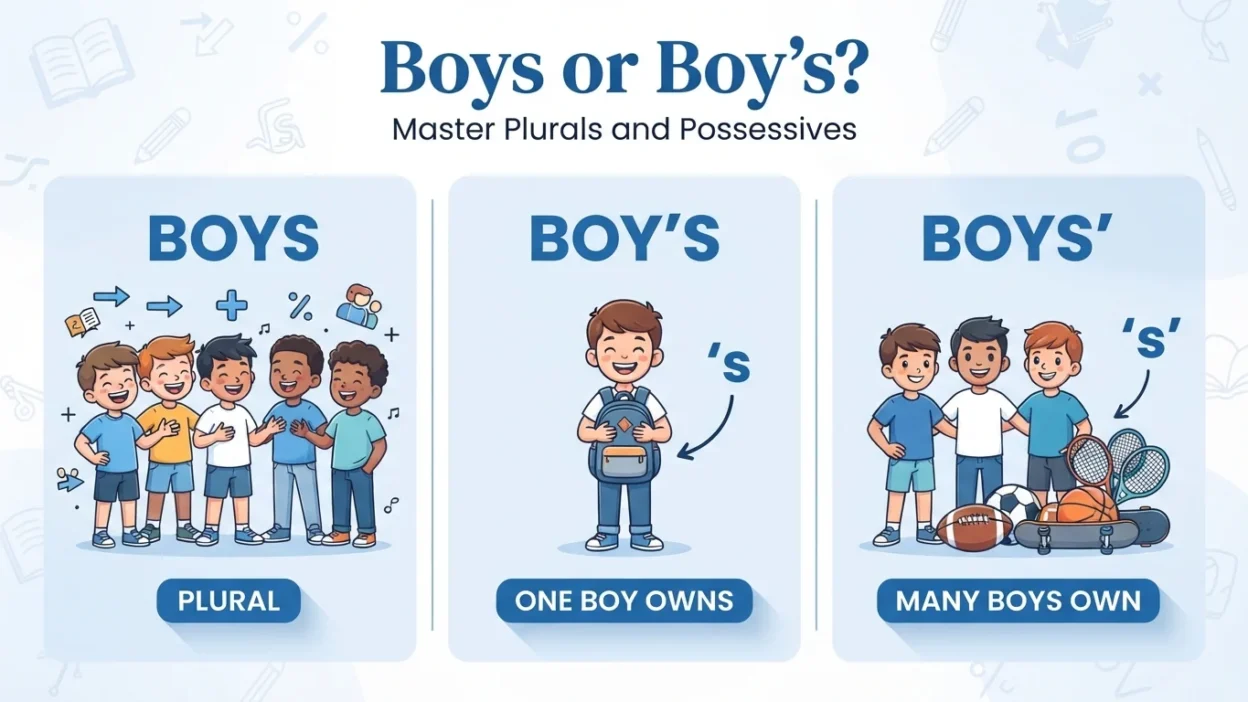
Boys is the plural form of boy, meaning more than one boy. Boy’s is the singular possessive form, meaning something belongs to one boy.
Understanding the difference between boys or boy’s will help you write correctly and avoid common punctuation mistakes.
Quick Answer
- Boys = More than one boy (plural).
- Boy’s = Something belongs to one boy (singular possessive).
Correct Examples
- The boys are playing football.
- The boy’s backpack is on the chair.
What Does “Boys” Mean?
Boys is the plural noun of boy.
Use boys when referring to two or more boys.
Examples of Boys in Sentences
- The boys are waiting for the bus.
- Three boys won the science competition.
- The boys enjoyed the football match.
- Those boys live next door.
- The boys helped clean the classroom.
What Does “Boy’s” Mean?
Boy’s is the singular possessive form of boy.
Use boy’s when something belongs to one boy.
Examples of Boy’s in Sentences
- The boy’s bicycle is new.
- I found the boy’s jacket.
- The boy’s parents arrived early.
- Everyone admired the boy’s artwork.
- The boy’s dog followed him home.
Boys vs Boy’s Comparison Table
| Feature | Boys | Boy’s |
|---|---|---|
| Plural noun | ✅ Yes | ❌ No |
| Singular possessive | ❌ No | ✅ Yes |
| Means more than one boy | ✅ Yes | ❌ No |
| Shows ownership | ❌ No | ✅ Yes |
| Standard English | ✅ Yes | ✅ Yes |
Word Comparison
When to Use Boys
Use boys when referring to:
- multiple boys
- groups of boys
- more than one male child
Examples
- The boys are studying together.
- Several boys joined the football team.
- The boys laughed at the joke.
- Two boys volunteered to help.
When to Use Boy’s
Use boy’s when referring to:
- something owned by one boy
- something associated with one boy
Examples
- The boy’s hat blew away.
- I borrowed the boy’s pencil.
- The boy’s room was tidy.
- We admired the boy’s painting.
What About “Boys'”?
There’s also a third form:
Boys’ (apostrophe after the s) is the plural possessive form.
It means something belongs to more than one boy.
Examples
- The boys’ locker room is upstairs.
- The boys’ football team won the tournament.
- The boys’ bicycles were parked outside.
Common Mistakes
Using Boy’s Instead of Boys
Incorrect:
- The boy’s are playing outside.
Correct:
- The boys are playing outside.
Using Boys Instead of Boy’s
Incorrect:
- The boys backpack is missing.
Correct:
- The boy’s backpack is missing.
Forgetting the Plural Possessive
Incorrect:
- The boys classroom is on the second floor. (if the classroom belongs to several boys)
Correct:
- The boys’ classroom is on the second floor.
Common Phrases
Boys
- boys and girls
- school boys
- young boys
- the boys are here
- boys’ club (plural possessive in context)
Boy’s
- boy’s shoes
- boy’s bicycle
- boy’s name
- boy’s uniform
- boy’s bedroom
American vs British English Differences
There is no difference between American and British English.
Both follow the same grammar rules:
- boys = plural
- boy’s = singular possessive
- boys’ = plural possessive
Why Correct Apostrophe Use Matters
Using apostrophes correctly helps you:
- improve grammar accuracy
- show ownership clearly
- avoid confusing readers
- write more professionally
A misplaced apostrophe can completely change the meaning of a sentence.
Tips to Remember the Difference
Boys = More Than One
If you’re simply talking about more than one boy, don’t use an apostrophe.
Example:
- The boys are playing.
Boy’s = One Boy Owns Something
If one boy owns something, add ‘s.
Example:
- The boy’s backpack is blue.
Boys’ = Many Boys Own Something
If more than one boy owns something, put the apostrophe after the s.
Example:
- The boys’ coach arrived early.
Easy Memory Trick
- boys = many boys
- boy’s = one boy owns
- boys’ = many boys own
(FAQs)
What is the difference between boys and boy’s?
Boys is the plural form of boy, while boy’s is the singular possessive form, showing that something belongs to one boy.
Which is correct: “boys school” or “boy’s school”?
It depends on the meaning:
- boy’s school = a school for one boy (rare).
- boys’ school = a school for boys (common).
What does boys’ mean?
Boys’ is the plural possessive form, meaning something belongs to more than one boy.
Is “boys” ever possessive?
No. Boys by itself is only the plural form. To show possession, use boy’s or boys’.
How do I know where to place the apostrophe?
- Before the s (‘s) = one owner.
- After the s (s’) = multiple owners ending in s.
Is there a difference between British and American English?
No. Both follow the same apostrophe rules.
How can I remember the difference?
Think:
- boys = more than one
- boy’s = one boy owns
- boys’ = many boys own
Final Summary
The difference between boys or boy’s is based on plurality and possession. Boys refers to more than one boy, while boy’s shows that one boy owns something.
If something belongs to more than one boy, the correct form is boys’.
Using the correct apostrophe placement makes your writing clearer and grammatically correct.
Actionable Takeaway
Use:
- boys ✅ for more than one boy.
- boy’s ✅ when one boy owns something.
- boys’ ✅ when more than one boy owns something.
Memory trick:
- No apostrophe = Plural
- ‘s = One owner
- s’ = Multiple owners