If you’ve ever wondered if “everyone” or “every one” is the correct choice, you’re not alone. Although these expressions look almost identical, they have different meanings and are not always interchangeable.
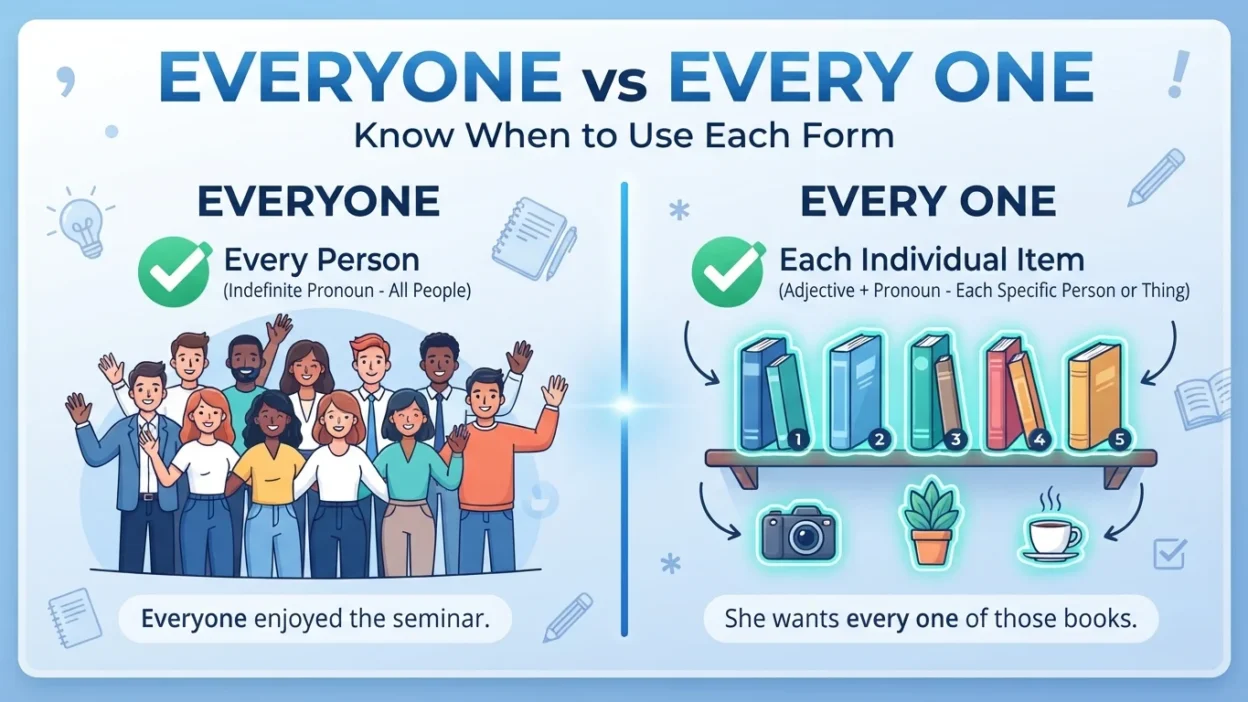
Everyone is an indefinite pronoun meaning every person, while every one refers to each individual member of a specific group or set of things or people.
Understanding the difference between everyone vs every one will help you write more accurately and naturally.
Quick Answer
- Everyone = Every person; an indefinite pronoun.
- Every one = Each individual person or thing in a particular group.
Correct Examples
- Everyone enjoyed the concert.
- Every one of the cookies was eaten.
What Does “Everyone” Mean?
Everyone is an indefinite pronoun that means:
- every person
- all people
It always refers to people, not things.
Examples of Everyone in Sentences
- Everyone is welcome to attend.
- Everyone enjoyed the movie.
- I hope everyone has a great day.
- Everyone agreed with the decision.
- Everyone should bring their ID.
What Does “Every One” Mean?
Every one is a phrase meaning:
- each individual one
- each member of a specific group
Unlike everyone, every one can refer to people or things, but it usually appears with of.
Examples of Every One in Sentences
- Every one of the books was returned.
- Every one of the players received a medal.
- Every one of the questions was difficult.
- I checked every one of the files.
- Every one of the students passed the exam.
Everyone vs Every One Comparison Table
| Feature | Everyone | Every One |
|---|---|---|
| Means every person | ✅ Yes | Sometimes |
| Refers to things | ❌ No | ✅ Yes |
| Usually followed by “of” | ❌ No | ✅ Yes |
| Part of speech | Indefinite pronoun | Determiner + pronoun |
| Standard English | ✅ Yes | ✅ Yes |
Word Comparison
When to Use Everyone
Use everyone when referring to all people in general.
Examples
- Everyone laughed at the joke.
- Everyone has a responsibility to help.
- Everyone was excited about the trip.
When to Use Every One
Use every one when emphasizing each individual member of a specific group, especially with of.
Examples
- Every one of the tickets was sold.
- I personally thanked every one of the volunteers.
- Every one of these paintings is unique.
Common Mistakes
Using Everyone for Objects
Incorrect:
- Everyone of the boxes was damaged.
Correct:
- Every one of the boxes was damaged.
Splitting Everyone Unnecessarily
Incorrect:
- Every one enjoyed the party.
Correct:
- Everyone enjoyed the party.
Common Phrases
Everyone
- everyone knows
- everyone agrees
- everyone is invited
- everyone wins
- everyone else
Every One
- every one of them
- every one of the books
- every one of the students
- every one of the items
- every one of these
Synonyms
Synonyms for Everyone
- everybody
- all people
- each person
Synonyms for Every One
- each one
- each individual
- every single one
- all of them (depending on context)
American vs British English Differences
There is no significant difference.
Both American and British English use everyone and every one according to the same grammar rules.
Why Correct Word Choice Matters
Using the correct form helps:
- improve grammatical accuracy
- make your writing more precise
- avoid common mistakes
- communicate your meaning clearly
Because these expressions differ by only one space, they are frequently confused.
Tips to Remember the Difference
Everyone = Every Person
If you can replace it with everybody, use everyone.
Example:
- Everyone is ready.
- Everybody is ready.
Every One = Each Individual
If you’re referring to each member of a specific group, especially with of, use every one.
Example:
- Every one of the chairs was occupied.
Easy Memory Trick
- Everyone = Everybody
- Every one = Each individual one
Frequently Asked Questions (FAQs)
What is the difference between everyone and every one?
Everyone means every person, while every one refers to each individual member of a particular group.
Which is correct: “everyone of us” or “every one of us”?
The correct phrase is every one of us.
Can everyone refer to objects?
No. Everyone refers only to people.
Is everyone one word?
Yes. When it means every person, it is always written as one word.
Why is “every one” sometimes two words?
Because it emphasizes each individual one, often followed by of.
Can I replace everyone with everybody?
Yes. In most cases, everyone and everybody are interchangeable.
Is there a difference between British and American English?
No. Both follow the same usage rules.
How can I remember the difference?
Think:
- Everyone = Everybody
- Every one = Each individual one
Final Summary
The difference between everyone vs every one is simple. Everyone is an indefinite pronoun meaning every person, while every one refers to each individual member of a specific group, often followed by of.
When talking about all people, use everyone. When emphasizing each individual item or member of a group, use every one.
Actionable Takeaway
Use:
- everyone ✅ for every person.
- every one ✅ for each individual member of a specific group.
Memory trick:
- Everyone = Everybody
- Every one = Each one