
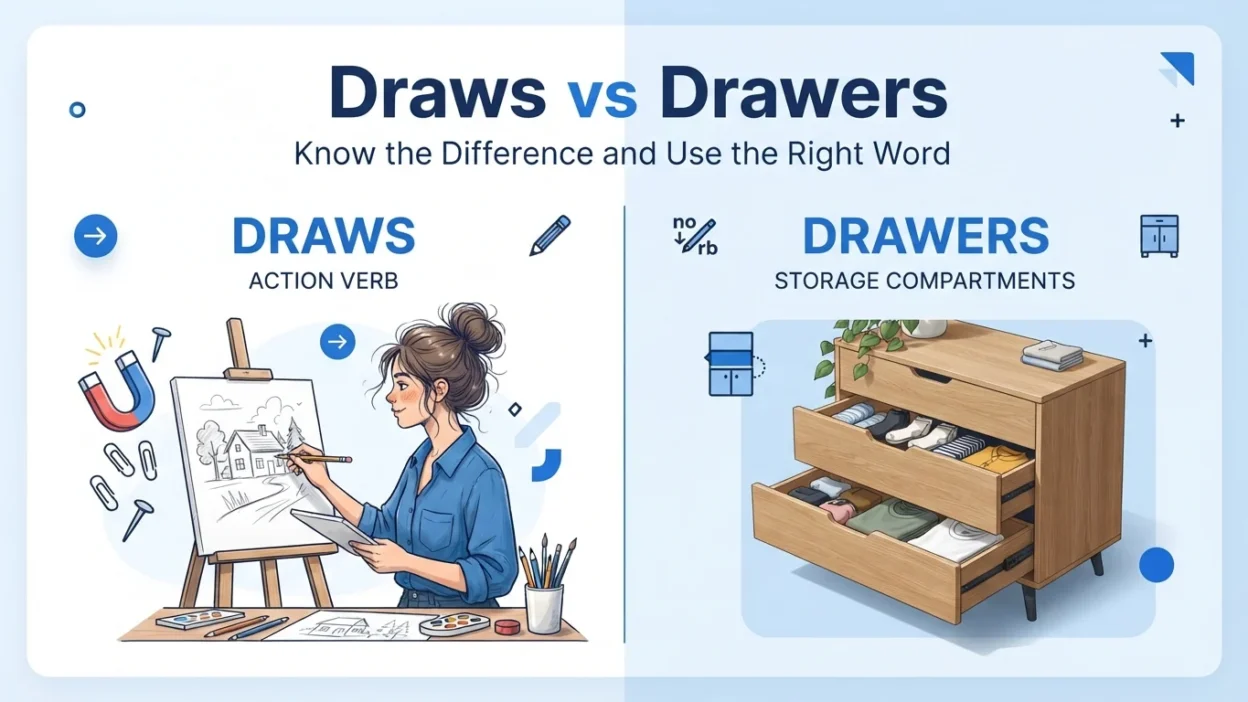
If you’ve ever wondered if “draws” or “drawers” is the correct word, you’re not alone. These two words are often confused because they look and sound similar, but they have completely different meanings.
Draws is the third person singular form of the verb draw, meaning to create a picture, pull something, attract someone, or reach a conclusion.
Drawers is the plural form of drawer, meaning sliding storage compartments found in furniture such as desks and dressers. Understanding the difference between draws vs drawers will help you use each word correctly.
Quick Answer
- Draws = Pulls, sketches, attracts, or reaches a conclusion.
- Drawers = Sliding storage compartments in furniture.
Correct Examples
- She draws beautiful landscapes.
- I keep my socks in the top drawers.
What Does “Draws” Mean?
Draws is the third person singular present tense of the verb draw.
It can mean:
- to sketch or create a picture
- to pull something
- to attract attention or people
- to reach a conclusion
- to take out something
Examples of Draws in Sentences
- She draws cartoons every weekend.
- The horse draws the carriage.
- The museum draws thousands of visitors each year.
- He draws water from the well.
- The report draws several important conclusions.
What Does “Drawers” Mean?
Drawers is the plural form of the noun drawer.
It refers to:
- sliding storage compartments in furniture
- compartments used for organising clothes, documents, or household items
Note: Historically, drawers could also refer to a type of undergarment, but today it most commonly means storage compartments.
Examples of Drawers in Sentences
- The kitchen drawers are full of utensils.
- She organised the office drawers yesterday.
- Keep important documents in locked drawers.
- The dresser has six large drawers.
- He searched all the drawers for his passport.
Draws vs Drawers Comparison Table
| Feature | Draws | Drawers |
|---|---|---|
| Verb | ✅ Yes | ❌ No |
| Noun | ❌ No | ✅ Yes |
| Means sketches or pulls | ✅ Yes | ❌ No |
| Means storage compartments | ❌ No | ✅ Yes |
| Standard English | ✅ Yes | ✅ Yes |
Word Comparison
When to Use Draws
Use draws when referring to:
- sketching
- pulling
- attracting
- taking out
- forming conclusions
Examples
- She draws portraits professionally.
- The advertisement draws new customers.
- He draws the curtains every evening.
- The scientist draws conclusions from the data.
When to Use Drawers
Use drawers when referring to:
- furniture storage
- filing cabinets
- dressers
- desks
- kitchen cabinets
Examples
- The silverware is stored in the kitchen drawers.
- Empty the desk drawers before moving it.
- She labelled all the filing drawers.
- The bedroom drawers need organising.
Common Mistakes
Using Drawers Instead of Draws
Incorrect:
- She drawers amazing pictures.
Correct:
- She draws amazing pictures.
Using Draws Instead of Drawers
Incorrect:
- Put your clothes in the draws.
Correct:
- Put your clothes in the drawers.
Note: In some regional dialects, people may pronounce drawers similarly to draws, but in standard written English, drawers is the correct spelling for storage compartments.
Common Phrases
Draws
- draws attention
- draws a picture
- draws a crowd
- draws water
- draws conclusions
Drawers
- chest of drawers
- kitchen drawers
- desk drawers
- filing drawers
- bedroom drawers
Synonyms
Synonyms for Draws
Depending on the context:
- sketches
- pulls
- attracts
- retrieves
- concludes
Synonyms for Drawers
- compartments
- storage trays
- sliding compartments
- filing compartments
American vs British English Differences
There is no significant difference.
Both American and British English use:
- draws as the verb form of draw.
- drawers as the plural of drawer.
Why Correct Word Choice Matters
Using the correct word helps you:
- improve grammar and spelling
- avoid misunderstandings
- write more clearly
- communicate professionally
Because drawers is often pronounced like draws in casual speech, it is a common spelling mistake.
Tips to Remember the Difference
Draws = Action
Think of draws as something a person does they draw, pull, attract, or conclude.
Drawers = Storage
Remember that drawers has “er”, like many nouns that name objects.
Easy Memory Trick
- Draws = Does an action
- Drawers = Furniture storage
(FAQs)
What is the difference between draws and drawers?
Draws is a verb meaning sketches, pulls, attracts, or reaches a conclusion, while drawers is a noun meaning sliding storage compartments.
Which is correct: “desk draws” or “desk drawers”?
The correct phrase is desk drawers.
Is “draws” ever a noun?
Yes. In some contexts, draw can be a noun (such as a tie in sports), and draws is its plural. However, in everyday writing, draws is most commonly used as a verb.
Why do some people say “draws” instead of “drawers”?
In some regional accents, drawers is pronounced similarly to draws, which can lead to spelling confusion. In standard written English, drawers is the correct form for storage compartments.
Is there a difference between British and American English?
No. Both use draws and drawers with the same meanings.
How can I remember the difference?
Think:
- Draws = Action
- Drawers = Storage compartments
Final Summary
The difference between draws vs drawers is simple. Draws is a verb that means to sketch, pull, attract, or conclude, while drawers is a noun referring to sliding storage compartments in furniture.
Whenever you’re talking about an action, use draws. If you’re referring to furniture storage, use drawers.
Actionable Takeaway
Use:
- draws ✅ for actions such as sketching, pulling, or attracting.
- drawers ✅ for storage compartments in furniture.
Memory trick:
- Draws = Does an action
- Drawers = Storage