If you’ve ever wondered if “me either” or “me neither” is the correct response, you’re not alone.
These two expressions are often confused because both are used after someone makes a negative statement. However, they differ in formality and grammatical correctness.
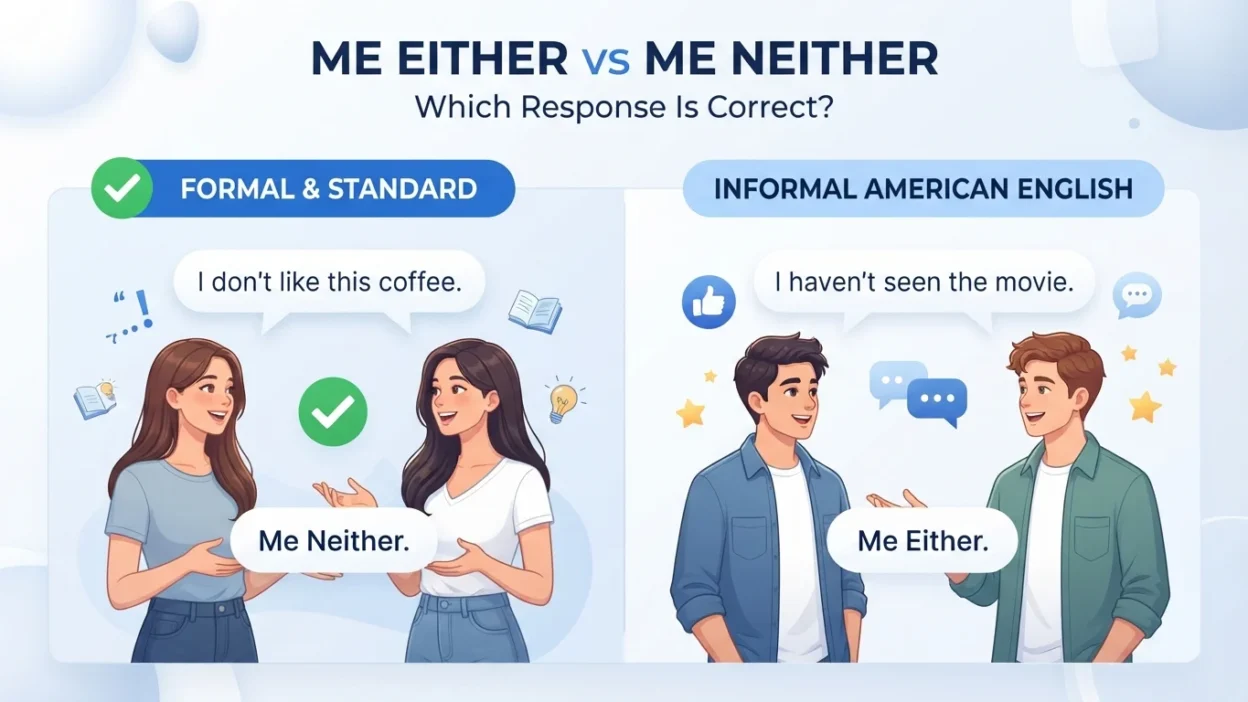
Traditionally, me neither is the grammatically correct response to a negative statement, while me either is widely used in informal American English and is generally accepted in casual conversation.
Quick Answer
- Me neither = Grammatically correct and standard.
- Me either = Common in informal American English, but less formal.
Correct Examples
- “I don’t like mushrooms.” Me neither. ✅
- “I can’t swim.” Me either. ✅ (Informal American English)
What Does “Me Neither” Mean?
Me neither means:
- I don’t either.
- The same is true for me.
- I also do not.
It is used in response to a negative statement.
Examples of Me Neither in Sentences
- “I don’t drink coffee.Me neither.”
- “I haven’t seen that movie.Me neither.”
- “I can’t drive.Me neither.”
- “I wasn’t invited.Me neither.”
- “I don’t understand the question.Me neither.”
What Does “Me Either” Mean?
Me either is an informal response with the same intended meaning as me neither.
Although traditional grammar books often prefer me neither, me either is very common in everyday American English.
Examples of Me Either in Sentences
- “I don’t watch horror movies.Me either.”
- “I didn’t finish the book.Me either.”
- “I can’t stay late.Me either.”
Me Either vs Me Neither Comparison Table
| Feature | Me Either | Me Neither |
|---|---|---|
| Means “I don’t either” | ✅ Yes | ✅ Yes |
| Formal writing | ❌ Not preferred | ✅ Preferred |
| Casual conversation | ✅ Very common | ✅ Common |
| Grammatically traditional | ❌ Less formal | ✅ Yes |
| American English | ✅ Very common | ✅ Common |
Word Comparison
When to Use Me Neither
Use me neither when:
- writing formally
- speaking in professional settings
- following traditional grammar rules
Examples
- “I don’t eat seafood.Me neither.”
- “I wasn’t aware of the meeting.”Me neither.”
When to Use Me Either
Use me either when:
- speaking casually
- chatting with friends
- using informal American English
Examples
- “I don’t like spicy food.”Me either.”
- “I can’t believe it.”Me either.”
Better Alternatives
For formal English, consider these complete responses:
- Neither do I.
- Nor do I.
- I don’t either.
Examples
- “I don’t like cold weather.Neither do I.”
- “I wasn’t there.” Nor was I.”
Common Mistakes
Using Me Either in Formal Writing
Less formal:
- Me either.
Preferred:
- Me neither.
- Neither do I.
Responding to Positive Statements
If someone says:
- “I like pizza.”
Do not reply:
- Me neither. ❌
Instead, say:
- Me too.
- So do I.
Common Phrases
Negative Responses
- me neither
- me either
- neither do I
- nor do I
- I don’t either
Positive Responses
- me too
- so do I
- I do too
Synonyms
Synonyms for Me Neither
- neither do I
- nor do I
- I don’t either
Synonyms for Me Either
- I don’t either
- me neither (more formal)
American vs British English Differences
American English
- Me either is very common in casual speech.
- Me neither is also correct and widely understood.
British English
- Me neither is generally preferred.
- Neither do I is especially common in formal contexts.
Why Correct Usage Matters
Choosing the right expression helps:
- match the level of formality
- improve grammatical accuracy
- sound more natural
- communicate clearly
Tips to Remember the Difference
Formal = Me Neither
If you’re writing an email, essay, or business document, choose:
- Me neither
Casual = Me Either Is Acceptable
In everyday American conversation:
- Me either sounds natural.
Easy Memory Trick
Negative statement →
- Me neither
- Neither do I
Positive statement →
- Me too
- So do I
Frequently Asked Questions (FAQs)
Which is correct: me either or me neither?
Traditionally, me neither is grammatically correct. Me either is common and acceptable in informal American English.
Is “me either” wrong?
Not necessarily. It is widely used in casual American English, though some style guides prefer me neither.
Can I use “me neither” in formal writing?
Yes. It is the preferred choice.
What is the most formal response to a negative statement?
Neither do I (or Nor do I, depending on the sentence).
Is “me either” used in British English?
It is less common. British English generally favors me neither.
What should I say after a positive statement?
Use me too or so do I, not me neither.
Why do people say “me either”?
It has become a natural part of spoken American English, even though it doesn’t follow the traditional grammatical pattern.
How can I remember the difference?
Think:
- Negative = Me neither
- Positive = Me too
Final Summary
The difference between me either vs me neither comes down to formality and traditional grammar. Me neither is the standard response to a negative statement and is preferred in formal writing. Me either is widely used in informal American English and is generally accepted in casual conversation.
If you’re unsure which to use, me neither is the safer choice.
Actionable Takeaway
After a negative statement, use:
- Me neither ✅ (formal and standard)
- Me either ✅ (informal American English)
After a positive statement, use:
- Me too ✅
- So do I ✅
Memory trick:
- Negative → Me neither
- Positive → Me too