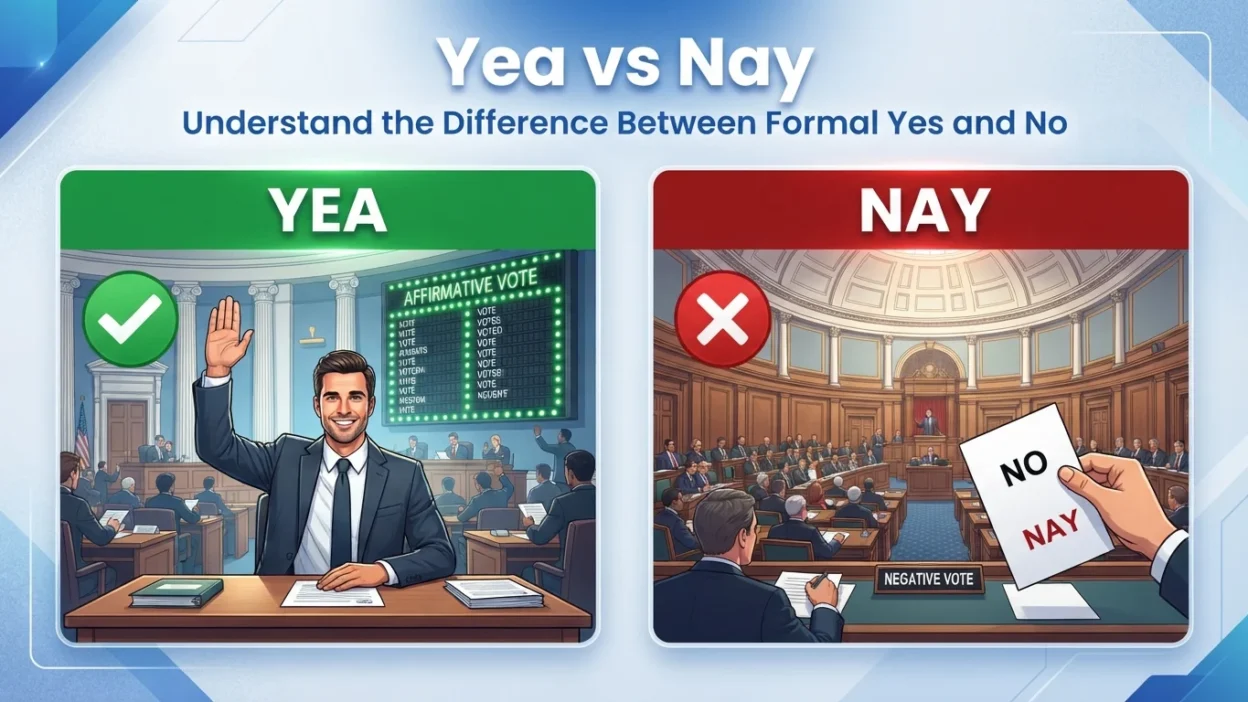
If you’ve ever wondered whether “yea” or “nay” is the correct word, you’re not alone. These two words are old-fashioned English terms that are still commonly used in formal voting, legislative proceedings, and historical or literary contexts.
Yea means yes or an affirmative vote, while nay means no or a negative vote. Although modern English usually uses yes and no in everyday conversation, understanding yea vs nay is useful when reading historical texts, parliamentary records, or legal documents.
Quick Answer
- Yea = Yes; an affirmative vote.
- Nay = No; a negative vote.
Correct Examples
- The committee voted yea on the proposal.
- Three members voted nay.
What Does Yea Mean?
Yea is an adverb, noun, or interjection meaning:
- yes
- an affirmative response
- an affirmative vote
Today, it is used mainly in:
- legislative voting
- parliamentary procedures
- historical writing
- religious texts
Examples of Yea in Sentences
- The motion passed with 85 yea votes.
- All members voted yea.
- The proposal received more yeas than nays.
- The chair called for those in favor to vote yea.
- In historical texts, yea often means “yes.”
What Does Nay Mean?
Nay is an adverb, noun, or interjection meaning:
- no
- a negative response
- a negative vote
Like yea, it is primarily used in formal or historical settings.
Examples of Nay in Sentences
- Only two senators voted nay.
- The amendment failed because of several nay votes.
- Those opposed should vote nay.
- The council recorded five nays.
- The speaker asked for the yeas and nays.
Yea vs Nay Comparison Table
| Feature | Yea | Nay |
|---|---|---|
| Meaning | Yes | No |
| Type of vote | Affirmative | Negative |
| Common in everyday speech | ❌ Rare | ❌ Rare |
| Used in legislative voting | ✅ Yes | ✅ Yes |
| Standard English | ✅ Yes | ✅ Yes |
Word Comparison
When to Use Yea
Use yea when referring to:
- an affirmative vote
- agreement in formal settings
- historical or biblical language
Examples
- The board voted yea on the budget.
- Every member present voted yea.
- The bill passed after a majority voted yea.
When to Use Nay
Use nay when referring to:
- a negative vote
- disagreement in formal proceedings
- historical or literary language
Examples
- Several members voted nay.
- The amendment received more nays than yeas.
- The proposal was rejected after multiple nay votes.
Yea vs Yes
Although they have similar meanings, yea and yes are not always interchangeable.
- Yes is the standard word used in everyday conversation.
- Yea is mainly reserved for formal voting and historical contexts.
Examples
Everyday English:
- Yes, I’d like some coffee. ✅
Legislative English:
- The representative voted yea. ✅
Common Mistakes
Confusing Yea with Yeah
Many people mistakenly confuse yea with yeah.
- Yeah = Informal version of yes.
- Yea = Formal affirmative vote.
Using Yea in Everyday Conversation
Less natural:
- Yea, I’ll meet you tomorrow.
Preferred:
- Yes, I’ll meet you tomorrow.
- Yeah, I’ll meet you tomorrow. (Informal)
Common Phrases
Yea
- yea vote
- vote yea
- the yeas and nays
- voted yea
Nay
- vote nay
- nay vote
- yeas and nays
- voted nay
Synonyms
Synonyms for Yea
- yes
- affirmative
- agreed
- approved
Synonyms for Nay
- no
- negative
- opposed
- rejected
American vs British English Differences
There is no significant difference.
Both American and British English use yea and nay primarily in:
- legislative proceedings
- parliamentary votes
- historical writing
- religious texts
Everyday conversation generally uses yes and no instead.
Why Correct Word Choice Matters
Using the correct term helps:
- improve historical accuracy
- strengthen formal writing
- avoid confusion with yeah
- communicate clearly in legal or parliamentary contexts
Tips to Remember the Difference
Yea = Yes
Think:
- Yea = Yes = Approve
Nay = No
Think:
- Nay = No = Reject
Easy Memory Trick
- Yea = Yay! (Positive)
- Nay = Negative
(FAQs)
What is the difference between yea and nay?
Yea means yes or an affirmative vote, while nay means no or a negative vote.
Is yea the same as yeah?
No. Yeah is an informal version of yes, while yea is a formal or historical word meaning yes.
Where is yea commonly used?
It is mainly used in legislative voting, parliamentary procedures, legal records, and historical or religious texts.
What does nay mean?
Nay means no, especially in formal voting.
Can I use yea in everyday conversation?
It’s grammatically correct but sounds old-fashioned. In most situations, use yes or yeah instead.
What are “the yeas and nays”?
They are the recorded affirmative and negative votes in a formal decision.
Is there a difference between British and American English?
No major difference. Both use these terms in similar formal contexts.
How can I remember the difference?
Think:
- Yea = Yes
- Nay = No
Final Summary
The difference between yea vs nay is straightforward. Yea means yes or an affirmative vote, while nay means no or a negative vote. Although these words are uncommon in everyday speech, they remain important in legislative, legal, historical, and religious contexts.
For everyday conversations, yes and no are the preferred choices.
Actionable Takeaway
Use:
- yea ✅ for formal affirmative votes.
- nay ✅ for formal negative votes.
For casual conversation, use:
- yes
- no
Memory trick:
- Yea = Yes
- Nay = No