If you’ve ever wondered if “any time” or “anytime” is the correct form, you’re not alone. These two expressions look similar, but they have different grammatical functions and cannot always be used interchangeably.
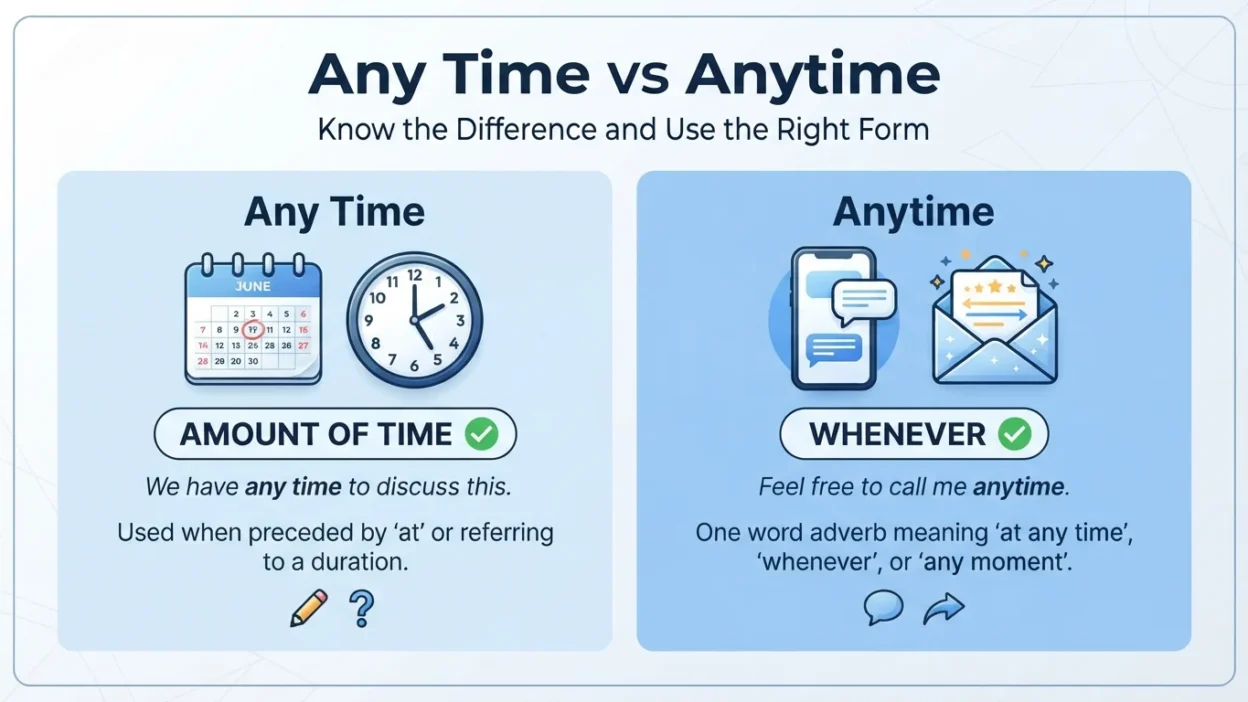
Any time is a noun phrase meaning any amount of time or whenever, while anytime is an adverb meaning whenever or at any time. Knowing when to use each form will make your writing more accurate and natural.
Quick Answer
- Any time = A noun phrase referring to any amount of time.
- Anytime = An adverb meaning whenever or at any time.
Correct Examples
- Do you have any time to talk today?
- You can call me anytime.
What Does “Any Time” Mean?
Any time is a two word noun phrase.
It refers to:
- any amount of time
- any available time
- no specific time limit
It often follows have, need, spend, or a preposition.
Examples of Any Time in Sentences
- Do you have any time this afternoon?
- I don’t have any time to waste.
- We didn’t spend any time arguing.
- Is there any time left before the meeting?
- She rarely has any time for herself.
What Does “Anytime” Mean?
Anytime is a one word adverb meaning:
- whenever
- at any time
- no matter when
It modifies a verb and does not need a preposition before it.
Examples of Anytime in Sentences
- Call me anytime.
- You can visit anytime.
- Feel free to stop by anytime.
- I’ll help you anytime you need me.
- You’re welcome anytime.
Any Time vs Anytime Comparison Table
| Feature | Any Time | Anytime |
|---|---|---|
| One word | ❌ No | ✅ Yes |
| Two words | ✅ Yes | ❌ No |
| Part of speech | Noun phrase | Adverb |
| Means “whenever” | Sometimes | ✅ Yes |
| Refers to an amount of time | ✅ Yes | ❌ No |
Word Comparison
When to Use Any Time
Use any time when referring to an amount or period of time.
Examples
- I don’t have any time today.
- We couldn’t find any time to meet.
- She didn’t spend any time waiting.
When to Use Anytime
Use anytime as an adverb meaning whenever or at any time.
Examples
- You’re welcome anytime.
- Come back anytime.
- Call anytime if you need help.
Common Mistakes
Writing “Anytime” as Two Words When It Means “Whenever”
Less natural:
- You can visit any time.
Preferred:
- You can visit anytime.
Using “Anytime” as a Noun Phrase
Incorrect:
- I don’t have anytime to spare.
Correct:
- I don’t have any time to spare.
Common Phrases
Any Time
- any time soon
- any time left
- any time available
- have any time
- spend any time
Anytime
- anytime soon
- anytime you like
- anytime now
- anytime at all
- anytime you need me
Synonyms
Synonyms for Any Time
- any amount of time
- available time
- free time
Synonyms for Anytime
- whenever
- at any time
- whenever you wish
American vs British English Differences
Both American and British English recognize any time and anytime.
However:
- Anytime is more common in American English, especially in informal writing.
- British English more often uses any time, even where American English might prefer anytime.
Both forms are accepted when used correctly.
Why Correct Usage Matters
Using the correct form helps:
- improve grammar
- strengthen clarity
- enhance professionalism
- avoid common writing mistakes
- make your writing more natural
Tips to Remember the Difference
Any Time = Time
If you can replace it with “some time” or “enough time,” use any time.
Example:
- I don’t have any time.
Anytime = Whenever
If you can replace it with “whenever,” use anytime.
Example:
- Visit anytime.
- Visit whenever.
Easy Memory Trick
- Any time = A period of time
- Anytime = Whenever
Frequently Asked Questions (FAQs)
What is the difference between any time and anytime?
Any time is a noun phrase referring to an amount of time, while anytime is an adverb meaning whenever.
Which is correct: any time or anytime?
Both are correct, but they are used in different grammatical contexts.
Can I say “Call me any time”?
Yes. Call me any time and Call me anytime are both acceptable, although anytime is more common in American English because it functions as an adverb.
Is “I don’t have anytime” correct?
No. The correct phrase is:
- I don’t have any time.
Is anytime one word?
Yes. It is one word when used as an adverb.
Is there a difference between American and British English?
Yes. American English uses anytime more frequently as an adverb, while British English often prefers any time.
How can I remember the difference?
Think:
- Any time = Time available
- Anytime = Whenever
Can the two forms ever be interchangeable?
In expressions like “Call me any time” and “Call me anytime,” both are widely accepted. In other contexts, such as “I don’t have any time,” only the two word form is correct.
Final Summary
The difference between any time vs anytime depends on grammar. Any time is a noun phrase referring to an amount of time, while anytime is an adverb meaning whenever or at any time.
Using the correct form will make your writing clearer and more grammatically accurate.
Actionable Takeaway
Use:
- any time ✅ when referring to an amount of time.
- anytime ✅ when you mean whenever.
Memory trick:
- Any time = Time
- Anytime = Whenever