If you’ve ever wondered if “indecisive” or “undecisive” is the correct word, you’re not alone. These two words look similar, but only one is considered standard English.
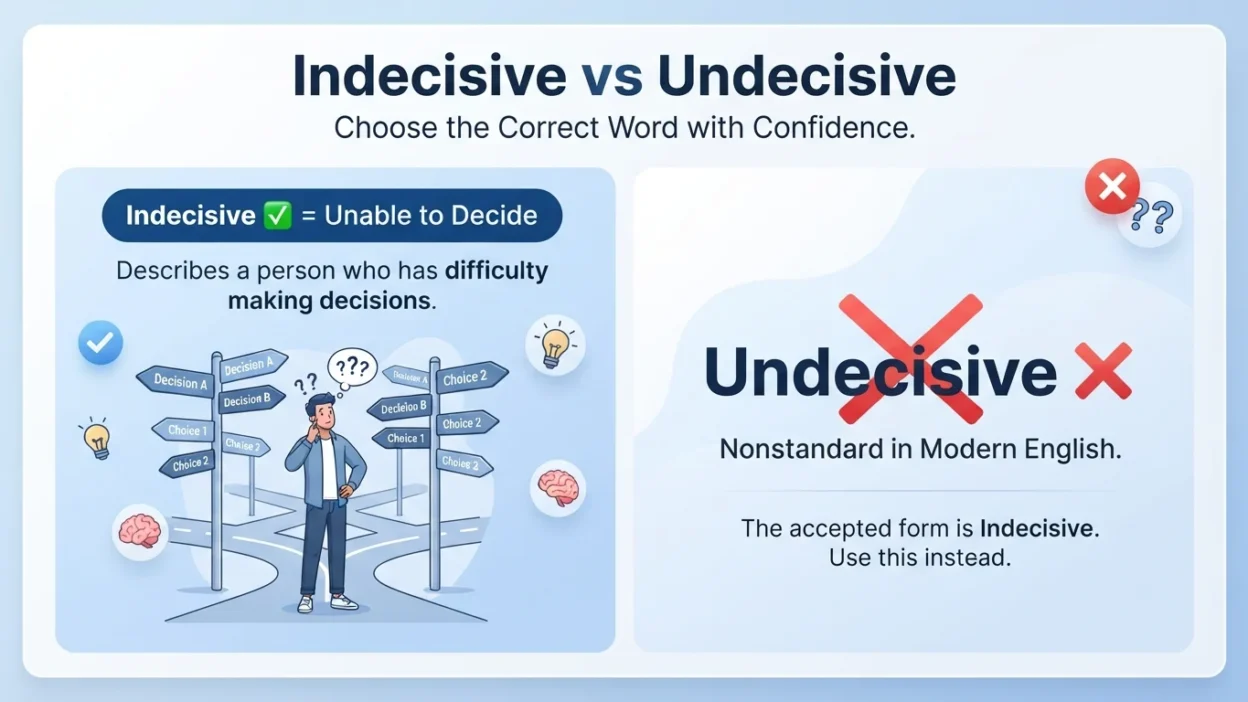
Indecisive is the correct and widely accepted adjective used to describe someone who has difficulty making decisions. Undecisive is generally considered nonstandard or incorrect in modern English and should usually be avoided.
Understanding the difference between indecisive vs undecisive will help you choose the right word in both formal and everyday writing.
Quick Answer
- Indecisive = ✅ Correct. Means unable to make decisions easily.
- Undecisive = ❌ Generally considered nonstandard and should be avoided.
Correct Examples
- She is indecisive when choosing a restaurant.
- His indecisive nature makes planning difficult.
What Does “Indecisive” Mean?
Indecisive is an adjective.
It means:
- unable to make decisions quickly
- hesitant between choices
- lacking firmness in decision making
Examples of Indecisive in Sentences
- She was indecisive about which university to attend.
- He remained indecisive during the meeting.
- The customer became indecisive after seeing so many options.
- Being indecisive can slow down progress.
- They were indecisive about where to go on holiday.
What About “Undecisive”?
Undecisive occasionally appears in informal writing or speech, but most modern dictionaries and style guides recommend using indecisive instead.
In standard English, indecisive is the preferred and accepted word.
Example
Incorrect (standard English):
- She is undecisive about her future.
Correct:
- She is indecisive about her future.
Indecisive vs Undecisive Comparison Table
| Feature | Indecisive | Undecisive |
|---|---|---|
| Standard English | ✅ Yes | ❌ Generally No |
| Means unable to decide | ✅ Yes | ⚠️ Sometimes intended to mean this, but not recommended |
| Accepted in formal writing | ✅ Yes | ❌ No |
| Common in everyday English | ✅ Yes | ❌ Rare |
Word Comparison
When to Use Indecisive
Use indecisive when describing someone or something that:
- struggles to make choices
- hesitates between options
- lacks decisiveness
Examples
- He is indecisive under pressure.
- The committee remained indecisive for several hours.
- Her indecisive personality often causes delays.
- I became indecisive after reading all the reviews.
When to Avoid Undecisive
Avoid undecisive in:
- academic writing
- business communication
- professional emails
- school assignments
- published content
Instead, use indecisive.
Common Mistakes
Using Undecisive
Incorrect:
- I’m undecisive about buying the car.
Correct:
- I’m indecisive about buying the car.
Assuming Both Words Are Interchangeable
Although undecisive may occasionally appear in informal contexts, it is not the standard choice. Use indecisive in almost all situations.
Common Phrases
Indecisive
- indecisive person
- indecisive voter
- indecisive behaviour
- feel indecisive
- become indecisive
Synonyms
Synonyms for Indecisive
- hesitant
- uncertain
- irresolute
- wavering
- unsure
- vacillating
- doubtful
American vs British English Differences
There is no difference between American and British English.
Both varieties consider indecisive the correct standard word. Undecisive is generally avoided in both.
Why Correct Word Choice Matters
Using indecisive instead of undecisive helps you:
- write grammatically correct English
- sound more natural
- improve professionalism
- avoid a common vocabulary mistake
Since indecisive is the accepted form, it is the word readers expect to see.
Tips to Remember the Difference
Indecisive = Correct
Whenever you mean unable to decide, choose indecisive.
Example:
- She is indecisive about her career.
Undecisive = Avoid
Remember that undecisive is not the standard English form.
Easy Memory Trick
- Indecisive = Correct
- Undecisive = Usually Incorrect
(FAQs)
What is the difference between indecisive and undecisive?
Indecisive is the correct standard English word meaning unable to make decisions. Undecisive is generally considered nonstandard and should usually be avoided.
Is “undecisive” a real word?
It has appeared in some dictionaries and historical usage, but it is rare and generally considered nonstandard in modern English. Most style guides recommend indecisive instead.
Which word should I use in formal writing?
Always use indecisive.
Why do people say “undecisive”?
People sometimes form it by analogy with words beginning with un-, but standard English uses indecisive.
Is there a difference between British and American English?
No. Both use indecisive as the preferred form.
How can I remember the difference?
Think:
- Indecisive = Standard English
- Undecisive = Avoid
Final Summary
The difference between indecisive and undecisive is simple. Indecisive is the correct, standard English adjective meaning unable to make decisions easily. Undecisive is generally considered nonstandard and is best avoided in both formal and informal writing.
Whenever you’re describing hesitation or difficulty making a choice, use indecisive.
Actionable Takeaway
Use:
- indecisive ✅ for someone who struggles to make decisions.
- undecisive ❌ in standard English writing.
Memory trick:
- Indecisive = Correct
- Undecisive = Avoid