
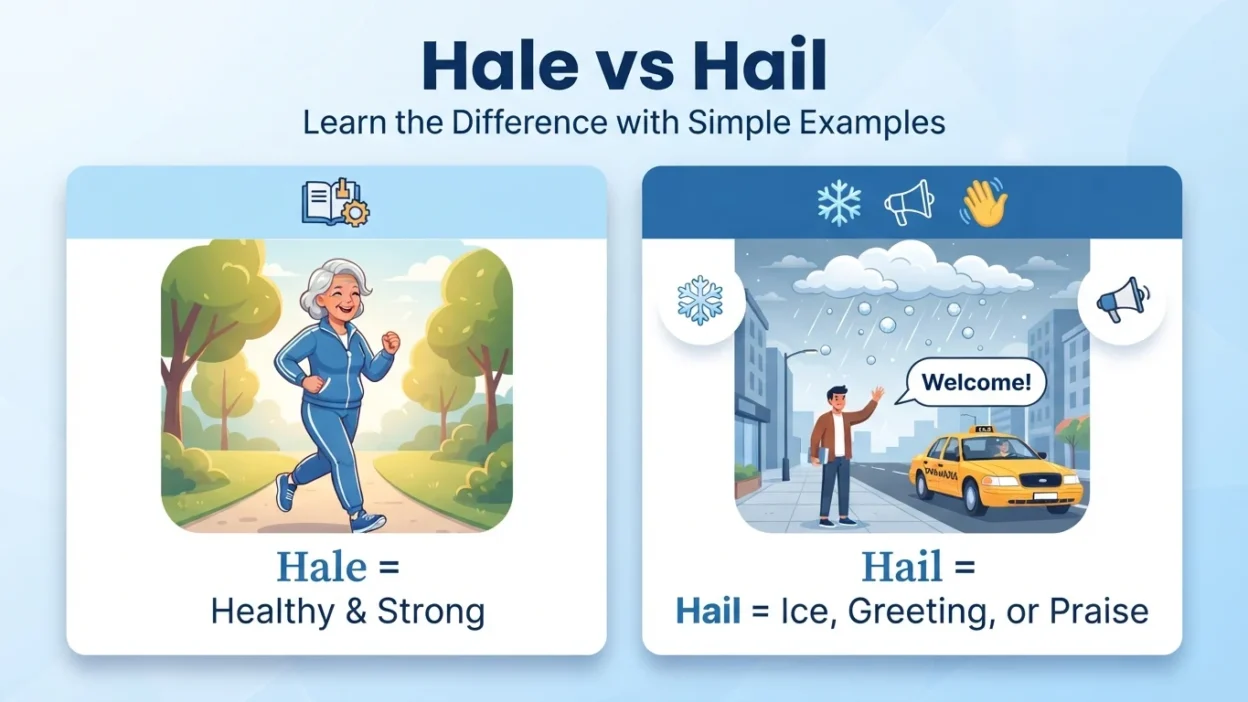
If you’ve ever wondered if “hale” or “hail” is the correct word, you’re not alone. These two words are homophones, meaning they sound alike but have completely different meanings.
Hale describes someone who is healthy, strong, and energetic, especially despite old age. Hail has several meanings: it can refer to frozen balls of ice that fall from the sky, calling out to someone, greeting or praising someone, or coming from a particular place. Understanding the difference between hale vs hail will help you choose the correct word in every context.
Quick Answer
- Hale = Healthy, strong, and robust. ✅
- Hail = Frozen ice pellets, to greet or call, to praise, or to come from a place. ✅
Correct Examples
- Even at 85, she remains hale and active.
- Heavy hail damaged several cars.
What Does “Hale” Mean?
Hale is an adjective.
It means:
- healthy
- strong
- vigorous
- in good physical condition
It is often used in the expression “hale and hearty.”
Examples of Hale in Sentences
- My grandfather is still hale at ninety.
- She remained hale throughout her retirement.
- The doctor said he was hale and fit.
- Despite his age, he looked remarkably hale.
- We hope you stay hale and healthy.
What Does “Hail” Mean?
Hail can be a noun or a verb.
As a noun, it means:
- small balls of ice that fall during a storm
As a verb, it can mean:
- to greet or call to someone
- to praise enthusiastically
- to come from a particular place
Examples of Hail in Sentences
- The storm brought heavy hail.
- She hailed a taxi outside the station.
- Critics hailed the film as a masterpiece.
- He hails from Scotland.
- We watched the hail bounce off the roof.
Hale vs Hail Comparison Table
| Feature | Hale | Hail |
|---|---|---|
| Means healthy or strong | ✅ Yes | ❌ No |
| Refers to frozen ice pellets | ❌ No | ✅ Yes |
| Means to greet or call | ❌ No | ✅ Yes |
| Means to praise | ❌ No | ✅ Yes |
| Means to come from a place | ❌ No | ✅ Yes |
| Standard English | ✅ Yes | ✅ Yes |
Word Comparison
When to Use Hale
Use hale when describing someone who is:
- healthy
- fit
- strong
- energetic
Examples
- She is still hale and hearty.
- The elderly farmer remained hale despite his age.
- He looked hale after recovering from his illness.
- They wished him a long, hale life.
When to Use Hail
Use hail when referring to:
- weather (ice pellets)
- greeting or calling someone
- praising someone
- someone’s place of origin
Examples
- Large hailstones cracked the windshield.
- He hailed his friend across the street.
- The scientist was hailed for her discovery.
- She hails from New Zealand.
Common Mistakes
Using Hail Instead of Hale
Incorrect:
- My grandmother is still hail at eighty five.
Correct:
- My grandmother is still hale at eighty five.
Using Hale Instead of Hail
Incorrect:
- We drove through heavy hale.
Correct:
- We drove through heavy hail.
Common Phrases
Hale
- hale and hearty
- hale old age
- remain hale
- hale and healthy
Hail
- hailstorm
- hailstones
- hail a taxi
- hail from
- hailed as a hero
Synonyms
Synonyms for Hale
- healthy
- fit
- robust
- vigorous
- strong
Synonyms for Hail
Weather:
- ice pellets
- hailstones
Verb:
- greet
- salute
- acclaim
- praise
- summon
American vs British English Differences
There is no significant difference between American and British English.
Both varieties use:
- hale for healthy and strong.
- hail for weather, greetings, praise, or origin.
Why Correct Word Choice Matters
Using the correct word helps you:
- avoid confusing two similar-sounding words
- improve spelling accuracy
- communicate your meaning clearly
- write more professionally
Because hale and hail are pronounced the same, they are often confused in writing.
Tips to Remember the Difference
Hale = Healthy
Think of hale whenever you’re describing health or strength.
Example:
- She is hale and hearty.
Hail = Ice or Hello
Think of hail as:
- hailstones falling from the sky
- hailing a taxi
- hailing someone with praise
Example:
- We experienced heavy hail.
Easy Memory Trick
- Hale = Healthy
- Hail = Ice, Greetings, or Praise
(FAQs)
What is the difference between hale and hail?
Hale means healthy and strong, while hail refers to frozen precipitation, greeting someone, praising someone, or coming from a particular place.
Which is correct: “hale and hearty” or “hail and hearty”?
The correct expression is hale and hearty.
What does “hail from” mean?
Hail from means to come from or to originate from a particular place.
Can “hail” be used as a verb?
Yes. It can mean to greet, to call, to praise, or to come from.
What does “hale” describe?
Hale describes someone who is healthy, vigorous, and physically strong.
Is there a difference between British and American English?
No. Both varieties use hale and hail with the same meanings.
How can I remember the difference?
Think:
- Hale = Healthy
- Hail = Ice, Greetings, or Praise
Final Summary
The difference between hale and hail is straightforward. Hale describes someone who is healthy, strong, and vigorous, while hail refers to ice pellets, greeting or calling someone, praising someone, or coming from a particular place.
Whenever you’re talking about health, use hale. If you’re referring to , greetings, praise, or origin, use hail.
Actionable Takeaway
Use:
- hale ✅ for health and strength.
- hail ✅ for ice pellets, greetings, praise, or place of origin.
Memory trick:
- Hale = Healthy
- Hail = Ice, Hello, or Praise