If you’ve ever wondered if “shudder” or “shutter” is the correct word, you’re not alone. These two words look and sound similar, but they have completely different meanings.
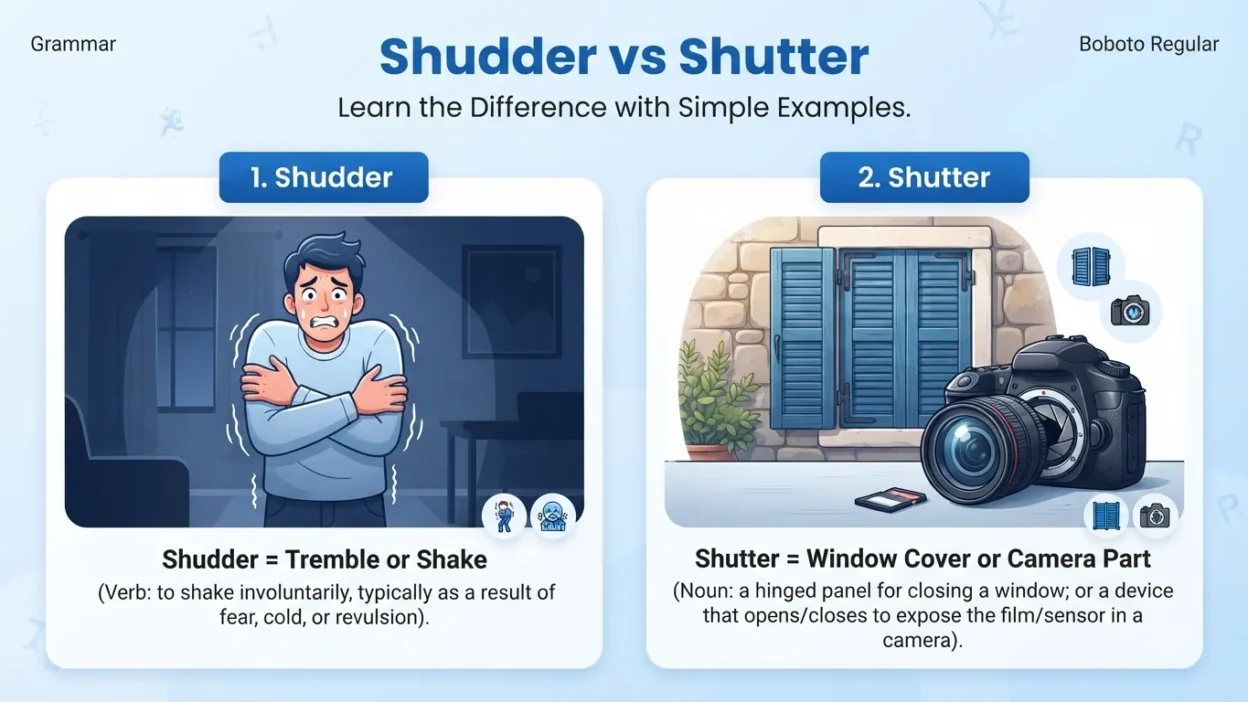
Shudder means to tremble or shake suddenly, usually because of fear, cold, or disgust. Shutter refers to a movable cover for a window, the part of a camera that controls light, or the act of closing a business or building. Understanding the difference between shudder vs shutter will help you avoid a common spelling mistake.
Quick Answer
- Shudder = To shake or tremble because of fear, cold, excitement, or disgust. ✅
- Shutter = A window cover, a camera mechanism, or to close a business or building. ✅
Correct Examples
- She shuddered when she heard the strange noise.
- He closed the shutters before the storm.
What Does “Shudder” Mean?
Shudder can be used as both a verb and a noun.
As a verb, it means:
- to shake suddenly
- to tremble involuntarily
- to react physically to fear, cold, or disgust
As a noun, it refers to a sudden trembling movement.
Examples of Shudder in Sentences
- I shuddered at the thought of the accident.
- She shuddered from the cold wind.
- The loud explosion made everyone shudder.
- A shudder ran down his spine.
- He couldn’t help but shudder after hearing the ghost story.
What Does “Shutter” Mean?
Shutter can be a noun or a verb.
As a noun, it means:
- a hinged cover for a window
- the part of a camera that controls exposure to light
As a verb, it means:
- to close or cover with shutters
- to permanently close a business, shop, or building
Examples of Shutter in Sentences
- We closed the shutters before leaving.
- The camera’s shutter clicked loudly.
- The company decided to shutter several stores.
- The old house had wooden shutters.
- The factory was shuttered after years of declining sales.
Shudder vs Shutter Comparison Table
| Feature | Shudder | Shutter |
|---|---|---|
| Means to tremble or shake | ✅ Yes | ❌ No |
| Refers to window covers | ❌ No | ✅ Yes |
| Refers to a camera mechanism | ❌ No | ✅ Yes |
| Means to close a business | ❌ No | ✅ Yes |
| Standard English | ✅ Yes | ✅ Yes |
Word Comparison
When to Use Shudder
Use shudder when referring to:
- fear
- cold
- disgust
- shock
- trembling
Examples
- She shuddered at the frightening movie.
- I shudder whenever I remember that experience.
- The icy water made him shudder.
- A shudder passed through the crowd after the announcement.
When to Use Shutter
Use shutter when referring to:
- windows
- cameras
- permanently closing businesses or buildings
Examples
- The photographer adjusted the shutter speed.
- Please shutter the windows before the storm.
- Several restaurants were shuttered during the renovation.
- The cottage had bright blue shutters.
Common Mistakes
Using Shutter Instead of Shudder
Incorrect:
- I shuttered when I saw the spider.
Correct:
- I shuddered when I saw the spider.
Using Shudder Instead of Shutter
Incorrect:
- The photographer adjusted the camera shudder.
Correct:
- The photographer adjusted the camera shutter.
Common Phrases
Shudder
- shudder with fear
- shudder at the thought
- send a shudder down your spine
- shudder from the cold
- involuntary shudder
Shutter
- window shutters
- camera shutter
- shutter speed
- shutter the business
- rolling shutters
Synonyms
Synonyms for Shudder
- tremble
- shiver
- quiver
- shake
- recoil
Synonyms for Shutter
Window meaning:
- blind
- screen
- cover
Verb meaning:
- close
- shut down
- cease operations
American vs British English Differences
There is no significant difference between American and British English.
Both varieties use:
- shudder for trembling or shaking.
- shutter for window covers, camera parts, or closing businesses.
Why Correct Word Choice Matters
Using the correct word helps you:
- avoid confusing two similar sounding words
- improve spelling accuracy
- communicate your meaning clearly
- write more professionally
Because shudder and shutter differ by only one letter, they are frequently mixed up in writing.
Tips to Remember the Difference
Shudder = Shake
Think of the “dd” in shudder as representing a body shaking.
Example:
- I shuddered from the cold.
Shutter = Shut
Notice that shutter begins with “shut.”
It helps you remember that shutters close windows or businesses.
Example:
- They shuttered the shop.
Easy Memory Trick
- Shudder = Shake
- Shutter = Shut
(FAQs)
What is the difference between shudder and shutter?
Shudder means to tremble or shake, while shutter refers to a window cover, a camera mechanism, or the act of closing a business.
Which is correct: “I shuddered with fear” or “I shuttered with fear”?
The correct phrase is I shuddered with fear.
What is a camera shutter?
A camera shutter is the mechanism that opens and closes to control how much light reaches the camera sensor or film.
Can “shutter” be used as a verb?
Yes. It means to close or permanently shut down a business, building, or facility.
Can “shudder” be used as a noun?
Yes. A shudder is a sudden trembling movement caused by fear, cold, or another strong emotion.
Is there a difference between British and American English?
No. Both varieties use shudder and shutter with the same meanings.
How can I remember the difference?
Think:
- Shudder = Shake
- Shutter = Shut
Final Summary
The difference between shudder and shutter is easy to remember. Shudder refers to trembling or shaking because of fear, cold, or disgust. Shutter refers to window covers, camera parts, or closing a business or building.
Whenever you’re talking about a physical reaction, use shudder. When referring to windows, cameras, or closures, use shutter.
Actionable Takeaway
Use:
- shudder ✅ for trembling or shaking.
- shutter ✅ for window covers, camera mechanisms, or closing businesses.
Memory trick:
- Shudder = Shake
- Shutter = Shut