If you have ever typed “puting” and paused to wonder if it should actually be “putting,” you are definitely not alone. English spelling rules can sometimes feel confusing, especially with short verbs like “put” that behave differently from other words. Many writers, students, and English learners commonly mix up these two spellings.
The good news is that the answer is simple. In standard English, “putting” is the correct spelling, while “puting” is considered a spelling mistake. Understanding why the extra “t” appears can help you avoid future grammar and writing errors with confidence.
Quick Answer
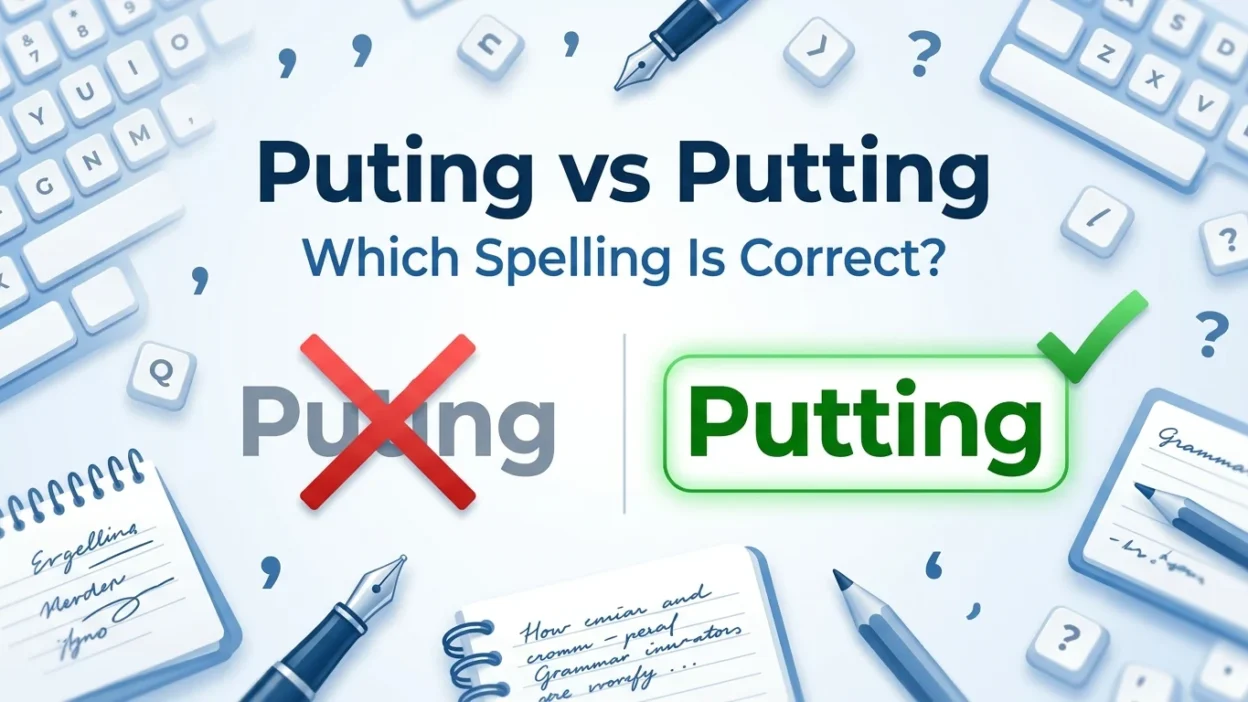
“Putting” is the correct spelling.
“Puting” is incorrect in modern English grammar.
Correct example:
- She is putting the books on the shelf.
Incorrect example:
- She is puting the books on the shelf.
What Does Putting Mean?
“Putting” is the present participle and gerund form of the verb “put.”
The word “put” means:
- to place something somewhere
- to move something into position
- to express or present something
Examples of Putting
- He is putting his phone in his pocket.
- They are putting effort into the project.
- She enjoys putting puzzles together.
Is Puting a Real Word?
No, “puting” is not considered a correct English word.
It is usually a spelling error caused by forgetting to double the final consonant before adding “-ing.”
Why Is “Putting” Spelled With Double T?
English grammar often doubles the final consonant when:
- a verb ends in a consonant-vowel-consonant pattern
- the ending “-ing” is added
Although “put” is very short, it follows this spelling rule.
Formula
Put + ing = putting
Not:
- puting
Similar Examples
| Base Verb | Correct -ing Form |
|---|---|
| run | running |
| sit | sitting |
| swim | swimming |
| put | putting |
Common Mistakes With Putting
Forgetting the Double Consonant
This is the most common error.
Incorrect:
- I am puting my bag away.
Correct:
- I am putting my bag away.
Typing Too Quickly
Many people accidentally type “puting” because:
- “put” is such a short word
- autocorrect may miss it
- fast typing causes dropped letters
Confusing Pronunciation and Spelling
Because “putting” is pronounced smoothly, some learners assume only one “t” is needed.
However, standard spelling always requires two Ts.
Putting Meaning in Different Contexts
Everyday Actions
“Putting” often describes placing objects somewhere.
Example:
- She is putting groceries in the refrigerator.
Effort and Energy
It can also describe investing time or energy.
Example:
- They are putting a lot of effort into the business.
Sports Context
In golf, “putting” refers to gently hitting the ball toward the hole on the green.
Example:
- His putting skills improved dramatically.
Putting vs Puting Comparison Table
| Feature | Putting | Puting |
|---|---|---|
| Correct spelling | Yes | No |
| Standard English | Accepted | Incorrect |
| Dictionary word | Yes | No |
| Used in professional writing | Yes | No |
| Grammar approved | Yes | No |
Grammar Rule Behind Putting
The spelling rule comes from consonant doubling in English.
When to Double the Final Consonant
You usually double the last consonant when:
- the verb has one syllable
- it ends in consonant-vowel-consonant
- you add “-ing” or “-ed”
Examples
| Verb | -ing Form |
|---|---|
| get | getting |
| stop | stopping |
| cut | cutting |
| put | putting |
Exceptions to the Rule
English contains exceptions, but “put” is not one of them.
For example:
- open → opening
- read → reading
These words do not double the consonant because they follow different spelling patterns.
American vs British English Differences
There is no spelling difference between American and British English for “putting.”
Both use:
- putting
Neither uses:
- puting
This makes the rule easy to remember regardless of the English variety you use.
Common Phrases Using Putting
Putting Together
Meaning: assembling something.
Example:
- We are putting together a presentation.
Putting Off
Meaning: delaying something.
Example:
- He keeps putting off his homework.
Putting Up With
Meaning: tolerating something.
Example:
- She is tired of putting up with the noise.
Putting On
Meaning: wearing or pretending.
Example:
- He is putting on his jacket.
Why Correct Spelling Matters
Using the correct spelling improves:
- professionalism
- readability
- academic writing
- SEO performance
- communication clarity
Misspellings like “puting” can:
- distract readers
- reduce credibility
- create confusion
Tips to Remember the Correct Spelling
Think of Similar Words
Remember:
- running
- sitting
- stopping
- putting
Use the Double-T Trick
“Put” needs another “t” before “-ing.”
Practice With Sentences
Writing full sentences helps reinforce correct spelling naturally.
Example:
- I am putting the dishes away.
FAQs
Is puting ever correct?
No. “Puting” is considered incorrect in standard English.
Why does putting have two Ts?
The final consonant is doubled before adding “-ing” according to English spelling rules.
Is putting a real word?
Yes. “Putting” is the correct present participle of “put.”
How do you spell putting in golf?
It is spelled “putting” with two Ts.
Do British and American English spell it differently?
No. Both spell it as “putting.”
Why do people write puting?
It is usually a typing mistake or misunderstanding of consonant-doubling rules.
Is putting used as a noun?
Yes. In golf, “putting” can function as a noun describing a skill or technique.
What is the past tense of put?
The past tense is simply “put.”
Example:
- She put the keys on the table.
Final Summary
The difference between puting vs putting is straightforward once you know the spelling rule. “Putting” is the correct and accepted English spelling, while “puting” is a common mistake. The extra “t” appears because English grammar often doubles the final consonant before adding “-ing” to short verbs like “put.”
If you are writing emails, blog posts, school assignments, or professional documents, using “putting” correctly helps your writing appear polished, accurate, and trustworthy. Small spelling details can make a big difference in communication quality.
Actionable Takeaway
Whenever you add “-ing” to the verb “put,” always remember to double the “t.” Write “putting,” not “puting.” Keeping this simple grammar rule in mind will instantly improve your writing accuracy and confidence.