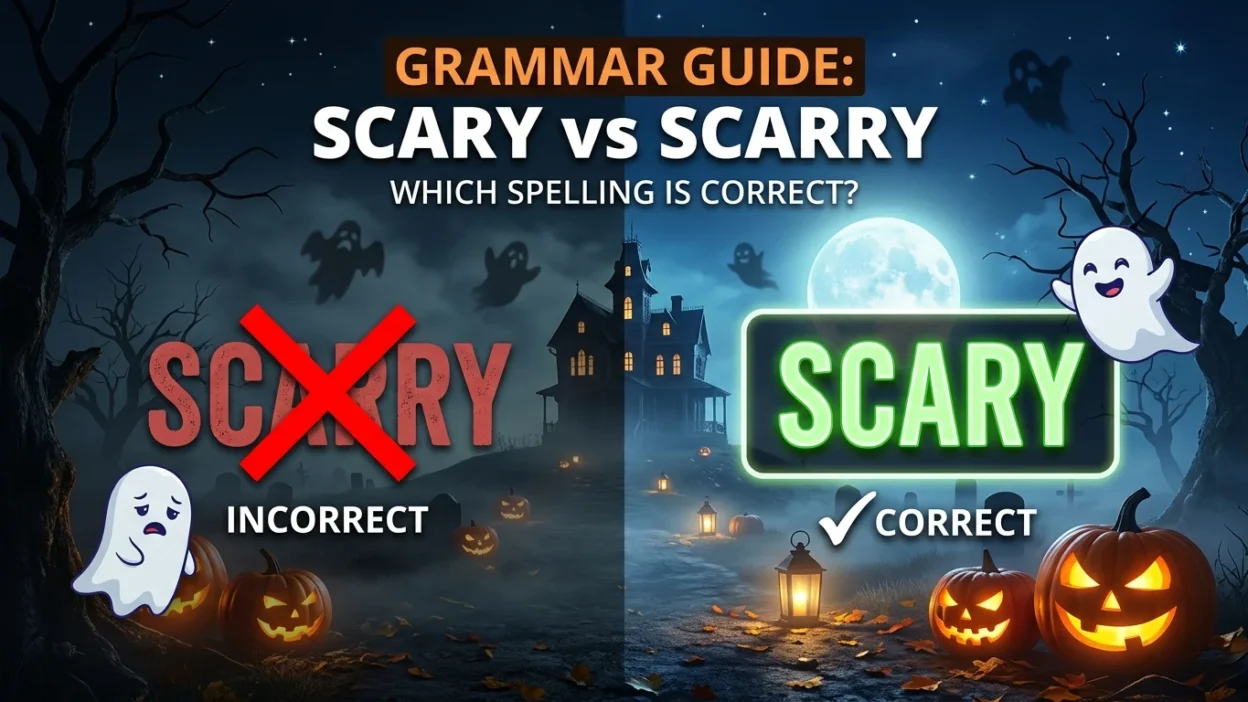
Many English words become confusing when similar spellings appear online or in casual writing. One common example is “scary” vs “scarry.” Because both words look believable at first glance, many people wonder which spelling is actually correct. This confusion is especially common among students, writers, and English learners trying to improve spelling accuracy.
The simple answer is that “scary” is the correct English word, while “scarry” is considered a misspelling. Understanding why this happens can help you avoid common grammar mistakes and write more confidently in both formal and everyday communication.
Quick Answer
“Scary” is the correct spelling.
“Scarry” is incorrect in standard English.
Correct Example
- That movie was really scary.
Incorrect Example
- That movie was really scarry.
What Does Scary Mean?
“Scary” is an adjective used to describe something that causes fear, nervousness, or anxiety.
It comes from the noun “scare.”
Meaning of Scary
Something scary:
- frightens people
- feels dangerous
- creates fear or tension
- seems alarming or spooky
Examples of Scary in Sentences
- The haunted house looked scary at night.
- I watched a scary horror movie yesterday.
- Public speaking can feel scary for some people.
- The thunderstorm sounded scary to the children.
- That roller coaster ride was scary but exciting.
Is Scarry a Real Word?
No, “scarry” is not a correct English word.
It is simply a spelling mistake that happens because people assume the word should contain a double “r.”
Dictionaries, grammar guides, and standard English writing all recognize only:
- scary
Not:
- scarry
Why Do People Spell It “Scarry”?
The confusion usually happens because of English pronunciation and spelling patterns.
People often think:
- scare → scarry
However, English spelling does not work that way in this case.
Correct Formation
The adjective comes from:
- scare + y = scary
Not:
- scarry
Similar Examples in English
| Base Word | Correct Adjective |
|---|---|
| scare | scary |
| mess | messy |
| fun | funny |
| cloud | cloudy |
The spelling changes slightly, but unnecessary extra letters are not added.
Scary vs Scarry Comparison Table
| Feature | Scary | Scarry |
|---|---|---|
| Correct spelling | Yes | No |
| Standard English | Accepted | Incorrect |
| Dictionary word | Yes | No |
| Used professionally | Yes | No |
| Grammar approved | Yes | No |
Common Mistakes With Scary
Adding Extra Letters
Many writers mistakenly double the “r.”
Incorrect:
- That game looks scarry.
Correct:
- That game looks scary.
Fast Typing Errors
Typing quickly often creates accidental spelling mistakes.
Learning English Phonetically
English learners sometimes spell words based on sound rather than spelling rules.
Since “scary” sounds strong when spoken, people may incorrectly assume another “r” belongs in the word.
Different Ways Scary Is Used
Horror and Entertainment
“Scary” is extremely common in movies, books, and games.
Examples:
- scary movies
- scary stories
- scary games
Real Life Situations
The word can also describe stressful or frightening experiences.
Example:
- Driving during a storm can be scary.
Emotional Feelings
“Scary” may describe emotional fear or anxiety.
Example:
- Starting a new job felt scary at first.
Grammar and Word Formation
“Scary” is formed by adding “-y” to the noun “scare.”
Formula
scare+y=scary
Notice that:
- the final “e” is removed
- only one “r” remains
Similar Word Patterns
| Word | Correct Form |
|---|---|
| taste | tasty |
| haze | hazy |
| shine | shiny |
| scare | scary |
These words follow similar spelling transformations.
American vs British English Differences
There is no spelling difference between American English and British English for this word.
Both varieties use:
- scary
Neither standard English variety uses:
- scarry
Synonyms for Scary
Depending on context, you can also use:
- frightening
- terrifying
- creepy
- spooky
- alarming
- horrifying
- intimidating
- unsettling
Example
- The abandoned building looked creepy and scary.
Scary in Pop Culture
The word “scary” is extremely popular in entertainment and online culture.
Common Uses
- scary Halloween costumes
- scary TikTok stories
- scary video games
- scary paranormal experiences
- scary documentaries
Because the word is so widely used online, spelling mistakes like “scarry” also appear frequently in social media posts and comments.
Why Correct Spelling Matters
Using the correct spelling improves:
- professionalism
- readability
- grammar accuracy
- SEO quality
- communication clarity
Misspellings like “scarry” can:
- distract readers
- reduce trust
- make writing appear careless
Tips to Remember the Correct Spelling
Think of the Root Word
Remember:
- scare → scary
Only one “r” is needed.
Practice Common Phrases
Examples:
- scary movie
- scary situation
- scary story
Avoid Adding Extra Letters
Many spelling mistakes happen because writers overcomplicate short words.
Keep it simple:
- scary
FAQs
Is scarry a real word?
No. “Scarry” is not considered a correct English word.
Which spelling is correct: scary or scarry?
“Scary” is the correct spelling.
Why do people spell scary as scarry?
Usually because of pronunciation confusion or accidental typing errors.
Is scary used in British English?
Yes. Both British and American English use “scary.”
What part of speech is scary?
“Scary” is an adjective.
What is the root word of scary?
The root word is “scare.”
Can scary describe emotions?
Yes. It can describe situations or feelings that create fear or anxiety.
What are synonyms for scary?
Common synonyms include frightening, creepy, terrifying, and spooky.
Final Summary
The difference between scary vs scarry is simple once you know the correct spelling rule. “Scary” is the proper and accepted English word used to describe something frightening or fear-inducing. “Scarry,” on the other hand, is just a common misspelling that should be avoided in professional and everyday writing.
If you are writing school assignments, social media captions, blog articles, or emails, using “scary” correctly helps your writing appear polished, accurate, and trustworthy. Small spelling improvements like this can make a big difference in communication clarity and reader confidence.
Actionable Takeaway
Whenever you want to describe something frightening, remember the correct spelling is “scary” with one “r.” Think of the root word “scare,” remove the “e,” and add “y.” This simple trick will help you avoid the common mistake of writing “scarry.”