If you’ve ever wondered whether “either” or “whether” is the correct word, you’re not alone. These two words are sometimes confused because they both appear in sentences involving choices or alternatives. However, they serve different grammatical purposes.
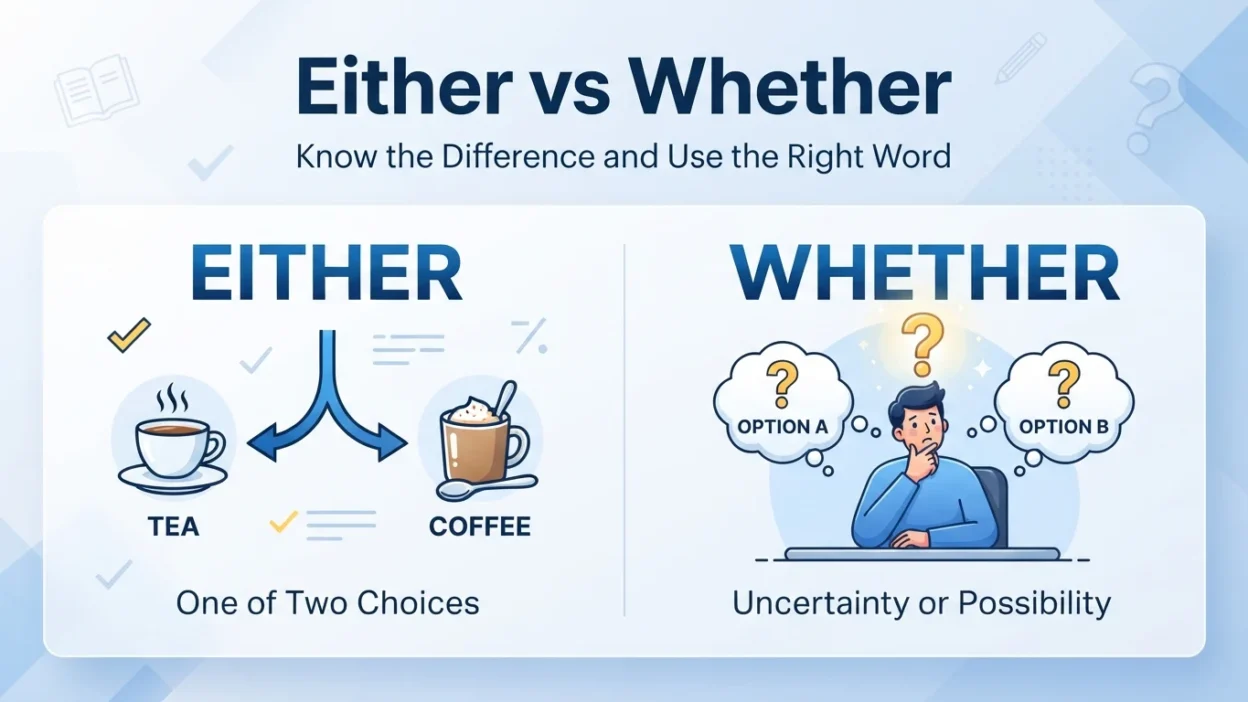
Either is used to refer to one of two choices, while whether introduces a choice, uncertainty, or possibility, often meaning if.
Understanding the difference between either vs whether will help you write and speak more naturally.
Quick Answer
- Either = One of two choices or alternatives.
- Whether = Introduces a choice, uncertainty, or possibility.
Correct Examples
- You can choose either tea or coffee.
- I don’t know whether she’ll attend the meeting.
What Does “Either” Mean?
Either can function as a:
- determiner
- pronoun
- adverb
- conjunction (in the phrase either…or)
It means:
- one or the other of two options
- both options are acceptable (depending on context)
Examples of Either in Sentences
- You may sit in either chair.
- Either answer is acceptable.
- We can leave either today or tomorrow.
- I don’t like coffee, and my brother doesn’t either.
- Either you apologize, or you leave.
What Does “Whether” Mean?
Whether is a conjunction.
It introduces:
- uncertainty
- indirect questions
- alternatives
- conditions
It often means if, especially when presenting two possibilities.
Examples of Whether in Sentences
- I don’t know whether he’ll come.
- She hasn’t decided whether to study abroad.
- Tell me whether you agree.
- Whether we win or lose, we’ll celebrate.
- I’m unsure whether it’s safe.
Either vs Whether Comparison Table
| Feature | Either | Whether |
|---|---|---|
| Refers to one of two choices | ✅ Yes | ❌ No |
| Introduces uncertainty | ❌ No | ✅ Yes |
| Used in “either…or” | ✅ Yes | ❌ No |
| Introduces indirect questions | ❌ No | ✅ Yes |
| Standard English | ✅ Yes | ✅ Yes |
Word Comparison
When to Use Either
Use either when talking about:
- one of two options
- two alternatives
- agreement in negative statements
- the phrase either…or
Examples
- Either route will get you there.
- You can wear either dress.
- Either call me or send an email.
- I don’t watch horror movies, and she doesn’t either.
When to Use Whether
Use whether when expressing:
- uncertainty
- doubt
- indirect questions
- alternatives
Examples
- I can’t decide whether to stay or leave.
- We haven’t confirmed whether the event is canceled.
- Let me know whether you’re interested.
- Whether you agree or not, the decision has been made.
Common Mistakes
Using Either Instead of Whether
Incorrect:
- I don’t know either he is coming.
Correct:
- I don’t know whether he is coming.
Using Whether Instead of Either
Incorrect:
- Whether tea or coffee is fine.
Correct:
- Either tea or coffee is fine.
Common Phrases
Either
- either…or
- either way
- either one
- either choice
- me either (informal)
Whether
- whether or not
- whether to
- whether it’s true
- whether we agree
- whether possible
Synonyms
Synonyms for Either
- one or the other
- any one of two
- whichever (in some contexts)
Synonyms for Whether
- if (in some contexts)
- regardless of whether
- whether or not
American vs British English Differences
There is no significant difference.
Both American and British English use either and whether according to the same grammar rules.
Pronunciation note: The pronunciation of either varies. Both /ˈiːðər/ (“EE-ther”) and /ˈaɪðər/ (“EYE-ther”) are correct in American and British English.
Why Correct Word Choice Matters
Using the correct word helps:
- improve grammatical accuracy
- make your writing clearer
- avoid confusion
- communicate choices and uncertainty correctly
Because both words can appear in discussions about alternatives, they are sometimes mistakenly interchanged.
Tips to Remember the Difference
Either = Choice
Think of either whenever you’re selecting one of two options.
Example:
- Either pizza or pasta.
Whether = Wondering
Think of whether whenever you’re expressing uncertainty.
Example:
- I wonder whether she’ll come.
Easy Memory Trick
- Either = Choice
- Whether = Uncertainty
Frequently Asked Questions (FAQs)
What is the difference between either and whether?
Either refers to one of two choices, while whether introduces uncertainty or alternatives.
Which is correct: “I don’t know either he will come” or “I don’t know whether he will come”?
The correct sentence is:
- I don’t know whether he will come.
Can whether mean if?
Yes. In many indirect questions, whether can mean if.
Example:
- I don’t know whether (or if) she’s available.
When should I use either?
Use either when choosing between two options or in the expression either…or.
Is “whether or not” always necessary?
No. In many sentences, whether alone is sufficient, although whether or not may add emphasis.
Is there a difference between British and American English?
No. Both varieties use these words in the same way.
How can I remember the difference?
Think:
- Either = Choice
- Whether = Wondering
Final Summary
The difference between either vs whether is simple. Either is used when choosing one of two alternatives, while whether is used to introduce uncertainty, indirect questions, or possibilities.
If you’re making a choice, use either. If you’re expressing doubt or asking about possibilities, use whether.
Actionable Takeaway
Use:
- either ✅ when referring to one of two choices.
- whether ✅ when expressing uncertainty or introducing alternatives.
Memory trick:
- Either = Choice
- Whether = Uncertainty