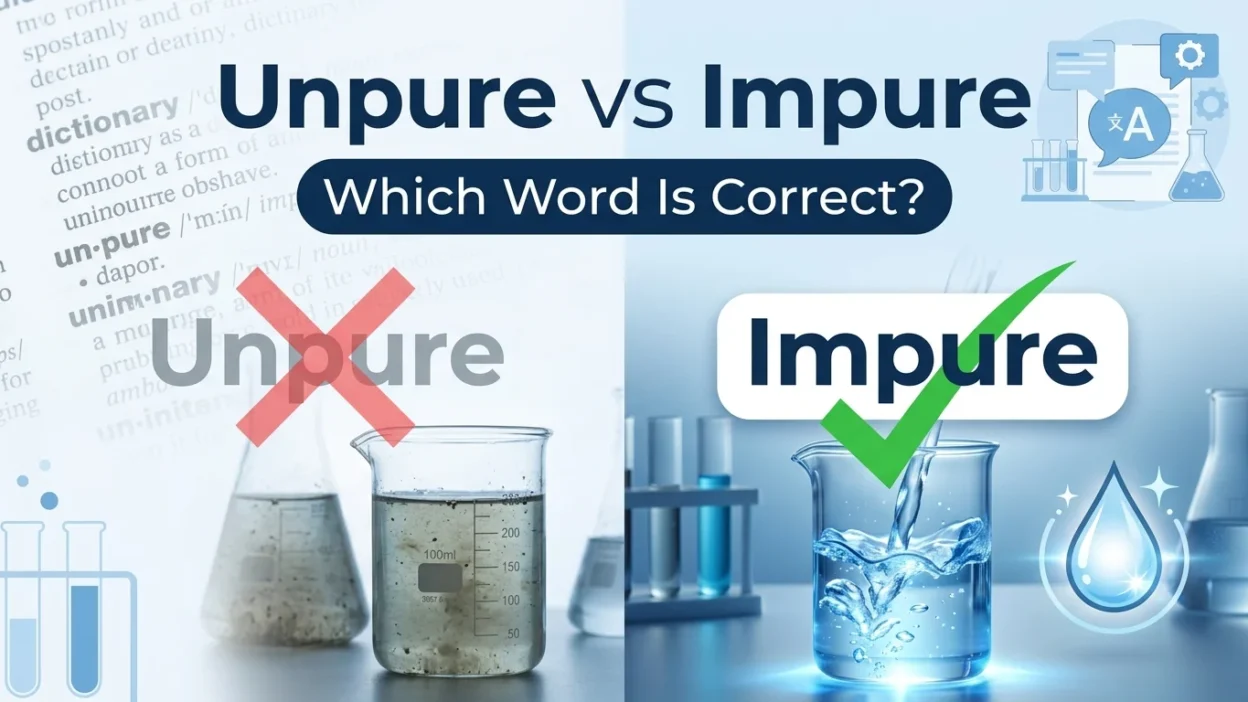
If you’ve ever wondered whether “unpure” or “impure” is the correct word, you’re not alone. Both seem logical because English often creates opposites by adding prefixes such as un- and im-. However, only one of these forms is widely accepted in standard English.
The correct and commonly used word is “impure.” While “unpure” occasionally appears in historical texts or rare contexts, it is generally considered nonstandard and is rarely used in modern English. Understanding the difference will help you choose the right word in formal and everyday writing.
Quick Answer
“Impure” is the correct and standard word.
“Unpure” is generally considered nonstandard and uncommon.
Correct Example
- The water was found to be impure.
Less Accepted Example
- The water was found to be unpure.
What Does Impure Mean?
Impure is an adjective that means:
- not pure
- contaminated
- mixed with unwanted substances
- morally or spiritually unclean in certain contexts
The word is commonly used in science, religion, ethics, and everyday language.
Examples of Impure in Sentences
- The laboratory rejected the impure sample.
- The water became impure after contamination.
- Ancient traditions sometimes referred to impure objects.
- The metal was impure and required further refining.
- The chemicals produced an impure compound.
Is Unpure a Real Word?
Unpure has appeared occasionally in historical writings and some dictionaries may acknowledge it as a rare form.
However, in modern English, the preferred and standard word is:
- impure
Most professional writers, educators, and style guides recommend using impure.
Why Is Impure Preferred?
English often forms opposites using different prefixes depending on the word.
Examples:
| Positive Word | Negative Form |
|---|---|
| possible | impossible |
| polite | impolite |
| mature | immature |
| pure | impure |
Because pure traditionally takes the prefix im-, the accepted opposite is:
- impure
Not:
- unpure
Unpure vs Impure Comparison Table
| Feature | Impure | Unpure |
|---|---|---|
| Standard English word | Yes | Rarely |
| Common modern usage | Yes | No |
| Dictionary recognized | Yes | Sometimes |
| Professional writing | Yes | No |
| Recommended choice | Yes | No |
Word Formation Rule
pure→impure
Common Mistakes With Impure
Assuming Every Opposite Uses “Un-”
Many English adjectives use un-, but not all do.
Incorrect assumption:
- pure → unpure
Correct form:
- pure → impure
Using Unpure in Formal Writing
While readers may understand the meaning, impure is the accepted choice in professional and academic contexts.
Confusing Rare Usage With Standard Usage
A word can exist historically without being the preferred modern form.
Different Uses of Impure
Scientific Context
Example:
- The sample was impure and unsuitable for testing.
Water Quality
Example:
- The river became impure due to pollution.
Religious Context
Example:
- Certain traditions classify specific items as impure.
Moral or Figurative Context
Example:
- The story described impure motives.
Common Phrases Using Impure
Impure Water
Meaning: contaminated water.
Example:
- Drinking impure water can be dangerous.
Impure Substance
Meaning: a material containing contaminants.
Example:
- Scientists removed impurities from the impure substance.
Impure Metal
Meaning: metal mixed with other materials.
Example:
- The impure metal required purification.
Impure Thoughts
Meaning: morally questionable thoughts in some religious contexts.
Example:
- The text warned against impure thoughts.
Synonyms for Impure
Depending on context, similar words include:
- contaminated
- polluted
- adulterated
- tainted
- unclean
Example
- The contaminated and impure sample was discarded.
Opposites of Impure
Antonyms include:
- pure
- clean
- uncontaminated
- refined
- pristine
Example
- The water was pure rather than impure.
American vs British English Differences
There is no significant difference between American and British English.
Both prefer:
- impure
Both rarely use:
- unpure
Why Correct Word Choice Matters
Using the accepted form improves:
- clarity
- professionalism
- readability
- credibility
- academic accuracy
Using uncommon forms like unpure may:
- distract readers
- appear outdated
- seem incorrect
Tips to Remember the Correct Word
Think of Similar Words
Examples:
- possible → impossible
- mature → immature
- pure → impure
Remember the Prefix
The opposite of pure begins with:
- im-
Use the Common Form
In nearly all modern writing, choose:
- impure
FAQs
Which word is correct: unpure or impure?
Impure is the standard and preferred word.
Is unpure a real word?
It exists as a rare or historical form, but it is not commonly used in modern English.
What does impure mean?
It means not pure, contaminated, mixed, or unclean.
Why is impure preferred?
Because English traditionally forms the opposite of pure using the prefix im-.
Is unpure grammatically wrong?
It may be understood, but it is generally considered nonstandard and should be avoided.
Is impure used in science?
Yes. It is commonly used to describe contaminated substances or materials.
Do British and American English use different forms?
No. Both prefer impure.
How can I remember the correct word?
Think:
- mature → immature
- pure → impure
Final Summary
The difference between unpure vs impure is straightforward. While unpure may occasionally appear in rare or historical usage, impure is the accepted and widely used word in modern English. It is the standard opposite of pure and is commonly used in scientific, religious, moral, and everyday contexts.
Whether you’re describing water quality, chemical substances, metals, or abstract concepts, impure is the form that readers expect and recognize.
Actionable Takeaway
Whenever you mean not pure or contaminated, write:
- impure ✅
Avoid:
- unpure ❌
A simple memory trick:
- pure → impure
Just as possible → impossible, the standard opposite of pure is impure.