
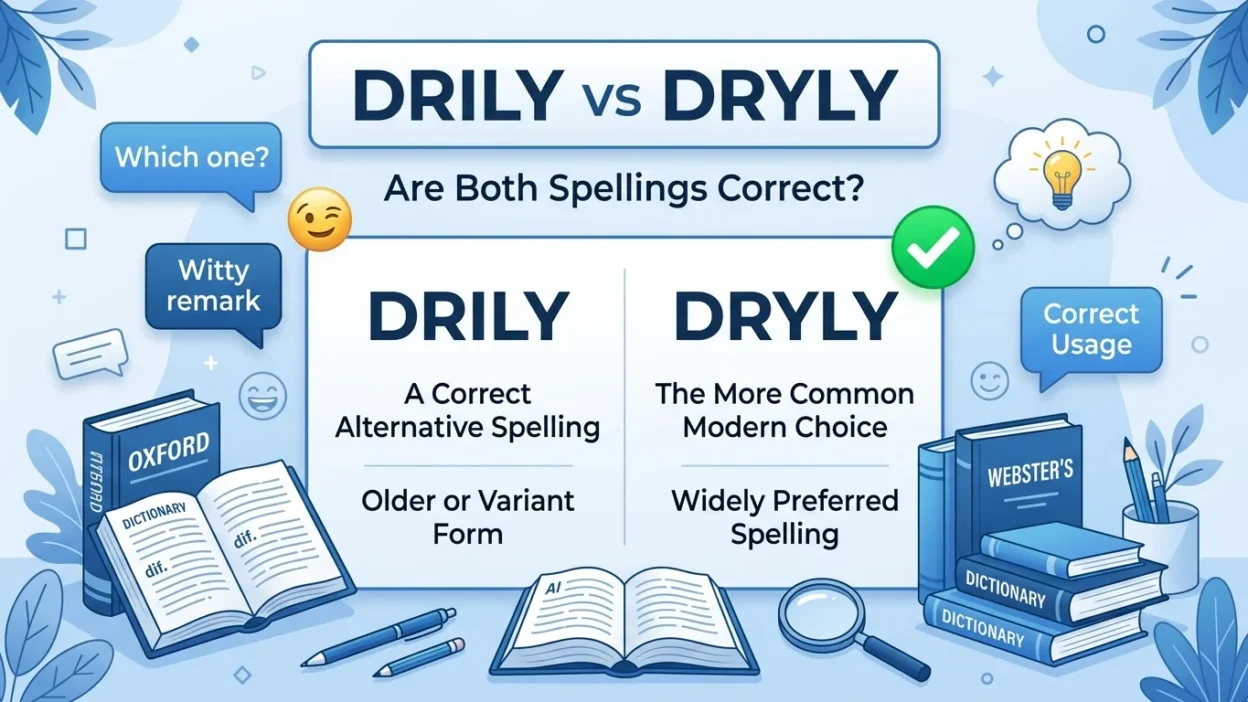
If you’ve encountered both “drily” and “dryly” in books, articles, or conversations, you may have wondered whether one spelling is correct and the other is a mistake. Unlike many commonly confused words, this pair is unique because both spellings are accepted in standard English.
However, dryly is much more common in modern usage, while drily is considered a less common but still correct alternative. Understanding the difference can help you choose the form that best suits your audience and writing style.
Quick Answer
Both “dryly” and “drily” are correct spellings.
However:
- Dryly is the more common and widely used form.
- Drily is a valid alternative spelling.
Correct Examples
- She replied dryly to the question.
- She replied drily to the question.
Both sentences are grammatically correct.
What Do Dryly and Drily Mean?
Dryly and drily are adverbs that mean:
- in a dry manner
- without emotion
- with subtle humor or sarcasm
- in a matter-of-fact way
They are often used to describe speech, comments, or reactions.
Examples of Dryly in Sentences
- He smiled dryly after hearing the excuse.
- She dryly remarked that the plan had obvious flaws.
- The professor answered the question dryly.
- He dryly noted the irony of the situation.
- The actor delivered the line dryly for comedic effect.
Examples of Drily in Sentences
- She drily observed that the project was overdue.
- He drily commented on the mistake.
- The critic drily summarized the film.
- The manager drily acknowledged the problem.
- She drily pointed out the contradiction.
Are Both Words Real?
Yes.
Both spellings appear in major dictionaries and style guides:
- dryly
- drily
Neither is considered incorrect.
The difference is mainly one of preference and frequency.
Why Are There Two Spellings?
The variation comes from different ways of forming adverbs from adjectives ending in y.
For many words ending in y, English changes the y to i before adding -ly.
Examples:
- happy → happily
- easy → easily
Following that pattern:
- dry → drily
However, many writers also prefer:
- dry → dryly
because it preserves the original spelling of the adjective.
Over time, both forms became accepted.
Drily vs Dryly Comparison Table
| Feature | Dryly | Drily |
|---|---|---|
| Correct spelling | Yes | Yes |
| Dictionary approved | Yes | Yes |
| More common today | Yes | No |
| Standard English | Yes | Yes |
| Preferred by many modern writers | Yes | Sometimes |
Word Formation
dry→drylyordrily
Which Spelling Should You Use?
For most modern writing, the safest choice is:
- dryly
It is:
- more familiar to readers
- more commonly used
- widely accepted in professional writing
However, drily remains correct and may appear in literary or traditional writing.
Common Mistakes With Dryly and Drily
Assuming One Is Wrong
Many people believe only one spelling is acceptable.
In reality:
- dryly ✔
- drily ✔
Both are correct.
Using Different Spellings in the Same Document
Choose one style and remain consistent.
Confusing Meaning
The spelling changes, but the meaning remains the same.
Dryly and Drily in Different Contexts
Humor
Example:
- He dryly remarked that everything was going perfectly despite the chaos.
Sarcasm
Example:
- She drily commented on the obvious mistake.
Formal Writing
Example:
- The report dryly summarized the findings.
Literature
Example:
- The narrator drily observed the absurd situation.
Common Phrases Using Dryly
Said Dryly
Meaning: spoke with understated humor or sarcasm.
Example:
- “That went well,” he said dryly.
Remarked Dryly
Meaning: made a subtle or sarcastic comment.
Example:
- She remarked dryly about the delay.
Observed Dryly
Meaning: commented in a restrained way.
Example:
- He observed dryly that the problem was predictable.
Commented Dryly
Meaning: spoke with little emotion or understated humor.
Example:
- The journalist commented dryly on the controversy.
Synonyms for Dryly
Depending on context, similar words include:
- sarcastically
- wryly
- matter-of-factly
- coolly
- unemotionally
Example
- She replied wryly and dryly to the criticism.
Opposites of Dryly
Antonyms may include:
- enthusiastically
- warmly
- emotionally
- passionately
- excitedly
Example
- Rather than responding dryly, he answered enthusiastically.
American vs British English Differences
Both American and British English recognize:
- dryly
- drily
However, dryly tends to be more common in modern usage on both sides of the Atlantic.
Why Word Choice Matters
Choosing the more familiar spelling can improve:
- readability
- consistency
- audience understanding
- professional presentation
For most readers, dryly feels more natural because it appears more frequently.
Tips to Remember the Difference
Both Are Correct
Unlike many spelling comparisons, neither word is wrong.
Use the More Common Form
When uncertain, choose:
- dryly
Stay Consistent
If you use one spelling in a document, continue using that same form throughout.
FAQs
Which spelling is correct: drily or dryly?
Both spellings are correct.
Which spelling is more common?
Dryly is more common in modern English.
Do drily and dryly mean the same thing?
Yes. They have the same meaning and usage.
Is drily old-fashioned?
Not exactly, but it is less common than dryly today.
Which spelling should I use in professional writing?
Most writers prefer dryly because it is more familiar to readers.
Are both words accepted in dictionaries?
Yes. Major dictionaries recognize both spellings.
Is there a British vs American English difference?
No significant difference. Both forms are accepted in both varieties.
How can I remember which spelling to use?
Choose dryly if you want the most common modern spelling.
Final Summary
The difference between drily vs dryly is unusual because both spellings are correct. They share the same meaning and can be used interchangeably to describe speech or actions that are restrained, sarcastic, unemotional, or subtly humorous.
Although drily remains a valid alternative, dryly is the more common and widely preferred spelling in modern English. For most professional, academic, and everyday writing, dryly is the safest and most familiar choice.
Actionable Takeaway
When describing someone speaking in a restrained, sarcastic, or matter-of-fact manner:
- dryly ✅ (most common)
- drily ✅ (also correct)
If you’re unsure which to choose, use:
- dryly
It’s the spelling most readers expect to see.