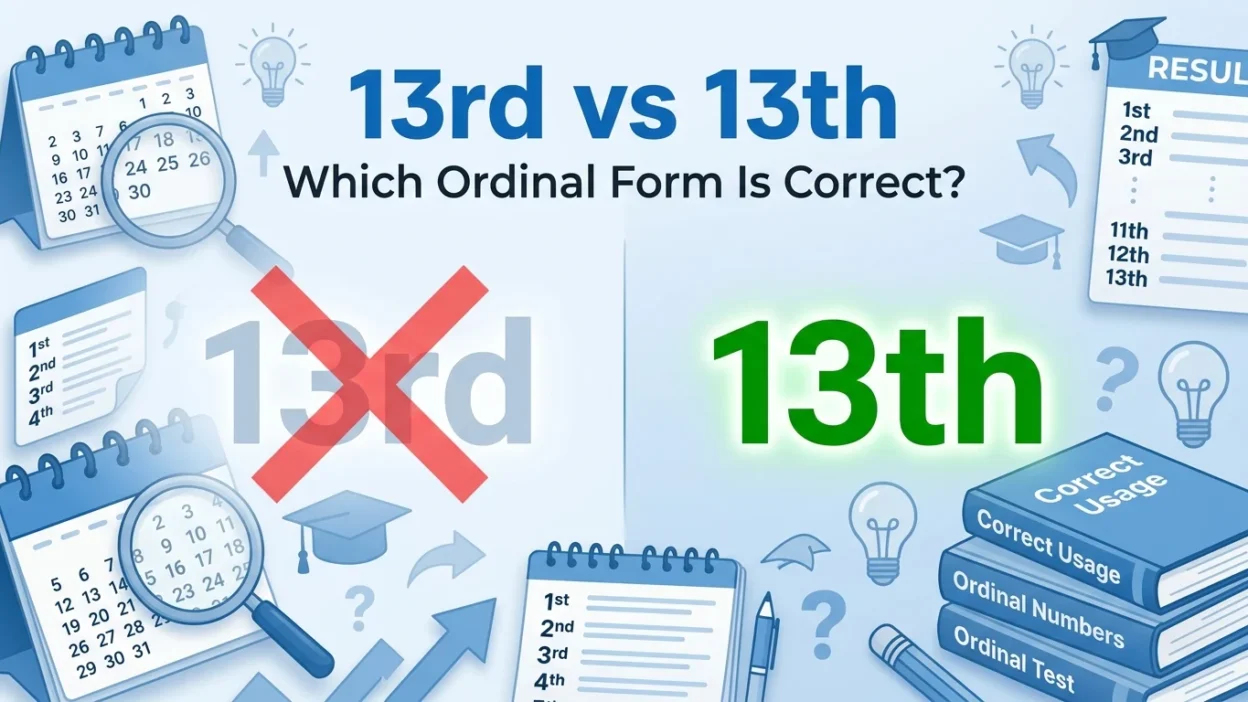
If you’ve ever written “13rd” instead of “13th,” you’re not alone. Ordinal numbers in English can be confusing because different numbers use different endings such as -st, -nd, -rd, and -th. It’s easy to assume that any number ending in 3 should use -rd, but that’s not always the case.
The good news is that the rule is straightforward once you understand it. “13th” is the correct form, while “13rd” is incorrect. Learning this simple grammar rule will help you write dates, rankings, and numbers correctly every time.
Quick Answer
“13th” is the correct form.
“13rd” is incorrect in standard English.
Correct Example
- Her birthday is on the 13th of June.
Incorrect Example
- Her birthday is on the 13rd of June.
What Does 13th Mean?
13th is the ordinal form of the number 13.
Ordinal numbers show:
- position
- order
- rank
- sequence
Examples:
- first place
- tenth chapter
- 13th day
- 20th anniversary
Examples of 13th in Sentences
- The meeting will be held on the 13th.
- She finished in 13th place.
- Today is the 13th day of the month.
- The 13th chapter is my favorite.
- He celebrated his 13th birthday.
Is 13rd a Real Word?
No, 13rd is not a correct English ordinal number.
It is a grammar mistake caused by incorrectly applying the -rd ending.
The correct form is:
- 13th
Why Is It 13th and Not 13rd?
Many people know:
- 3 → 3rd
- 23 → 23rd
- 33 → 33rd
This leads them to assume:
- 13 → 13rd
However, numbers ending in 11, 12, and 13 are special exceptions.
Correct Forms
| Number | Ordinal Form |
|---|---|
| 11 | 11th |
| 12 | 12th |
| 13 | 13th |
Even though 13 ends with the digit 3, it still uses:
- th
Ordinal Number Rules
Use -st
For numbers ending in 1:
- 1st
- 21st
- 31st
Except:
- 11th
Use -nd
For numbers ending in 2:
- 2nd
- 22nd
- 32nd
Except:
- 12th
Use -rd
For numbers ending in 3:
- 3rd
- 23rd
- 33rd
Except:
- 13th
Use -th
For most other numbers:
- 4th
- 5th
- 10th
- 13th
- 20th
13rd vs 13th Comparison Table
| Feature | 13th | 13rd |
|---|---|---|
| Correct English form | Yes | No |
| Used in dates | Yes | No |
| Used in rankings | Yes | No |
| Grammar approved | Yes | No |
| Standard English | Yes | No |
Ordinal Rule Illustration
13→13th
Common Mistakes With 13th
Following the Last Digit Only
Incorrect reasoning:
- 13 ends in 3, so it must be 13rd.
Correct rule:
- 11, 12, and 13 always use th.
Writing Dates Incorrectly
Incorrect:
- August 13rd
Correct:
- August 13th
Confusing 13th With 23rd
Correct:
- 13th
- 23rd
These numbers follow different ordinal rules.
Examples of Ordinal Numbers
| Cardinal Number | Ordinal Number |
|---|---|
| 1 | 1st |
| 2 | 2nd |
| 3 | 3rd |
| 4 | 4th |
| 11 | 11th |
| 12 | 12th |
| 13 | 13th |
| 21 | 21st |
| 22 | 22nd |
| 23 | 23rd |
Common Uses of 13th
Dates
Example:
- The event is scheduled for July 13th.
Birthdays
Example:
- She celebrated her 13th birthday.
Rankings
Example:
- The athlete finished 13th overall.
Chapters and Sections
Example:
- The answer appears in the 13th chapter.
American vs British English Differences
There is no difference between American and British English.
Both use:
- 13th
Neither uses:
- 13rd
Why Correct Ordinals Matter
Using the correct ordinal form improves:
- grammar accuracy
- professionalism
- readability
- academic writing
- business communication
Using 13rd can:
- distract readers
- appear careless
- create grammatical errors
Tips to Remember the Correct Form
Memorize the Exceptions
Always remember:
- 11th
- 12th
- 13th
Think of the “Teen” Numbers
Numbers ending in:
- 11
- 12
- 13
always take:
- th
Check Dates Carefully
When writing dates, make sure:
- June 13th ✔
- June 13rd ✘
FAQs About 13rd vs 13th
Which is correct: 13rd or 13th?
13th is the correct form.
Why is 13th correct instead of 13rd?
Because 11, 12, and 13 are exceptions that always use -th.
Is 13rd ever correct?
No. It is considered incorrect in standard English.
How do you write the ordinal form of 13?
Write:
- 13th
What is the rule for numbers ending in 3?
Most use -rd, such as 3rd and 23rd, except for 13th.
Is 13th used in British and American English?
Yes. Both use 13th.
How should I write a date with 13?
Example:
- March 13th
What are the exceptions to ordinal endings?
The exceptions are:
- 11th
- 12th
- 13th
Final Summary
The difference between 13rd vs 13th is simple once you know the ordinal number rules. Although the number 13 ends in the digit 3, it does not take the -rd ending. Instead, it follows the special exception rule for 11, 12, and 13, which all use -th.
Whether you’re writing dates, birthdays, rankings, or chapter numbers, always use 13th. Using the correct ordinal form makes your writing more accurate, professional, and grammatically correct.
Actionable Takeaway
Whenever you need the ordinal form of 13, write:
- 13th
Never:
- 13rd
A simple memory trick:
- 11th, 12th, and 13th are special exceptions.
Remembering these three numbers will help you avoid one of the most common ordinal number mistakes.