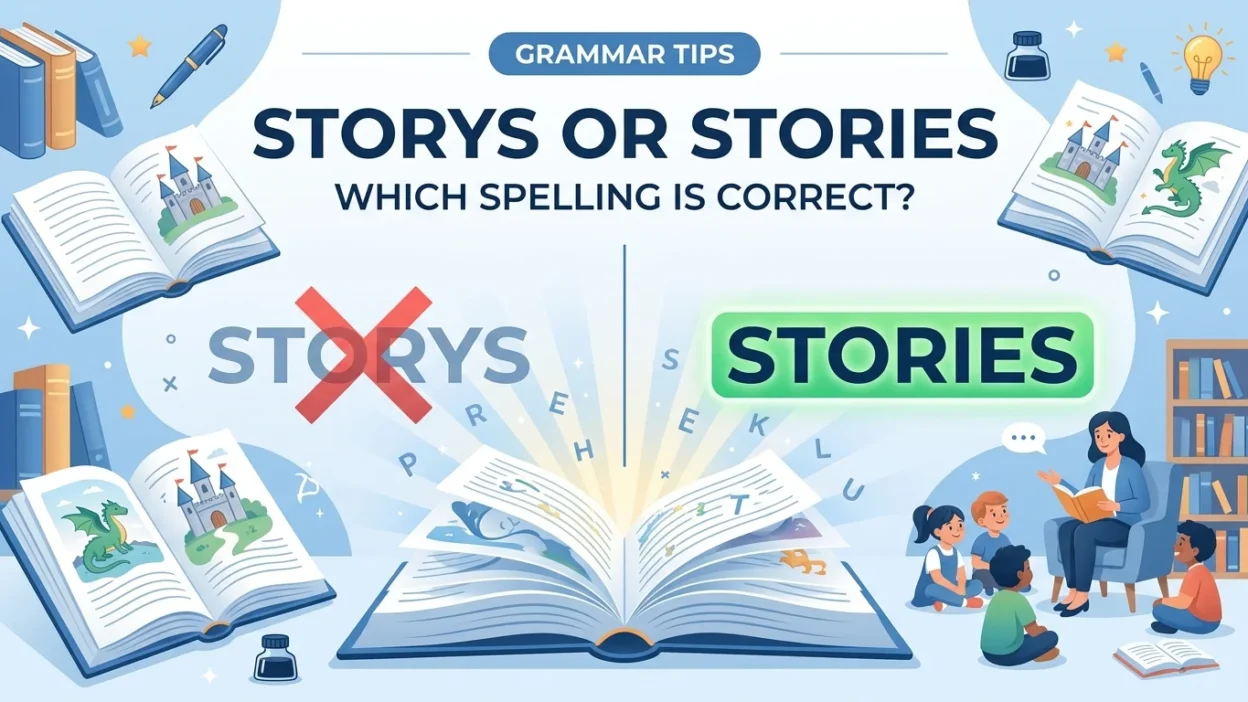
English plural rules can sometimes feel confusing, especially with words ending in the letter “y.” One common mistake many writers make is using “storys” instead of “stories.” Since many English words simply add “s” to form plurals, this error is understandable.
The correct spelling is “stories.” Meanwhile, “storys” is incorrect in standard English grammar. Understanding the simple plural rule behind this word can help improve your spelling, writing confidence, and grammar accuracy in everyday and professional communication.
Quick Answer
“Stories” is the correct spelling.
“Storys” is incorrect in standard English.
Correct Example
- Children enjoy listening to bedtime stories.
Incorrect Example
- Children enjoy listening to bedtime storys.
What Does Stories Mean?
“Stories” is the plural form of:
- story
A “story” can mean:
- a narrative or tale
- a report of events
- a fictional account
- a level in a building
Examples of Stories in Sentences
- Grandparents often tell wonderful stories.
- The newspaper published several stories today.
- She enjoys reading mystery stories.
- The building has three stories.
- Students shared personal stories in class.
Is Storys a Real Word?
No, “storys” is not considered a correct English word.
It is simply a spelling mistake caused by incorrectly forming the plural of:
- story
Standard dictionaries and grammar guides only recognize:
- stories
Why Is Stories Spelled With “IES”?
English grammar has a common rule for nouns ending in:
- consonant + y
When this happens:
- the “y” changes to “i”
- then “es” is added
Since “story” ends with:
- r + y
the correct plural becomes:
- stories
Correct Plural Formation
story→stories
Not:
- storys
Similar Examples
| Singular Word | Correct Plural |
|---|---|
| story | stories |
| city | cities |
| baby | babies |
| family | families |
These nouns follow the same grammar pattern.
Storys vs Stories Comparison Table
| Feature | Stories | Storys |
|---|---|---|
| Correct spelling | Yes | No |
| Standard English | Accepted | Incorrect |
| Dictionary word | Yes | No |
| Grammar approved | Yes | No |
| Used professionally | Yes | No |
Common Mistakes With Stories
Adding Only “S”
Incorrect:
- He writes adventure storys.
Correct:
- He writes adventure stories.
Forgetting the “Y to IES” Rule
Many writers forget that words ending in consonant + y usually change:
- y → ies
Typing Too Quickly
Fast typing can cause simplified but incorrect plural forms.
Grammar Rule Behind Stories
Change “Y” to “IES”
When a noun ends in:
- consonant + y
you generally:
- remove “y”
- add “ies”
Examples
| Singular | Plural |
|---|---|
| story | stories |
| party | parties |
| country | countries |
| lady | ladies |
Exceptions to the Rule
If a noun ends in:
- vowel + y
you usually only add:
- s
Examples
| Singular | Plural |
|---|---|
| boy | boys |
| toy | toys |
| key | keys |
These words keep the “y.”
Different Meanings of Stories
Fictional Tales
Example:
- Children love fantasy stories.
News Reports
Example:
- Journalists covered breaking stories.
Personal Experiences
Example:
- People shared emotional stories online.
Building Levels
Example:
- The hotel has ten stories.
American vs British English Differences
There is no spelling difference between American English and British English for this word.
Both use:
- stories
Neither standard variety uses:
- storys
Synonyms for Stories
Depending on context, similar words include:
- tales
- narratives
- accounts
- reports
- legends
Example
- The author writes fascinating tales and stories.
Why Correct Spelling Matters
Correct spelling improves:
- professionalism
- readability
- grammar accuracy
- communication clarity
- writing confidence
Misspellings like “storys” may:
- distract readers
- reduce credibility
- appear careless
Common Phrases Using Stories
Short Stories
Meaning: brief fictional narratives.
Example:
- She enjoys reading short stories.
Success Stories
Meaning: inspiring examples of achievement.
Example:
- Entrepreneurs shared their success stories.
Bedtime Stories
Meaning: tales told before sleeping.
Example:
- Parents often read bedtime stories to children.
News Stories
Meaning: journalistic reports.
Example:
- The channel covered major news stories.
Tips to Remember the Correct Spelling
Remember the “Y to IES” Rule
Correct:
- stories
Not:
- storys
Practice Similar Words
Examples:
- cities
- countries
- families
- babies
Think Singular to Plural
- story → stories
FAQs
Which spelling is correct: storys or stories?
“Stories” is the correct spelling.
Is storys a real word?
No. “Storys” is considered incorrect in standard English.
Why does stories end in “ies”?
Because nouns ending in consonant + y usually change “y” to “ies” in plural form.
What is the singular form of stories?
The singular form is:
- story
Is stories used in British and American English?
Yes. Both varieties use “stories.”
What are synonyms for stories?
Common synonyms include tales, narratives, and accounts.
Why do people write storys?
Usually because they incorrectly add only “s” instead of changing “y” to “ies.”
How can I remember the correct spelling?
Remember:
- story → stories
Change:
- y → ies
Final Summary
The difference between storys or stories is straightforward once you know the plural spelling rule. “Stories” is the correct and accepted English plural form of “story,” while “storys” is incorrect because nouns ending in consonant + y usually change “y” to “ies.”
Whether you are writing essays, emails, articles, blog posts, or professional documents, using “stories” correctly helps your writing appear polished, accurate, and trustworthy. Small spelling improvements like this can significantly strengthen communication clarity and professionalism.
Actionable Takeaway
Whenever making “story” plural, always write:
- stories
Not:
- storys
Remember the simple grammar rule:
- consonant + y → ies
This easy pattern will help you avoid a very common English spelling mistake.