English spelling rules can sometimes feel confusing, especially when adding endings like “-ed” to verbs. One common mistake many writers make is using “offerred” instead of “offered.” Since some words double their final consonants before adding suffixes, it is understandable why this confusion happens.
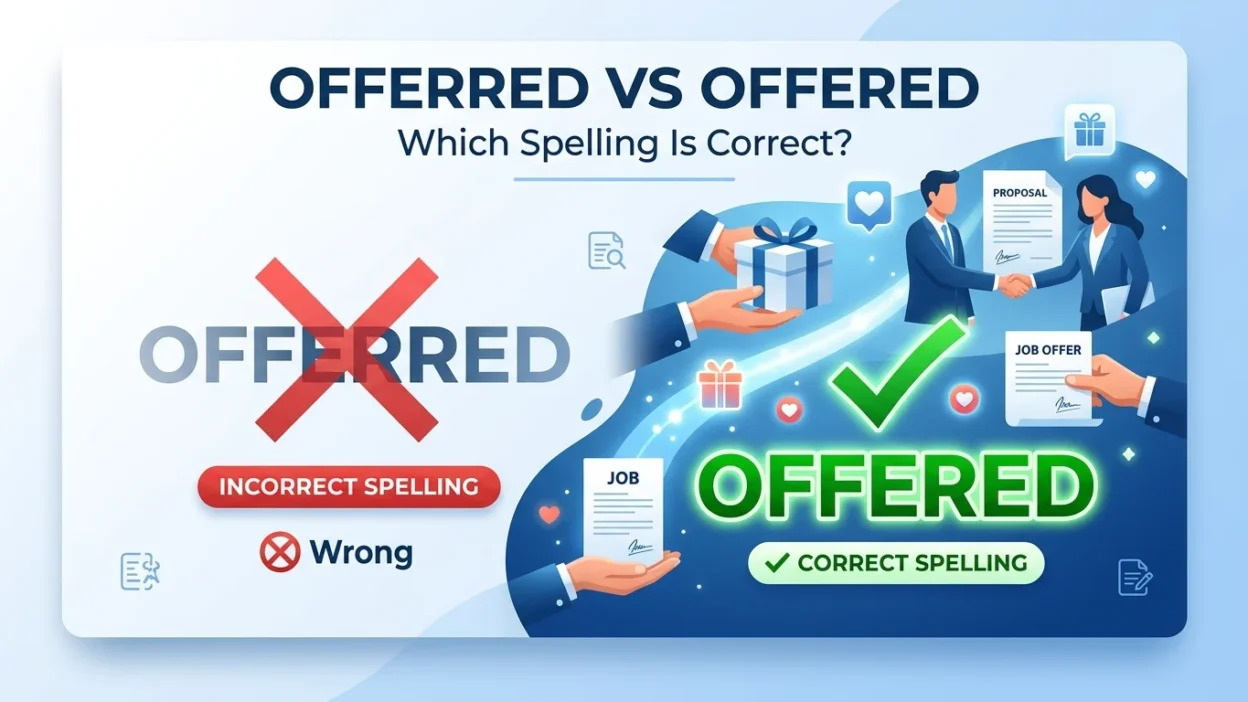
The correct spelling is “offered” with one “r.” Meanwhile, “offerred” is incorrect in standard English grammar. Learning why the extra “r” is unnecessary can help improve your writing accuracy, professionalism, and confidence in both casual and formal communication.
Quick Answer
“Offered” is the correct spelling.
“Offerred” is incorrect in standard English.
Correct Example
- She offered help during the meeting.
Incorrect Example
- She offerred help during the meeting.
What Does Offered Mean?
“Offered” is the past tense and past participle form of the verb “offer.”
The word “offer” means:
- to present something
- to provide help or services
- to suggest something
- to give willingly
Examples of Offered in Sentences
- They offered free drinks at the event.
- He offered useful advice.
- The company offered a discount to customers.
- She offered to drive us home.
- We offered support during difficult times.
Is Offerred a Real Word?
No, “offerred” is not considered a correct English word.
It is simply a spelling mistake caused by incorrectly doubling the final “r.”
Standard dictionaries and grammar guides only recognize:
- offered
Why Is Offered Spelled With One R?
Not all English verbs double the final consonant before adding:
- ed
or - ing
The verb “offer” does not double the “r” because the stress falls on the first syllable:
- OF-fer
Not:
- of-FER
Since the final syllable is not stressed, the “r” remains single.
Correct Word Formation
offer+ed=offered
Not:
- offerred
Similar Examples
| Base Verb | Correct Past Form |
|---|---|
| offer | offered |
| visit | visited |
| happen | happened |
| open | opened |
These words also keep a single final consonant.
Offerred vs Offered Comparison Table
| Feature | Offered | Offerred |
|---|---|---|
| Correct spelling | Yes | No |
| Standard English | Accepted | Incorrect |
| Dictionary word | Yes | No |
| Used professionally | Yes | No |
| Grammar approved | Yes | No |
Common Mistakes With Offered
Adding an Extra “R”
Incorrect:
- He offerred assistance.
Correct:
- He offered assistance.
Confusing Consonant Doubling Rules
Some writers assume every verb ending in consonants doubles the final letter before adding:
- ed
But English stress patterns determine whether doubling occurs.
Typing Errors
Fast typing often creates accidental extra letters.
Grammar Rule Behind Offered
English usually doubles the final consonant when:
- the word ends in consonant vowel consonant
- the final syllable is stressed
Examples That Double
| Verb | Correct Form |
|---|---|
| refer | referred |
| occur | occurred |
| admit | admitted |
Examples That Do Not Double
| Verb | Correct Form |
|---|---|
| offer | offered |
| visit | visited |
| happen | happened |
Different Meanings of Offered
Providing Something
Example:
- The store offered lower prices.
Giving Help
Example:
- She offered emotional support.
Suggesting an Idea
Example:
- He offered a creative solution.
Presenting an Opportunity
Example:
- The university offered scholarships.
American vs British English Differences
There is no spelling difference between American English and British English for this word.
Both use:
- offered
Neither standard variety uses:
- offerred
Synonyms for Offered
Depending on context, similar words include:
- provided
- presented
- suggested
- proposed
- supplied
Example
- The company provided and offered excellent customer service.
Why Correct Spelling Matters
Correct spelling improves:
- professionalism
- readability
- communication clarity
- grammar accuracy
- writing confidence
Misspellings like “offerred” may:
- distract readers
- reduce credibility
- appear careless
Common Phrases Using Offered
Offered Help
Meaning: gave assistance.
Example:
- She offered help immediately.
Offered Advice
Meaning: shared guidance or suggestions.
Example:
- The mentor offered valuable advice.
Offered Support
Meaning: provided encouragement or assistance.
Example:
- Friends offered support during hard times.
Offered Services
Meaning: provided business or professional assistance.
Example:
- The agency offered marketing services.
Tips to Remember the Correct Spelling
Remember the Stress Rule
“Offer” stresses the first syllable:
- OF-fer
So the “r” does not double.
Keep One R
Correct:
- offered
Not:
- offerred
Practice Similar Words
Examples:
- opened
- visited
- happened
- offered
FAQs
Which spelling is correct: offerred or offered?
“Offered” is the correct spelling.
Is offerred a real word?
No. “Offerred” is considered incorrect in standard English.
Why doesn’t offered have two Rs?
Because the stress is on the first syllable of “offer,” so the final consonant is not doubled.
What does offered mean?
It means presented, provided, suggested, or gave something.
Is offered used in British and American English?
Yes. Both varieties use “offered.”
What are synonyms for offered?
Common synonyms include provided, presented, suggested, and proposed.
What is the base verb of offered?
The base verb is:
- offer
How can I remember the spelling?
Remember:
- offer → offered
Only one “r” stays.
Final Summary
The difference between offerred vs offered is simple once you understand the grammar rule. “Offered” is the correct and accepted English spelling, while “offerred” is incorrect because the final “r” should not be doubled before adding “-ed.” The word commonly refers to presenting, giving, suggesting, or providing something.
Whether you are writing emails, essays, blog posts, or professional documents, using “offered” correctly helps your writing appear polished, accurate, and trustworthy. Small spelling improvements like this can significantly strengthen communication clarity and professionalism.
Actionable Takeaway
Whenever you add “-ed” to the verb “offer,” remember the correct spelling is:
- offered
Not:
- offerred
Keeping this simple stress rule pattern in mind will help you avoid a common English spelling mistake.