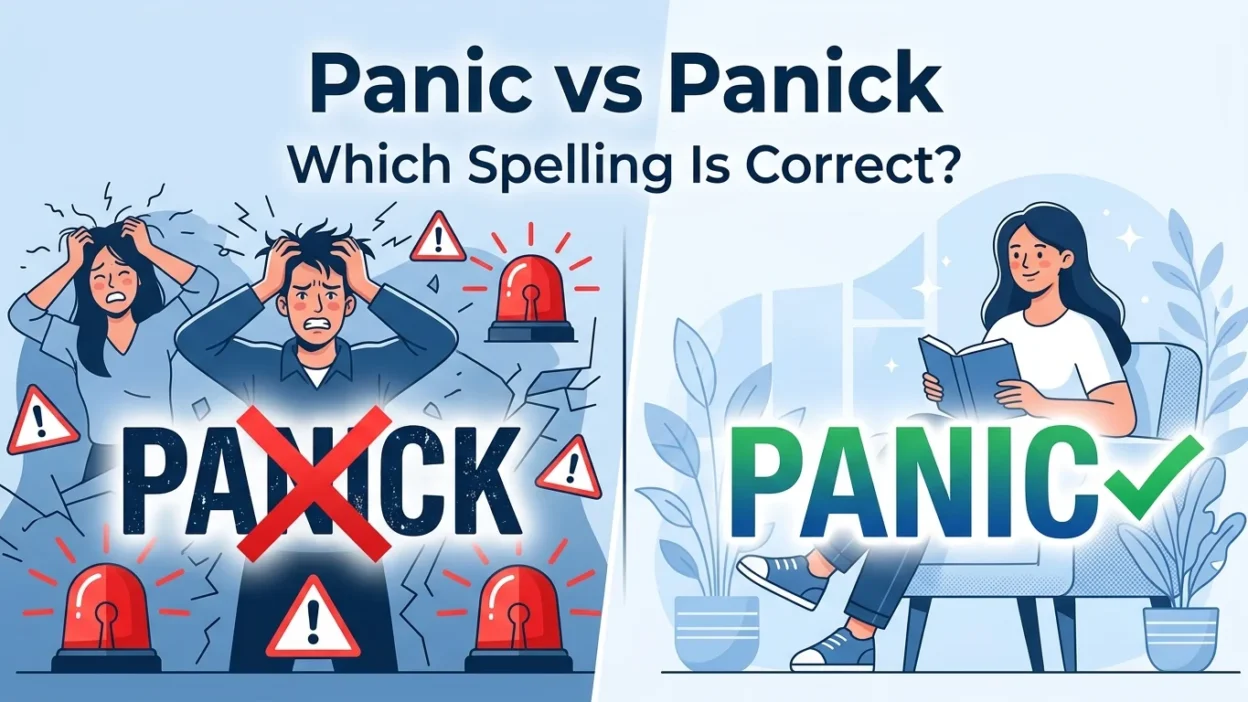
English spelling can be confusing, especially when words sound exactly the way they are spoken. One common mistake many people make is writing “panick” instead of “panic.” Since some English words end with “-ck,” it is understandable why this extra letter sometimes appears.
The correct spelling is “panic.” Meanwhile, “panick” is incorrect in standard English. Understanding the difference can help improve your grammar, spelling accuracy, and writing confidence in both professional and everyday communication.
Quick Answer
“Panic” is the correct spelling.
“Panick” is incorrect in standard English.
Correct Example
- Try not to panic during emergencies.
Incorrect Example
- Try not to panick during emergencies.
What Does Panic Mean?
“Panic” can function as both:
- a noun
- a verb
It refers to:
- sudden fear
- extreme anxiety
- loss of calm control
Examples of Panic in Sentences
- The loud noise caused panic in the crowd.
- She began to panic before the exam.
- Investors panicked during the market crash.
- There is no reason to panic.
- He stayed calm instead of panicking.
Is Panick a Real Word?
No, “panick” is not considered a correct English word.
It is simply a misspelling of:
- panic
Standard dictionaries and grammar guides only recognize:
- panic
Why Do People Write “Panick”?
The mistake usually happens because:
- many English words end with “-ck”
- pronunciation sounds strong at the end
- typing habits add an extra “k”
However, the correct spelling ends with:
- ic
Not:
- ick
Panic vs Panick Comparison Table
| Feature | Panic | Panick |
|---|---|---|
| Correct spelling | Yes | No |
| Standard English | Accepted | Incorrect |
| Dictionary word | Yes | No |
| Used professionally | Yes | No |
| Grammar approved | Yes | No |
Word Forms of Panic
| Form | Correct Word |
|---|---|
| Base word | panic |
| Present participle | panicking |
| Past tense | panicked |
| Noun | panic |
Notice that when adding:
- -ing
or - -ed
English adds:
- k
to maintain pronunciation.
Correct Word Formation
panic=panick
Why Does Panicking Add a K?
This grammar rule confuses many learners.
The base word is:
- panic
But when adding:
- -ing
or - -ed
English adds:
- k
Examples:
- panicking
- panicked
This keeps the hard “k” sound consistent.
Examples of Related Forms
| Base Word | Correct Form |
|---|---|
| panic | panicking |
| panic | panicked |
| mimic | mimicking |
| picnic | picnicking |
Common Mistakes With Panic
Adding “K” to the Base Word
Incorrect:
- Do not panick.
Correct:
- Do not panic.
Confusing Derived Forms
Some writers mistakenly assume:
- panick
must be correct because:
- panicking
contains:
- k
Fast Typing Errors
Quick typing often causes accidental extra letters.
Different Meanings of Panic
Emotional Fear
Example:
- He felt panic before speaking publicly.
Emergency Reactions
Example:
- People panicked during the storm warning.
Financial Panic
Example:
- Economic panic affected the markets.
Synonyms for Panic
Depending on context, similar words include:
- fear
- anxiety
- alarm
- terror
- distress
- hysteria
Example
- The sudden news caused fear and panic.
Opposites of Panic
Antonyms include:
- calm
- confidence
- composure
- relaxation
Example
- She remained calm instead of panicking.
American vs British English Differences
There is no spelling difference between American English and British English for this word.
Both use:
- panic
Neither standard variety uses:
- panick
Why Correct Spelling Matters
Correct spelling improves:
- professionalism
- readability
- communication clarity
- grammar accuracy
- writing confidence
Misspellings like “panick” may:
- distract readers
- reduce credibility
- appear careless
Common Phrases Using Panic
Panic Attack
Meaning: sudden intense anxiety or fear.
Example:
- She experienced a panic attack during the flight.
Panic Buying
Meaning: buying excessively due to fear.
Example:
- Panic buying emptied store shelves.
Panic Mode
Meaning: state of extreme stress or urgency.
Example:
- He entered panic mode before the deadline.
Mass Panic
Meaning: fear spreading through large groups.
Example:
- Rumors caused mass panic online.
Tips to Remember the Correct Spelling
Base Word Ends in IC
Correct:
- panic
Not:
- panick
K Appears Only in Added Forms
Examples:
- panicking
- panicked
But not:
- panick
Practice Full Sentences
Example:
- Try not to panic under pressure.
FAQs
Which spelling is correct: panic or panick?
“Panic” is the correct spelling.
Is panick a real word?
No. “Panick” is considered incorrect in standard English.
Why does panicking have a K?
English adds “k” before suffixes like “-ing” and “-ed” to preserve pronunciation.
What does panic mean?
It refers to sudden fear, anxiety, or loss of calm control.
Is panic used in British and American English?
Yes. Both varieties use “panic.”
What is the past tense of panic?
The past tense is:
- panicked
What are synonyms for panic?
Common synonyms include fear, alarm, anxiety, and terror.
How can I remember the spelling?
Remember:
- panic ends in “ic”
The “k” only appears in:
- panicking
- panicked
Final Summary
The difference between panic vs panick is straightforward once you understand the spelling rule. “Panic” is the correct and accepted English spelling, while “panick” is incorrect. Although derived forms like “panicking” and “panicked” include a “k,” the base word itself does not.
Whether you are writing essays, emails, articles, or professional communication, using “panic” correctly helps your writing appear polished, accurate, and trustworthy. Small spelling improvements like this can significantly strengthen communication clarity and professionalism.
Actionable Takeaway
Whenever using the base word, always write:
- panic
Not:
- panick
Remember that the extra “k” only appears in forms like:
- panicking
- panicked
Keeping this simple grammar rule in mind will help you avoid a common English spelling mistake.