If you’ve ever wondered if “sitting” or “seating” is the correct word, you’re not alone. These two words are related to the verb sit, but they have different meanings and uses.
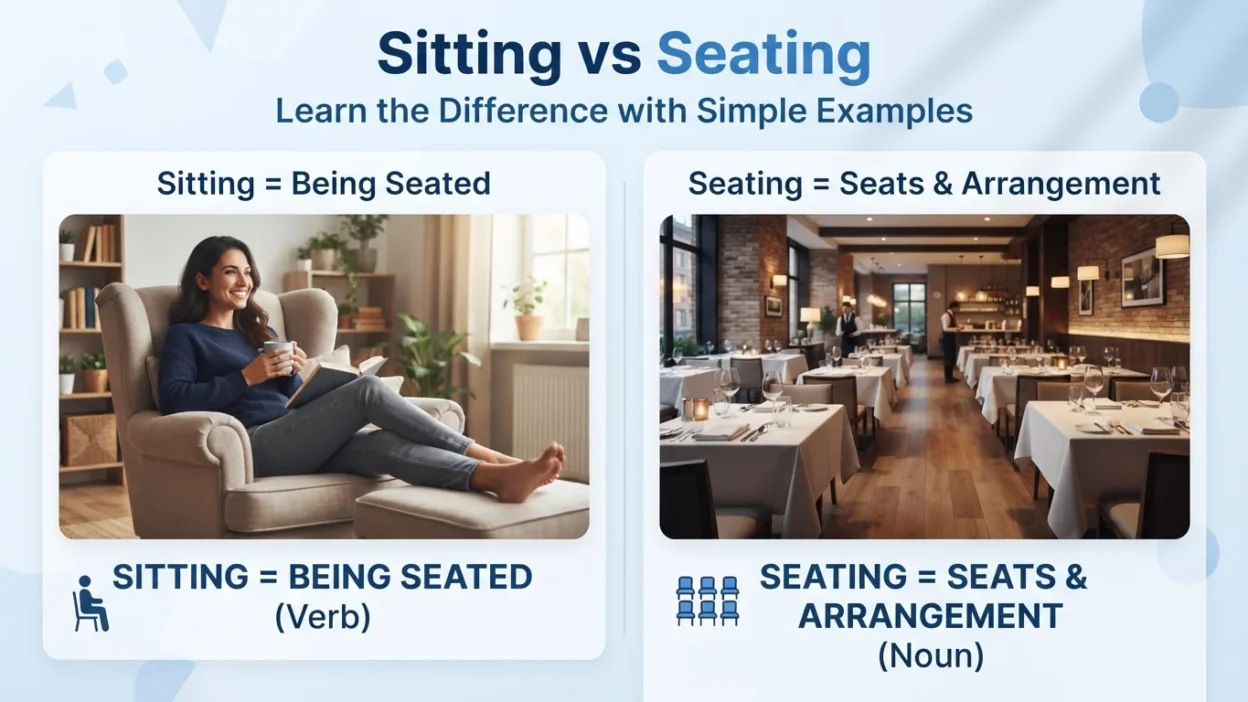
Sitting refers to the act of being seated or remaining in a seated position. Seating usually refers to chairs or places where people can sit, the arrangement of seats, or the act of providing someone with a seat.
Understanding the difference between sitting vs seating will help you use each word correctly in everyday English.
Quick Answer
- Sitting = The act of being seated or remaining seated. ✅
- Seating = Seats, seating arrangements, seating capacity, or the act of providing seats. ✅
Correct Examples
- She is sitting by the window.
- The restaurant has outdoor seating.
What Does “Sitting” Mean?
Sitting is the present participle and gerund of the verb sit.
It means:
- being in a seated position
- remaining seated
- the act of sitting
Examples of Sitting in Sentences
- He is sitting on the sofa.
- We spent the afternoon sitting by the lake.
- Sitting for long periods can cause back pain.
- She was sitting next to her friend.
- They are sitting quietly in the library.
What Does “Seating” Mean?
Seating is a noun and sometimes the present participle of the verb seat.
As a noun, it refers to:
- chairs or places where people sit
- the arrangement of seats
- the number of people a place can accommodate
As a verb, seating means placing someone in a seat.
Examples of Seating in Sentences
- The theatre has seating for 500 people.
- We prefer outdoor seating.
- The wedding seating chart was carefully planned.
- The host is seating guests at their tables.
- The stadium offers accessible seating.
Sitting vs Seating Comparison Table
| Feature | Sitting | Seating |
|---|---|---|
| Refers to being seated | ✅ Yes | ❌ No |
| Refers to chairs or places to sit | ❌ No | ✅ Yes |
| Refers to seat arrangements | ❌ No | ✅ Yes |
| Used for seating capacity | ❌ No | ✅ Yes |
| Standard English | ✅ Yes | ✅ Yes |
Word Comparison
When to Use Sitting
Use sitting when talking about:
- someone being seated
- remaining in a chair
- the action of sitting
Examples
- She is sitting near the front.
- We were sitting outside enjoying the if.
- Sitting all day isn’t good for your health.
- He spent hours sitting at his desk.
When to Use Seating
Use seating when referring to:
- available seats
- seating arrangements
- venue capacity
- placing people in seats
Examples
- The café offers indoor and outdoor seating.
- Reserved seating is available for VIP guests.
- The hall has seating for 1,000 people.
- Ushers were seating guests before the ceremony.
Common Mistakes
Using Seating Instead of Sitting
Incorrect:
- She is seating on the bench.
Correct:
- She is sitting on the bench.
Using Sitting Instead of Seating
Incorrect:
- The restaurant has outdoor sitting.
Correct:
- The restaurant has outdoor seating.
Common Phrases
Sitting
- sitting down
- sitting quietly
- sitting by the window
- sitting at a desk
- sitting position
Seating
- seating capacity
- seating arrangement
- reserved seating
- outdoor seating
- stadium seating
Synonyms
Synonyms for Sitting
- seated
- resting
- remaining seated
- occupying a seat
Synonyms for Seating
- seats
- accommodation
- sitting places
- seat allocation
- seat arrangement
American vs British English Differences
There is no significant difference between American and British English.
Both varieties use:
- sitting for the act of being seated.
- seating for seats, seating arrangements, or seating capacity.
Why Correct Word Choice Matters
Using the correct word helps you:
- improve grammar accuracy
- sound more natural
- communicate clearly
- avoid common English mistakes
Confusing sitting and seating can make a sentence sound awkward or incorrect.
Tips to Remember the Difference
Sitting = Person’s Action
If someone is doing the action of sitting, use sitting.
Example:
- He is sitting in the garden.
Seating = Seats or Arrangement
If you’re talking about chairs, capacity, or where people will sit, use seating.
Example:
- The concert offers premium seating.
Easy Memory Trick
- Sitting = Action
- Seating = Seats
(FAQs)
What is the difference between sitting and seating?
Sitting refers to being in a seated position, while seating refers to seats, seating arrangements, seating capacity, or placing people in seats.
Which is correct: “outdoor sitting” or “outdoor seating”?
The correct phrase is outdoor seating.
Can “seating” be used as a verb?
Yes. For example, The usher is seating guests means the usher is showing guests to their seats.
Is “sitting” a verb or a noun?
It can be both. It is the present participle of sit and can also function as a gerund (noun), as in Sitting for long hours can cause discomfort.
What is “seating capacity”?
Seating capacity is the maximum number of people a venue, vehicle, or room can accommodate.
Is there a difference between British and American English?
No. Both use sitting and seating in the same way.
How can I remember the difference?
Think:
- Sitting = Someone is sitting
- Seating = The seats themselves
Final Summary
The difference between sitting and seating is based on meaning and usage. Sitting describes the action or state of being seated, while seating refers to seats, seating arrangements, venue capacity, or placing people in seats.
Whenever you’re talking about a person’s position, use sitting. If you’re referring to chairs, capacity, or seat arrangements, use seating.
Actionable Takeaway
Use:
- sitting ✅ for the action or state of being seated.
- seating ✅ for seats, seating arrangements, or seating capacity.
Memory trick:
- Sitting = Action
- Seating = Seats