
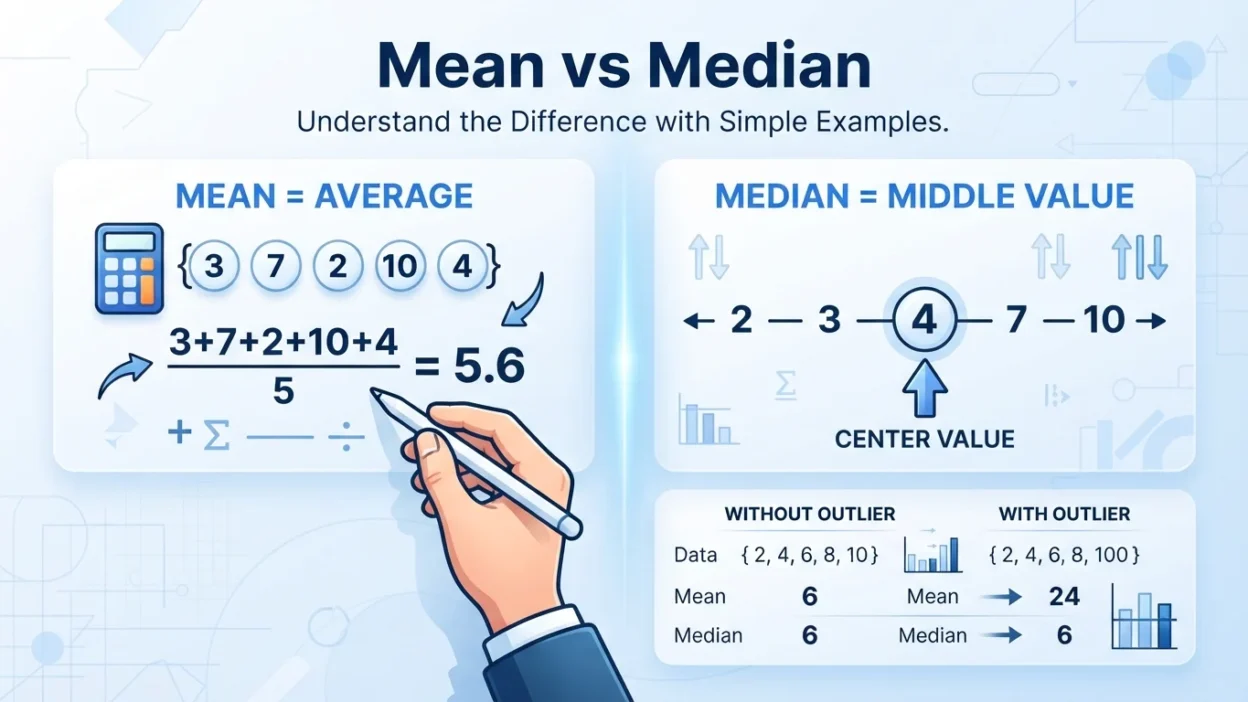
If you’ve ever wondered if “mean” or “median” is the correct measure of a dataset, you’re not alone. Both are measures of central tendency, but they are calculated differently and are useful in different situations.
Mean is the average of all values in a dataset, calculated by adding the values together and dividing by the number of values.
Median is the middle value when the data is arranged in numerical order. Understanding the difference between mean vs median helps you interpret statistics more accurately.
Quick Answer
- Mean = The arithmetic average of all values. ✅
- Median = The middle value in an ordered dataset. ✅
Correct Examples
Dataset: 2, 4, 6, 8, 10
- Mean = 6
- Median = 6
Dataset: 2, 4, 6, 8, 100
- Mean = 24
- Median = 6
The second example shows how an outlier (100) greatly affects the mean but not the median.
What Is the Mean?
The mean is the arithmetic average of a group of numbers.
To find it:
- Add all the values.
- Divide the total by the number of values.
Formula
Where:
- Σx = Sum of all values
- n = Number of values
Examples of Mean
Dataset:
10, 20, 30, 40, 50
Sum = 150
150 ÷ 5 = 30
So, the mean is 30.
What Is the Median?
The median is the middle value after arranging the numbers from smallest to largest.
Finding the Median
- If there is an odd number of values, choose the middle one.
- If there is an even number of values, average the two middle values.
Examples
Odd number of values:
3, 5, 7, 9, 11
Median = 7
Even number of values:
2, 4, 6, 8
Median = (4 + 6) ÷ 2 = 5
Mean vs Median Comparison Table
| Feature | Mean | Median |
|---|---|---|
| Definition | Average of all values | Middle value |
| Affected by outliers | ✅ Yes | ❌ No (or very little) |
| Requires all values | ✅ Yes | ✅ Yes |
| Best for symmetrical data | ✅ Yes | ✅ Can be used |
| Best for skewed data | ❌ Often not | ✅ Yes |
Word Comparison
When to Use the Mean
Use the mean when:
- the data has no extreme outliers
- values are fairly evenly distributed
- you need the mathematical average
Examples
- Average exam scores
- Average daily temperature
- Average monthly rainfall
- Average production output
When to Use the Median
Use the median when:
- the dataset contains outliers
- the data is skewed
- you want the middle value
Examples
- Household incomes
- House prices
- Property values
- Salaries in a company
Mean vs Median Example
Suppose five employees earn:
$30,000
$32,000
$35,000
$38,000
$500,000
Mean
(30,000 + 32,000 + 35,000 + 38,000 + 500,000) ÷ 5
= $127,000
Median
Middle value:
$35,000
The median better represents what a typical employee earns because the CEO’s salary is an outlier.
Common Mistakes
Assuming Mean and Median Are Always the Same
They are only equal in some datasets.
Ignoring Outliers
Extreme values can significantly change the mean, while the median usually remains stable.
Using the Wrong Measure
For skewed data like income or housing prices, the median often provides a more accurate picture.
Common Uses
Mean
- scientific research
- education
- engineering
- finance
- business analytics
Median
- real estate
- income statistics
- economics
- population studies
- demographic research
Related Statistical Terms
- Mode = Most frequently occurring value.
- Range = Difference between the highest and lowest values.
- Average = Often refers to the mean but may be used more generally.
Why Choosing the Right Measure Matters
Selecting the correct measure of central tendency helps you:
- interpret data accurately
- avoid misleading conclusions
- analyze trends effectively
- make better decisions
Using the mean when extreme values exist can produce a misleading result, whereas the median often better represents the typical value.
Tips to Remember the Difference
Mean = Mathematical Average
Think:
Add everything and divide.
Median = Middle Number
Think:
Arrange the numbers and find the center.
Easy Memory Trick
- Mean = Average
- Median = Middle
(FAQs)
What is the difference between mean and median?
The mean is the arithmetic average of all values, while the median is the middle value in an ordered dataset.
Which is better, mean or median?
Neither is always better. Use the mean for normally distributed data and the median for skewed data or datasets with outliers.
Why is the median less affected by outliers?
Because it depends only on the middle position, not on the size of the largest or smallest values.
Can the mean and median be the same?
Yes. In many symmetrical datasets, the mean and median are equal.
What is an outlier?
An outlier is a value that is much larger or smaller than the rest of the data.
Is the median always one of the numbers in the dataset?
Not always. When there is an even number of values, the median is the average of the two middle numbers and may not appear in the dataset.
Which measure is commonly used for income statistics?
The median is often preferred because very high incomes can distort the mean.
Final Summary
The difference between mean and median lies in how they summarize a dataset. The mean is the average of all values, while the median is the middle value after the numbers are sorted. The mean works best for balanced datasets, whereas the median is more reliable when outliers or skewed data are present.
Choosing the right measure ensures your statistical analysis is both accurate and meaningful.
Actionable Takeaway
Use:
- Mean ✅ when calculating the average of balanced data.
- Median ✅ when working with skewed data or outliers.
Memory trick:
- Mean = Average
- Median = Middle