If you’ve ever wondered if “proof” or “prove” is the correct word, you’re not alone. These two words are closely related, but they serve different grammatical functions.
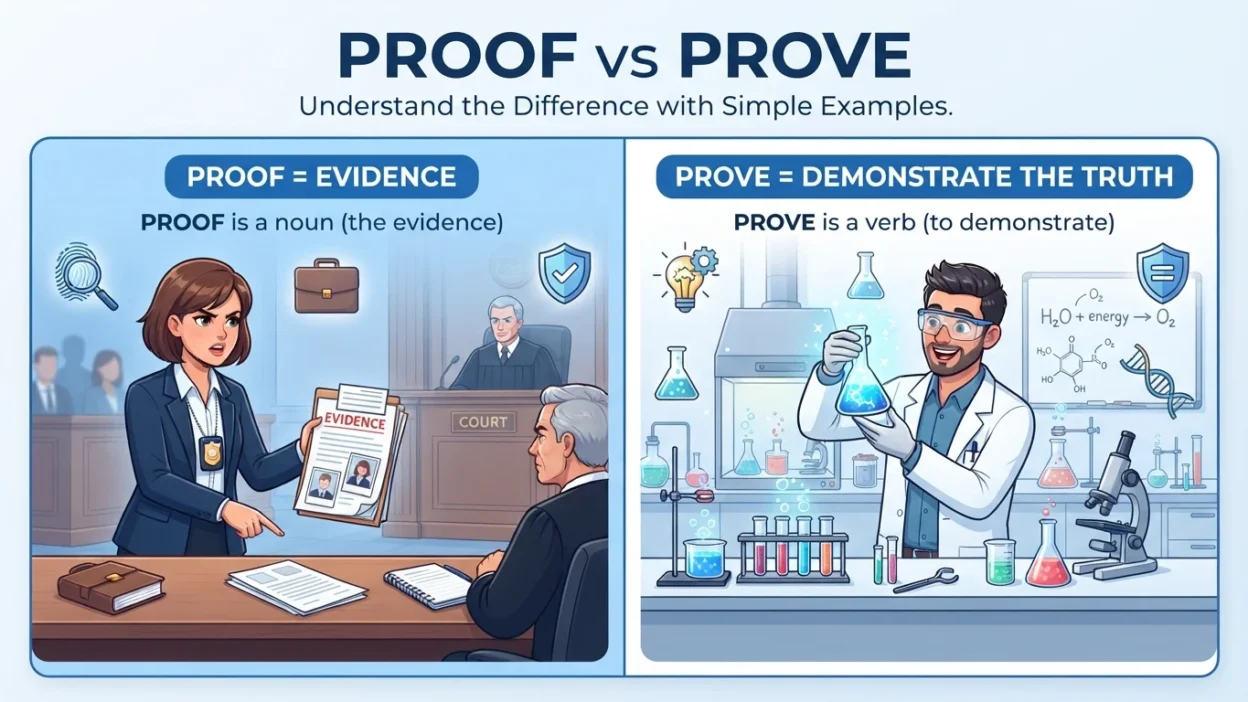
Prove is a verb that means to demonstrate that something is true or correct. Proof is a noun that refers to the evidence or facts that show something is true.
Understanding the difference between proof vs prove will help you use each word correctly in both everyday and professional English.
Quick Answer
- Prove = A verb meaning to demonstrate or establish that something is true. ✅
- Proof = A noun meaning evidence or facts that confirm something is true. ✅
Correct Examples
- Can you prove your claim?
- Do you have proof of your identity?
What Does “Prove” Mean?
Prove is a verb.
It means:
- to show something is true
- to establish a fact with evidence
- to demonstrate ability or worth
Examples of Prove in Sentences
- You must prove your identity before entering.
- She hopes to prove that her theory is correct.
- The scientist proved the hypothesis with experiments.
- Hard work can prove your dedication.
- He wanted to prove himself to the team.
What Does “Proof” Mean?
Proof is a noun.
It refers to:
- evidence
- documentation
- confirmation
- facts that establish truth
It can also refer to:
- a trial print of a document before publication (printing proof)
- the strength of alcoholic beverages (alcohol proof)
Examples of Proof in Sentences
- The police found proof of the crime.
- We need proof of address.
- Is there any proof that the treatment works?
- She showed proof of payment.
- The editor reviewed the final proof before printing.
Proof vs Prove Comparison Table
| Feature | Proof | Prove |
|---|---|---|
| Part of speech | Noun | Verb |
| Means evidence | ✅ Yes | ❌ No |
| Means demonstrate truth | ❌ No | ✅ Yes |
| Used as an action | ❌ No | ✅ Yes |
| Standard English | ✅ Yes | ✅ Yes |
Word Comparison
When to Use Prove
Use prove when describing the action of showing that something is true.
Examples
- The lawyer must prove the defendant’s guilt.
- Can you prove your statement?
- She worked hard to prove her skills.
- Scientific studies prove the effectiveness of the treatment.
When to Use Proof
Use proof when referring to the evidence itself.
Examples
- There isn’t enough proof to support the accusation.
- Please provide proof of purchase.
- His fingerprints were the proof investigators needed.
- We require proof of insurance.
Common Mistakes
Using Proof as a Verb
Incorrect:
- Can you proof that this happened?
Correct:
- Can you prove that this happened?
Using Prove as a Noun
Incorrect:
- I need prove of residency.
Correct:
- I need proof of residency.
Common Phrases
Prove
- prove a point
- prove your innocence
- prove yourself
- prove a theory
- prove beyond doubt
Proof
- proof of identity
- proof of purchase
- proof of address
- proof of concept
- burden of proof
Synonyms
Synonyms for Prove
- demonstrate
- establish
- verify
- confirm
- validate
Synonyms for Proof
- evidence
- confirmation
- verification
- documentation
- testimony
American vs British English Differences
There is no significant difference between American and British English.
Both varieties use:
- prove as the verb.
- proof as the noun.
Why Correct Word Choice Matters
Using the correct form helps you:
- improve grammar accuracy
- distinguish between actions and evidence
- communicate clearly
- write more professionally
Because proof and prove are closely related, they are often confused by English learners.
Tips to Remember the Difference
Prove = Action
If someone is doing the act of demonstrating something, use prove.
Example:
- She will prove her innocence.
Proof = Evidence
If you’re talking about the evidence that supports a claim, use proof.
Example:
- They presented proof in court.
Easy Memory Trick
- Prove = Verb (Action)
- Proof = Noun (Evidence)
(FAQs)
What is the difference between proof and prove?
Prove is a verb meaning to demonstrate that something is true. Proof is a noun referring to the evidence that confirms it.
Which is correct: “proof of identity” or “prove of identity”?
The correct phrase is proof of identity.
Can “proof” be used as a verb?
In standard English, proof is primarily a noun. However, in publishing, to proof means to check a document for errors (short for proofread). This is a specialized use.
What is the past tense of “prove”?
The past tense is proved. The past participle can be proved or proven, depending on the context and regional preference.
What does “burden of proof” mean?
It refers to the responsibility to provide enough evidence to support a claim, especially in legal contexts.
Is there a difference between British and American English?
No major difference. Both use proof and prove in the same way, although proven is more common as a past participle in American English.
How can I remember the difference?
Think:
- Prove = Action
- Proof = Evidence
Final Summary
The difference between proof and prove comes down to grammar. Prove is a verb that means to demonstrate or establish truth, while proof is a noun referring to the evidence that supports that truth.
Whenever you’re describing an action, use prove. When referring to evidence or documentation, use proof.
Actionable Takeaway
Use:
- prove ✅ as a verb meaning to demonstrate something is true.
- proof ✅ as a noun meaning evidence or confirmation.
Memory trick:
- Prove = Action
- Proof = Evidence