
If you’ve ever wondered whether “Segway” or “segue” is the correct word, you’re not alone. These two terms are often confused because they sound almost identical, but they have completely different meanings.
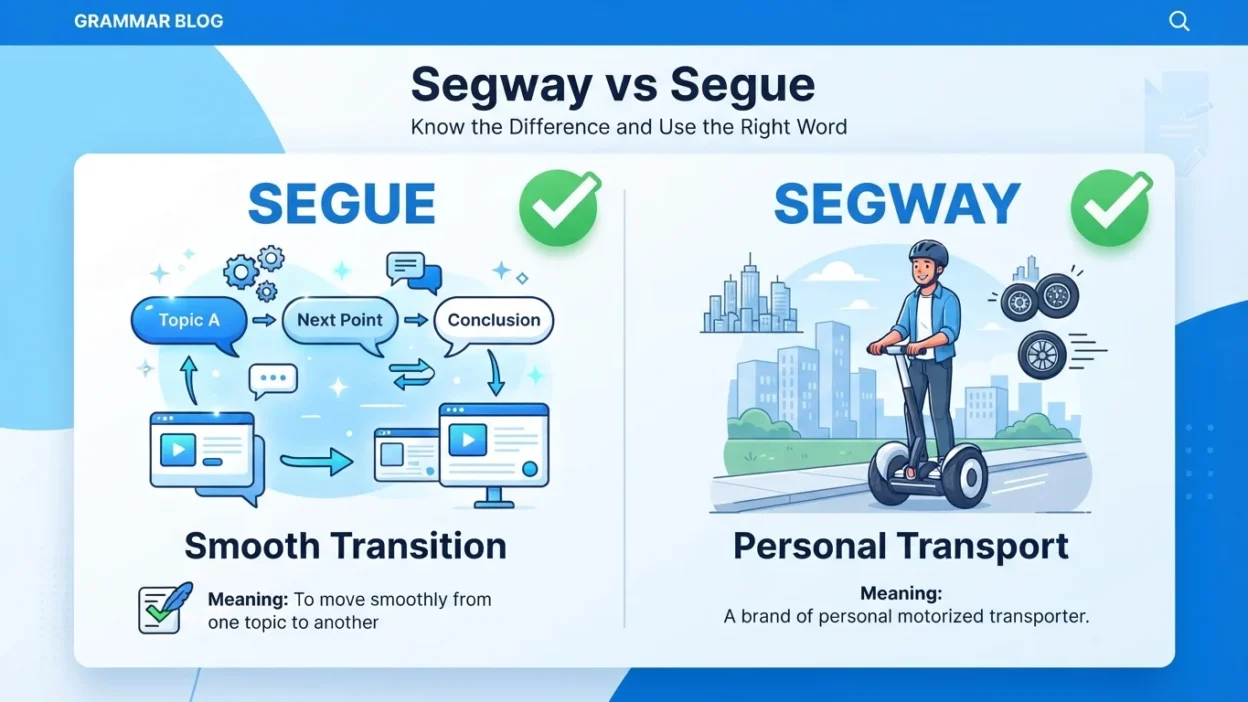
Segue is a common English word meaning a smooth transition from one topic, activity, or section to another, while Segway is a brand name for a self balancing personal transportation device.
If you’re talking about changing topics in conversation or writing, segue is the correct choice.
Quick Answer
- Segue = A smooth transition between ideas, topics, or sections.
- Segway = A trademarked personal transportation device.
Correct Examples
- Let me segue into the next topic.
- We explored the city on a Segway tour.
Incorrect Example
- Let me Segway into the next topic. ❌ (unless referring to the vehicle)
What Does “Segue” Mean?
Segue can be used as both a noun and a verb.
It means:
- a smooth transition
- to move naturally from one topic, idea, or activity to another without interruption
It is commonly used in:
- speeches
- presentations
- writing
- broadcasting
- conversations
Examples of Segue in Sentences
- The speaker smoothly segued into the next point.
- That story provides a perfect segue to our discussion.
- She used humor as a segue between topics.
- The documentary segues from history to modern life.
- Let’s segue into today’s final agenda item.
What Does “Segway” Mean?
Segway is a trademarked brand name for a two-wheeled, self-balancing electric personal transporter.
It refers only to the vehicle (or the company associated with it), not to a transition in speech or writing.
Examples of Segway in Sentences
- We rented Segways for the city tour.
- He learned to ride a Segway in a few minutes.
- The museum offers guided Segway tours.
- She purchased a Segway for commuting.
- Tourists enjoyed riding Segways along the waterfront.
Segway vs Segue Comparison Table
| Feature | Segway | Segue |
|---|---|---|
| Meaning | Personal transportation device | Smooth transition |
| Part of speech | Proper noun (brand name) | Noun and verb |
| Used in writing and speeches | ❌ No | ✅ Yes |
| Refers to a vehicle | ✅ Yes | ❌ No |
| Standard English | ✅ Yes | ✅ Yes |
Word Comparison
When to Use Segue
Use segue when referring to:
- transitions in writing
- moving between ideas
- connecting topics smoothly
- changing subjects naturally
Examples
- That question is a great segue into our next discussion.
- The presenter segued from research findings to recommendations.
- The article segues beautifully between sections.
When to Use Segway
Use Segway when referring to:
- the self-balancing scooter
- the brand
- tours using the vehicle
- personal transportation
Examples
- They booked a Segway tour.
- He rides a Segway to work.
- The park allows Segways on designated paths.
Common Mistakes
Using “Segway” Instead of “Segue”
Incorrect:
- Let’s Segway into the next chapter.
Correct:
- Let’s segue into the next chapter.
Capitalization
Segway is a trademark and should be capitalized when referring to the brand.
segue is a common English word and is normally written in lowercase unless it begins a sentence.
Common Phrases
Segue
- segue into
- smooth segue
- natural segue
- perfect segue
- seamless segue
Segway
- Segway tour
- ride a Segway
- Segway scooter
- Segway transportation
- Segway rental
Synonyms
Synonyms for Segue
- transition
- move into
- shift
- bridge
- connect
Synonyms for Segway
There is no true synonym because Segway is a brand name. Depending on the context, you could say:
- self-balancing scooter
- personal transporter
- electric transporter
American vs British English Differences
There is no significant difference.
Both American and British English use:
- segue for transitions.
- Segway for the personal transportation device.
Why Correct Word Choice Matters
Using the correct word helps:
- improve clarity
- avoid confusing readers
- strengthen professional writing
- demonstrate attention to detail
Using Segway when you mean segue is one of the most common spelling mistakes in modern English.
Tips to Remember the Difference
Segue = Smooth Transition
Think:
- Segue sounds like “go” you smoothly go from one idea to another.
Segway = Transportation
Think:
- Segway has “way”, which reminds you of traveling or finding your way.
Easy Memory Trick
- Segue = Transition
- Segway = Ride
(FAQs)
What is the difference between Segway and segue?
Segue means a smooth transition between ideas or topics, while Segway is a brand of self-balancing electric vehicle.
Which is correct: “segue into” or “Segway into”?
The correct phrase is segue into.
Is Segway a real word?
Yes. It is a registered trademark for a personal transportation device.
Can “segue” be used as a verb?
Yes. For example:
- The speaker segued into the next topic.
Why do people confuse Segway and segue?
They are pronounced almost the same, making them easy to confuse in writing.
Is “Segway into the next topic” ever correct?
No. Unless you literally ride a Segway into the next topic, the correct word is segue.
Is there a difference between British and American English?
No. Both varieties use segue and Segway in the same way.
How can I remember the difference?
Think:
- Segue = Transition
- Segway = Ride
Final Summary
The difference between Segway vs segue is simple. Segue is the correct word for a smooth transition between ideas, while Segway is a trademarked name for a self balancing personal transportation device.
If you’re writing or speaking about moving from one topic to another, always use segue.
Actionable Takeaway
Use:
- segue ✅ for transitions in writing, speaking, or presentations.
- Segway ✅ only when referring to the personal transportation device.
Memory trick:
- Segue = Transition
- Segway = Ride