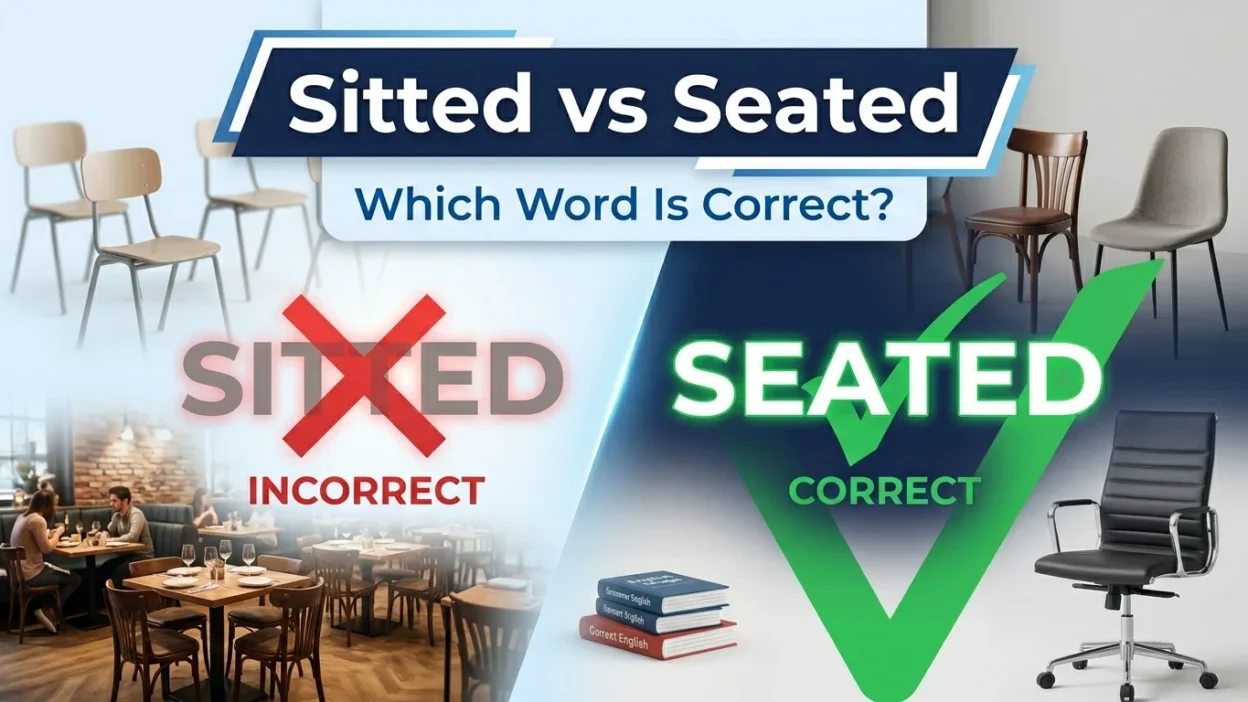
If you’ve ever wondered whether “sitted” or “seated” is the correct word, you’re not alone. Many English learners and writers become confused because the verb sit has irregular forms, and it can be tempting to assume that sitted follows the same pattern as regular verbs like started or walked.
The simple answer is that “seated” is the correct word in most situations, while “sitted” is generally considered nonstandard in modern English. Understanding the difference can help you write and speak more naturally.
Quick Answer
“Seated” is the correct and commonly used word.
“Sitted” is generally considered incorrect or nonstandard in modern English.
Correct Example
- The guests were seated near the stage.
Incorrect Example
- The guests were sitted near the stage.
What Does Seated Mean?
Seated is the past participle of seat, meaning:
- placed in a sitting position
- sitting in a particular location
- assigned a seat
It is commonly used in both formal and everyday English.
Examples of Seated in Sentences
- The audience was seated before the show began.
- She was seated next to her friend.
- The guests were seated at their tables.
- He remained seated throughout the meeting.
- We were seated near the window.
Is Sitted a Real Word?
Sitted has appeared in some dialects, historical texts, and regional varieties of English. However, it is generally not accepted in standard modern English.
Instead, English uses the irregular forms of sit:
| Verb Form | Correct Form |
|---|---|
| Base Form | Sit |
| Past Tense | Sat |
| Past Participle | Sat |
Examples:
- I sit here every day.
- I sat here yesterday.
- I have sat here before.
Not:
- I sitted here yesterday.
Why Do People Say “Sitted”?
The confusion occurs because many English verbs form their past tense by adding -ed.
Examples:
- walk → walked
- start → started
- clean → cleaned
Some people incorrectly assume:
- sit → sitted
However, sit is an irregular verb.
The correct past tense is:
- sat
Sitted vs Seated Comparison Table
| Feature | Seated | Sitted |
|---|---|---|
| Standard English | Yes | No |
| Common modern usage | Yes | Rarely |
| Professional writing | Yes | No |
| Dictionary accepted | Yes | Limited |
| Recommended choice | Yes | No |
Related Verb Forms
Sit vs Seat
Part of the confusion comes from the difference between sit and seat.
Sit
Means to rest in a sitting position.
Example:
- She sat on the chair.
Seat
Means to place someone in a seat.
Example:
- The host seated the guests.
Past Participle
Example:
- The guests were seated near the entrance.
Common Mistakes With Sitted and Seated
Using Sitted as the Past Tense
Incorrect:
- He sitted beside me.
Correct:
- He sat beside me.
Using Sitted Instead of Seated
Incorrect:
- We were sitted at the front table.
Correct:
- We were seated at the front table.
Confusing Sit and Seat
Incorrect:
- The waiter sat us at a table.
More natural:
- The waiter seated us at a table.
Different Uses of Seated
Restaurants
Example:
- We were seated immediately after arriving.
Events
Example:
- All attendees were seated before the presentation.
Transportation
Example:
- Passengers remained seated during takeoff.
Meetings
Example:
- She was seated beside the manager.
Common Phrases Using Seated
Be Seated
Meaning: take a seat or remain sitting.
Example:
- Please be seated.
Seated Near
Meaning: sitting close to someone or something.
Example:
- They were seated near the stage.
Seated Arrangement
Meaning: an organized seating plan.
Example:
- The wedding had a formal seated arrangement.
Seated Position
Meaning: the act of being in a chair or seat.
Example:
- Remain in a seated position.
Synonyms for Seated
Depending on context, similar words include:
- sitting
- positioned
- settled
- placed
- stationed
Example
- The guests were seated and settled comfortably.
Opposites of Seated
Antonyms may include:
- standing
- upright
- rising
- walking
Example
- Most people were standing rather than seated.
American vs British English Differences
Both American and British English generally use:
- seated
- sat
Neither variety commonly uses:
- sitted
Why Correct Usage Matters
Using the correct form improves:
- grammar accuracy
- professionalism
- readability
- communication clarity
- credibility
Using sitted in formal writing may:
- sound unnatural
- distract readers
- appear grammatically incorrect
Tips to Remember the Correct Word
Memorize the Irregular Verb
Remember:
- sit
- sat
- sat
Use Seated for Placement
Example:
- The guests were seated.
Avoid Adding “-ed” to Sit
Incorrect:
- sitted
Correct:
- sat
or
- seated
depending on the sentence.
FAQs
Which is correct: sitted or seated?
Seated is the correct and widely accepted form.
Is sitted a real word?
It exists in some dialects and historical usage but is generally considered nonstandard in modern English.
What is the past tense of sit?
The past tense is:
- sat
What is the past participle of sit?
The past participle is:
- sat
When should I use seated?
Use seated when referring to someone being placed or positioned in a seat.
Is “I sitted down” correct?
No. The correct form is:
- I sat down.
Do British and American English use sitted?
No. Both generally prefer sat and seated.
How can I remember the correct form?
Think:
- sit → sat → sat
Not:
- sit → sitted
Final Summary
The difference between sitted vs seated is straightforward. “Seated” is the standard and widely accepted word used when someone is placed in a seat or remains sitting. “Sitted” is generally considered nonstandard and should be avoided in modern English writing and speech.
When talking about the verb sit, remember that it is irregular:
- sit → sat → sat
And when describing someone in a seat, use:
- seated
Doing so will make your writing sound natural, polished, and grammatically correct.
Actionable Takeaway
Use:
- sat for the past tense of sit
- seated when referring to someone being placed in a seat
Avoid:
- sitted
A simple memory trick:
- sit → sat → sat
- guests are seated
Keeping these forms in mind will help you avoid a common English grammar mistake.