If you’ve ever typed “compair” instead of “compare,” you’re not alone. This is a common spelling mistake because the words sound similar, and the pronunciation can make it seem as though both spellings are acceptable.
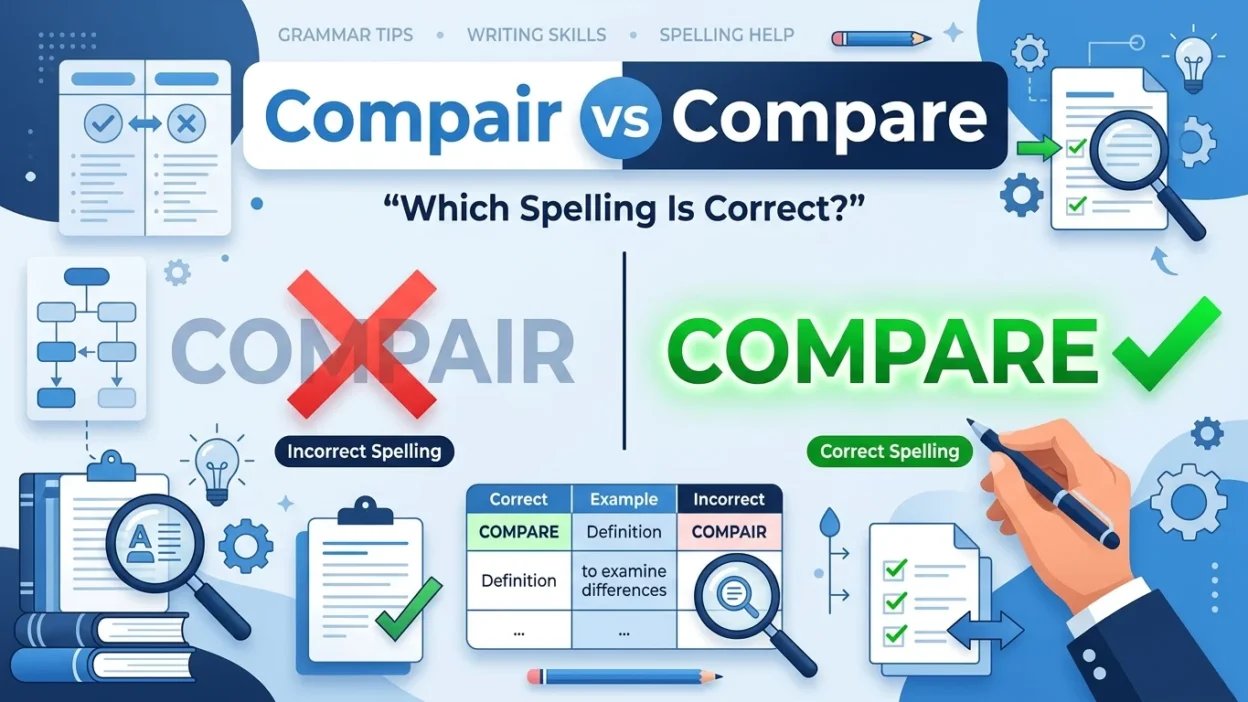
The correct spelling is “compare.” “Compair” is not a recognized English word and should be avoided in formal, academic, and everyday writing. Knowing the correct spelling will help you communicate more clearly and professionally.
Quick Answer
“Compare” is the correct spelling.
“Compair” is incorrect in standard English.
Correct Example
- Please compare the two reports before making a decision.
Incorrect Example
- Please compair the two reports before making a decision.
What Does Compare Mean?
Compare is a verb that means:
- to examine two or more things to identify similarities and differences
- to evaluate one thing against another
- to describe one thing as being similar to another
It is widely used in education, business, science, and everyday conversation.
Examples of Compare in Sentences
- Compare the prices before buying.
- Teachers often compare students’ progress.
- It is difficult to compare the two paintings.
- Scientists compare data from different experiments.
- You should compare several options before choosing one.
Is Compair a Real Word?
No, “compair” is not a standard English word.
It is simply a misspelling of:
- compare
Standard dictionaries recognize:
- compare
Not:
- compair
Why Do People Write “Compair”?
The mistake usually happens because:
- compare and pair sound similar
- pronunciation can be misleading
- fast typing leads to letter substitutions
- writers spell the word the way they hear it
Despite the pronunciation, the correct spelling always ends with:
- -pare
Compair vs Compare Comparison Table
| Feature | Compare | Compair |
|---|---|---|
| Correct spelling | Yes | No |
| Standard English word | Yes | No |
| Dictionary approved | Yes | No |
| Professional writing | Yes | No |
| Grammar accepted | Yes | No |
Correct Word Structure
Common Mistakes With Compare
Replacing “-pare” With “-pair”
Incorrect:
- Let’s compair the results.
Correct:
- Let’s compare the results.
Spelling by Sound
Many people spell the word according to its pronunciation rather than its correct spelling.
Typing Too Quickly
Keyboard slips can easily produce compair instead of compare.
Different Uses of Compare
Education
Example:
- Compare the two poems.
Shopping
Example:
- Always compare prices before purchasing.
Business
Example:
- Investors compare company performance each year.
Science
Example:
- Researchers compare the findings from multiple studies.
Common Phrases Using Compare
Compare and Contrast
Meaning: identify similarities and differences.
Example:
- The assignment asks students to compare and contrast two novels.
Compare Notes
Meaning: share information or experiences.
Example:
- After the meeting, the team compared notes.
Compare Prices
Meaning: check costs from different sellers.
Example:
- Compare prices before making a purchase.
Compare With
Meaning: examine one thing alongside another.
Example:
- Compare this year’s results with last year’s.
Synonyms for Compare
Depending on context, similar words include:
- examine
- evaluate
- contrast
- assess
- measure
Example
- We compared and evaluated every option.
Opposites of Compare
Antonyms may include:
- ignore
- separate
- distinguish
- overlook
- disregard
Example
- Instead of comparing the products, he ignored the differences.
American vs British English Differences
There is no spelling difference between American and British English.
Both use:
- compare
Neither uses:
- compair
Why Correct Spelling Matters
Using the correct spelling improves:
- professionalism
- readability
- credibility
- communication clarity
- writing quality
Misspellings like compair can:
- distract readers
- reduce confidence in your writing
- appear careless
Tips to Remember the Correct Spelling
Think of “Prepare”
Both words end with:
- -pare
Examples:
- prepare
- compare
Remember the Ending
Correct:
- compare
Not:
- compair
Practice Full Sentences
Example:
- Compare the features before deciding.
FAQs About Compair vs Compare
Which spelling is correct: compair or compare?
Compare is the correct spelling.
Is compair a real word?
No. It is considered a spelling mistake.
What does compare mean?
It means to examine two or more things to identify similarities and differences.
Why do people write compair?
Usually because they spell the word based on its pronunciation.
Is compare used in British and American English?
Yes. Both varieties use compare.
What does compare and contrast mean?
It means to identify both similarities and differences between two or more things.
Is compare a verb?
Yes. Compare is a verb.
How can I remember the correct spelling?
Think of prepare and compare both end with -pare.
Final Summary
The difference between compair vs compare is straightforward. “Compare” is the correct English spelling and is used when examining similarities and differences between people, objects, ideas, or situations. “Compair” is not a recognized English word and should be avoided in all types of writing.
Whether you’re comparing products, prices, research findings, or opinions, using compare correctly will make your writing more accurate, professional, and credible.
Actionable Takeaway
Whenever you mean to examine similarities or differences, always write:
- compare ✅
Never write:
- compair ❌
A simple memory trick:
- Prepare and compare both end with -pare.
Remembering this pattern will help you spell compare correctly every time.