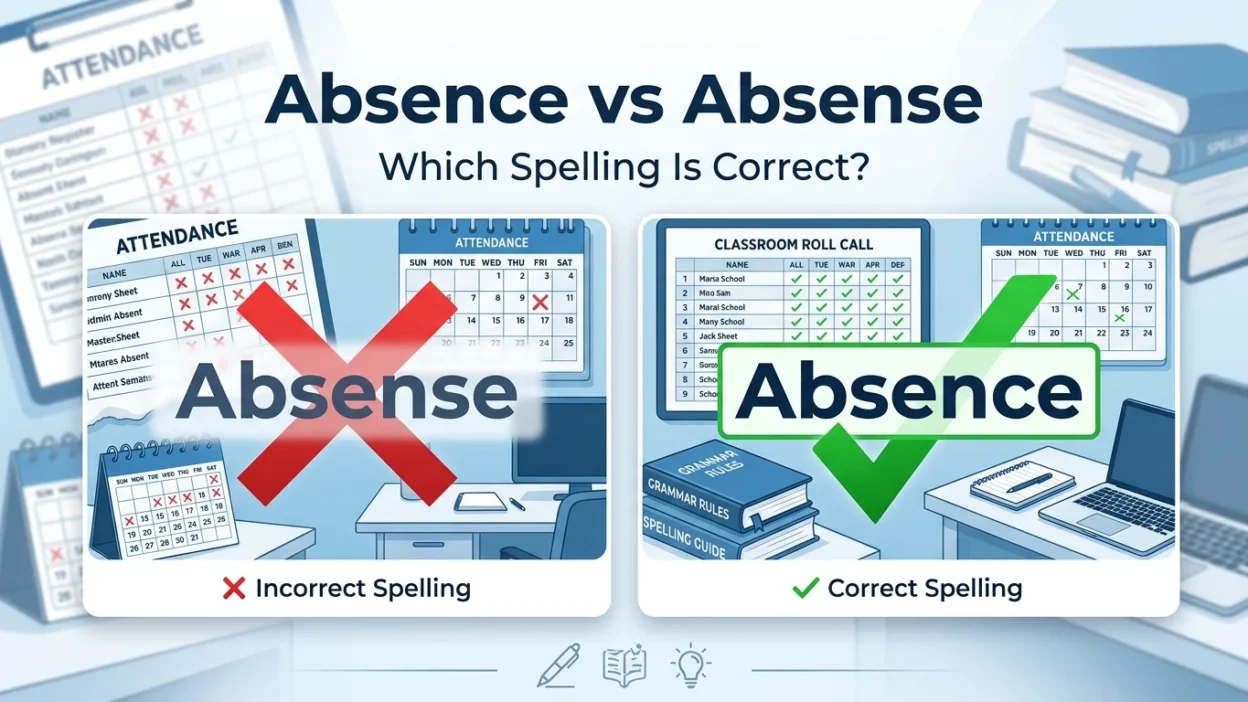
If you’ve ever typed “absense” and wondered whether it should be “absence,” you’re not alone. This is a frequent spelling mistake because the ending sounds similar to many English words that use -sense. However, only one spelling is correct in standard English.
The correct word is “absence.” The spelling “absense” is a common error and should be avoided in academic, professional, and everyday writing. Understanding the difference can help you communicate more clearly and confidently.
Quick Answer
“Absence” is the correct spelling.
“Absense” is incorrect in standard English.
Correct Example
- Her absence was noticed during the meeting.
Incorrect Example
- Her absense was noticed during the meeting.
What Does Absence Mean?
Absence is a noun that means:
- the state of being away
- a lack of presence
- a failure to attend
- the nonexistence of something expected
It is commonly used in schools, workplaces, healthcare, and everyday conversations.
Examples of Absence in Sentences
- His absence from work was unexpected.
- The teacher noted her absence in the attendance register.
- We felt the absence of leadership during the crisis.
- Her absence was explained by illness.
- The absence of evidence does not prove anything.
Is Absense a Real Word?
No, “absense” is not a recognized English word.
Standard dictionaries accept:
- absence
Not:
- absense
If you’re referring to someone being away or something missing, the correct spelling is always:
- absence
Why Do People Write “Absense”?
This mistake usually occurs because of pronunciation and spelling patterns.
Reasons include:
- confusion with words ending in -sense
- typing errors
- spelling based on sound rather than memorization
Although absence and sense sound somewhat similar, they are unrelated words and have different spellings.
Absence vs Absense Comparison Table
| Feature | Absence | Absense |
|---|---|---|
| Correct spelling | Yes | No |
| Standard English word | Yes | No |
| Dictionary approved | Yes | No |
| Professional writing | Yes | No |
| Grammar accepted | Yes | No |
Correct Word Structure
Common Mistakes With Absence
Replacing “C” With “S”
Incorrect:
- Her absense was recorded.
Correct:
- Her absence was recorded.
Spelling by Pronunciation
Many writers spell the word the way it sounds rather than following the correct spelling pattern.
Fast Typing Errors
The letters c and s are often confused when typing quickly.
Different Uses of Absence
School Attendance
Example:
- The student’s absence was excused.
Workplace
Example:
- Frequent absence can affect productivity.
Legal Context
Example:
- The case proceeded in his absence.
Emotional Context
Example:
- The absence of support was disappointing.
Common Phrases Using Absence
In the Absence Of
Meaning: without someone or something being present.
Example:
- In the absence of the manager, the assistant took charge.
Absence From Work
Meaning: not attending work.
Example:
- His absence from work lasted a week.
Leave of Absence
Meaning: approved time away from work or study.
Example:
- She requested a leave of absence.
Notable Absence
Meaning: a missing person or thing that is easily noticed.
Example:
- His notable absence raised questions.
Synonyms for Absence
Depending on context, similar words include:
- nonattendance
- unavailability
- lack
- omission
- vacancy
Example
- Her absence and nonattendance were both documented.
Opposites of Absence
Antonyms include:
- presence
- attendance
- participation
- availability
- existence
Example
- His presence was appreciated after a long absence.
American vs British English Differences
There is no spelling difference between American and British English.
Both use:
- absence
Neither uses:
- absense
Why Correct Spelling Matters
Using the correct spelling improves:
- professionalism
- readability
- credibility
- communication clarity
- writing quality
Misspellings like absense can:
- distract readers
- appear careless
- reduce confidence in your writing
Tips to Remember the Correct Spelling
Remember the “C”
Correct:
- absence
Not:
- absense
Associate It With Similar Words
Examples:
- presence
- innocence
- patience
- absence
Practice Full Sentences
Example:
- Her absence was noted immediately.
FAQs
Which spelling is correct: absence or absense?
Absence is the correct spelling.
Is absense a real word?
No. It is considered a spelling mistake in standard English.
What does absence mean?
It means the state of being away or not present.
Why do people write absense?
Usually because the ending sounds similar to words containing -sense.
Is absence used in British and American English?
Yes. Both varieties use absence.
What is a leave of absence?
It is approved time away from work, school, or another responsibility.
What is the opposite of absence?
The opposite is presence.
How can I remember the correct spelling?
Remember that absence contains the letter c, just like presence.
Final Summary
The difference between absence vs absense is simple. “Absence” is the correct spelling used to describe the state of being away, missing, or not present. “Absense” is a common spelling mistake and is not recognized in standard English.
Whether you’re writing emails, reports, academic papers, or everyday messages, using absence correctly helps your writing appear accurate, professional, and trustworthy.
Actionable Takeaway
Whenever you mean the state of being away or not present, always write:
- absence ✅
Never write:
- absense ❌
A simple memory trick:
- absence and presence both contain the letter c.
Remembering this connection can help you avoid the mistake every time.