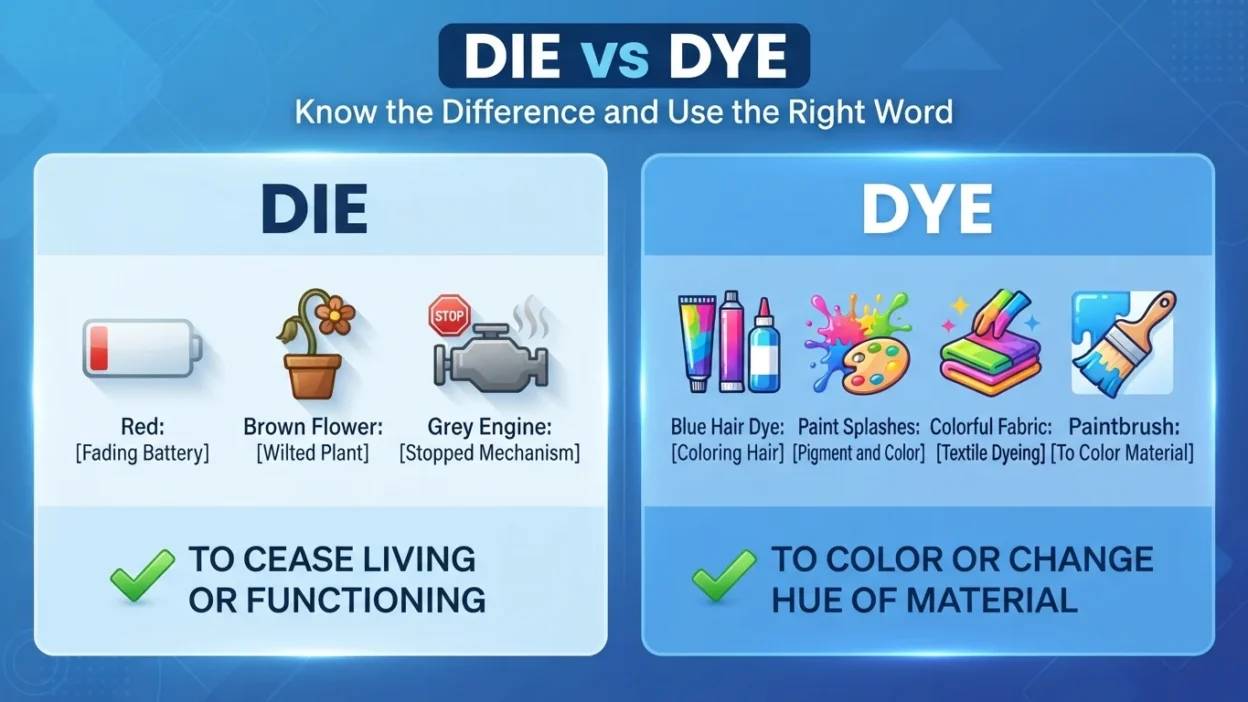
If you’ve ever wondered whether “die” or “dye” is the correct word, you’re not alone. These two words are homophones, meaning they sound the same but have entirely different meanings and spellings.
Die generally refers to death or stopping functioning, while dye refers to a substance used to change the color of something or the act of coloring. Knowing when to use die vs dye will help you avoid one of the most common spelling mistakes in English.
Quick Answer
- Die = To stop living or stop functioning.
- Dye = A coloring substance or the act of coloring something.
Correct Examples
- Plants can die without water.
- She decided to dye her hair blonde.
What Does Die Mean?
Die is primarily a verb that means:
- to stop living
- to cease functioning
- to come to an end
It can also be a noun in manufacturing, referring to a tool used for cutting or shaping materials, though this meaning is less common.
Examples of Die in Sentences
- Flowers die without sunlight.
- His phone battery is about to die.
- Many traditions never die.
- The engine suddenly died.
- I don’t want my plants to die.
What Does Dye Mean?
Dye can be a noun or a verb.
As a noun, it means a substance used to color fabric, hair, or other materials.
As a verb, it means to apply color to something.
Examples of Dye in Sentences
- She used blue dye to color the fabric.
- I’m going to dye my hair brown.
- They dyed the curtains green.
- Natural dye is made from plants.
- The artist experimented with fabric dye.
Die vs Dye Comparison Table
| Feature | Die | Dye |
|---|---|---|
| Meaning | Stop living or functioning | Color something |
| Part of speech | Verb (also noun in manufacturing) | Noun and verb |
| Related to death | Yes | No |
| Related to color | No | Yes |
| Standard English | Yes | Yes |
Word Comparison
When to Use Die
Use die when talking about:
- living things stopping life
- machines stopping work
- endings or disappearance
Examples
- The flowers will die without water.
- My laptop might die soon.
- Old customs sometimes die out.
When to Use Dye
Use dye when talking about:
- changing color
- hair coloring
- fabric coloring
- pigments and coloring substances
Examples
- She dyed her hair red.
- The shirt was dyed black.
- This fabric absorbs dye easily.
Common Mistakes
Using Die Instead of Dye
Incorrect:
- I’m going to die my hair.
Correct:
- I’m going to dye my hair.
Using Dye Instead of Die
Incorrect:
- Fish can dye without clean water.
Correct:
- Fish can die without clean water.
Common Phrases
Die
- die out
- die down
- die hard
- die young
- never say die
Dye
- hair dye
- fabric dye
- natural dye
- tie-dye
- dye your hair
Synonyms
Synonyms for Die
- perish
- expire
- pass away
- cease
- end
Synonyms for Dye
- color
- tint
- stain
- pigment
- colorize
American vs British English Differences
There is no spelling difference.
Both American and British English use:
- die
- dye
The meanings and spellings are identical in both varieties.
Why Correct Word Choice Matters
Using the correct word helps:
- improve readability
- prevent confusion
- strengthen professionalism
- communicate accurately
- avoid embarrassing mistakes
For example:
- I want to dye my hair. ✅
- I want to die my hair. ❌
The incorrect version completely changes the meaning.
Tips to Remember the Difference
Die = Death
Both die and death relate to life ending.
Think:
- Die = Death
Dye = Color
The letter Y in dye can remind you of colorful yellow.
Think:
- Dye = Yellow = Color
Practice With Sentences
- The battery will die soon.
- I’m going to dye my hair this weekend.
(FAQs)
What is the difference between die and dye?
Die means to stop living or functioning, while dye means to color something.
Which is correct: die your hair or dye your hair?
Dye your hair is correct.
Is dye a noun or a verb?
It can be both. It refers to a coloring substance and the act of coloring.
Can die be used for machines?
Yes. For example:
- My phone died.
Is die only used for people?
No. It can describe animals, plants, batteries, engines, traditions, and more.
Are die and dye pronounced the same?
Yes. They are homophones.
Is there a spelling difference in British and American English?
No. Both varieties use the same spellings.
How can I remember the difference?
Think:
- Die = Death
- Dye = Dye your hair
Final Summary
The difference between die vs dye is simple. Die refers to stopping life or functioning, while dye refers to coloring hair, fabric, or other materials. Although they sound the same, they have completely different meanings.
Using the correct spelling ensures your writing is clear, professional, and free from confusing mistakes.
Actionable Takeaway
Whenever you mean to stop living or functioning, use:
- die ✅
Whenever you mean to color something, use:
- dye ✅
Memory trick:
- Die = Death
- Dye = Color your hair