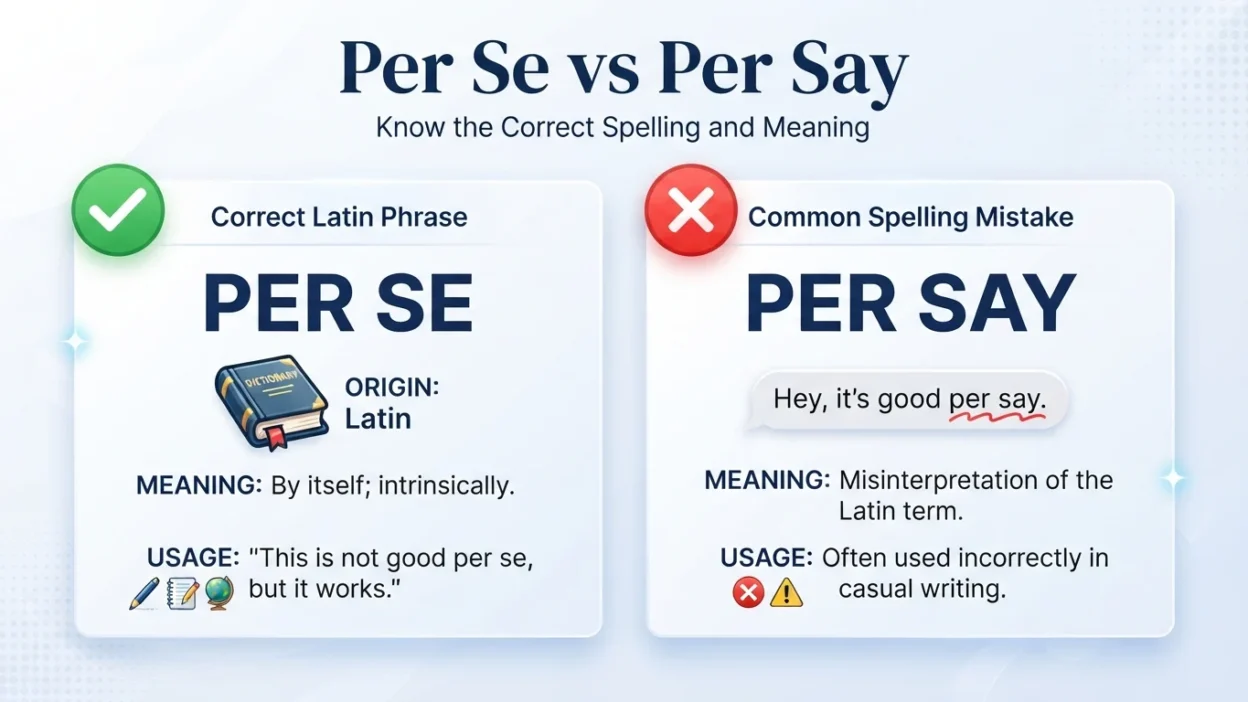
If you’ve ever wondered whether “per se” or “per say” is the correct phrase, you’re not alone. Because the two sound identical, many people mistakenly write “per say.” However, only per se is correct.
Per se is a Latin phrase meaning “by itself,” “intrinsically,” or “in and of itself.” Per say is simply a misspelling and is not recognized as standard English.
Quick Answer
- Per se = Correct; means by itself or in itself.
- Per say = Incorrect spelling.
Correct Examples
- The idea isn’t bad per se, but it needs more research.
- Money isn’t evil per se.
Incorrect Example
- The idea isn’t bad per say. ❌
What Does “Per Se” Mean?
Per se is a Latin expression used in English to mean:
- by itself
- in itself
- inherently
- intrinsically
It emphasizes that something is being considered on its own, rather than in a broader context.
Examples of Per Se in Sentences
- The movie wasn’t boring per se; it was just too long.
- Coffee isn’t unhealthy per se, but too much caffeine can be harmful.
- The policy isn’t unfair per se.
- Success isn’t about money per se.
- His comments weren’t offensive per se, but they were insensitive.
Why Is “Per Say” Incorrect?
Per say is a common spelling mistake caused by pronunciation.
There is no English phrase spelled per say.
Always write:
- per se ✅
Never write:
- per say ❌
Per Se vs Per Say Comparison Table
| Feature | Per Se | Per Say |
|---|---|---|
| Correct spelling | ✅ Yes | ❌ No |
| Standard English | ✅ Yes | ❌ No |
| Means “by itself” | ✅ Yes | ❌ No |
| Found in dictionaries | ✅ Yes | ❌ No |
| Suitable for formal writing | ✅ Yes | ❌ No |
Word Comparison
When to Use Per Se
Use per se when you mean:
- in itself
- by itself
- inherently
- considered alone
Examples
- The technology isn’t dangerous per se.
- The problem isn’t the software per se.
- Exercise isn’t difficult per se; consistency is the challenge.
Common Mistakes
Spelling It as “Per Say”
Incorrect:
- It’s not wrong per say.
Correct:
- It’s not wrong per se.
Overusing Per Se
Although per se is useful, avoid using it too often in casual writing. Simpler alternatives like in itself or necessarily may sound more natural depending on the context.
Common Phrases
- not bad per se
- not wrong per se
- not illegal per se
- not harmful per se
- not difficult per se
Synonyms
Synonyms for Per Se
- in itself
- inherently
- intrinsically
- by itself
- essentially
American vs British English Differences
There is no significant difference.
Both American and British English use per se in the same way, and per say is considered incorrect in both.
Why Correct Spelling Matters
Using the correct phrase helps:
- improve credibility
- avoid common spelling mistakes
- strengthen professional writing
- demonstrate a solid understanding of English usage
Because per se is a borrowed Latin phrase, it should always be written as two separate words.
Tips to Remember the Difference
Per Se = Standard Phrase
Remember that per se is the original Latin expression.
Per Say = Sounds Right, But Isn’t
Many people write per say because that’s how per se is pronounced, but the spelling is incorrect.
Easy Memory Trick
- Se = Standard
- Say = Spelling mistake
(FAQs)
Which is correct: per se or per say?
Per se is the correct spelling. Per say is a misspelling.
What does per se mean?
It means by itself, in itself, or intrinsically.
Is “per say” ever correct?
No. It is not a recognized English expression.
Is per se italicized?
Generally, no. Although it comes from Latin, it is now widely accepted as a standard English phrase and usually appears in regular type.
Can I use “per se” in formal writing?
Yes. It is commonly used in academic, legal, and professional writing.
What is another way to say “per se”?
Depending on the context, you can use:
- in itself
- inherently
- intrinsically
- by itself
Is there a difference between American and British English?
No. Both use per se, and both consider per say incorrect.
How can I remember the correct spelling?
Think:
- Per se = Standard English
- Per say = Sounds correct but is wrong
Final Summary
The difference between per se vs per say is simple. Per se is the correct Latin phrase meaning “by itself” or “in itself.” Per say is a common misspelling caused by pronunciation and should never be used in standard English.
Whenever you need this expression, always write per se.
Actionable Takeaway
Use:
- per se ✅ when you mean by itself or in itself.
Never use:
- per say ❌
Memory trick:
- Per se = Correct
- Per say = Incorrect