If you’ve ever wondered if “despite” or “in spite of” is the correct expression, you’re not alone.
These two expressions have almost the same meaning and are usually interchangeable. Both indicate that something happened even though there was an obstacle or difficulty.
The main difference is grammatical: despite is a single word preposition, while in spite of is a three word prepositional phrase.
Understanding the difference between despite or in spite will help you write more naturally and confidently.
Quick Answer
- Despite = A one word preposition meaning regardless of.
- In spite of = A three word phrase with the same meaning as despite.
Correct Examples
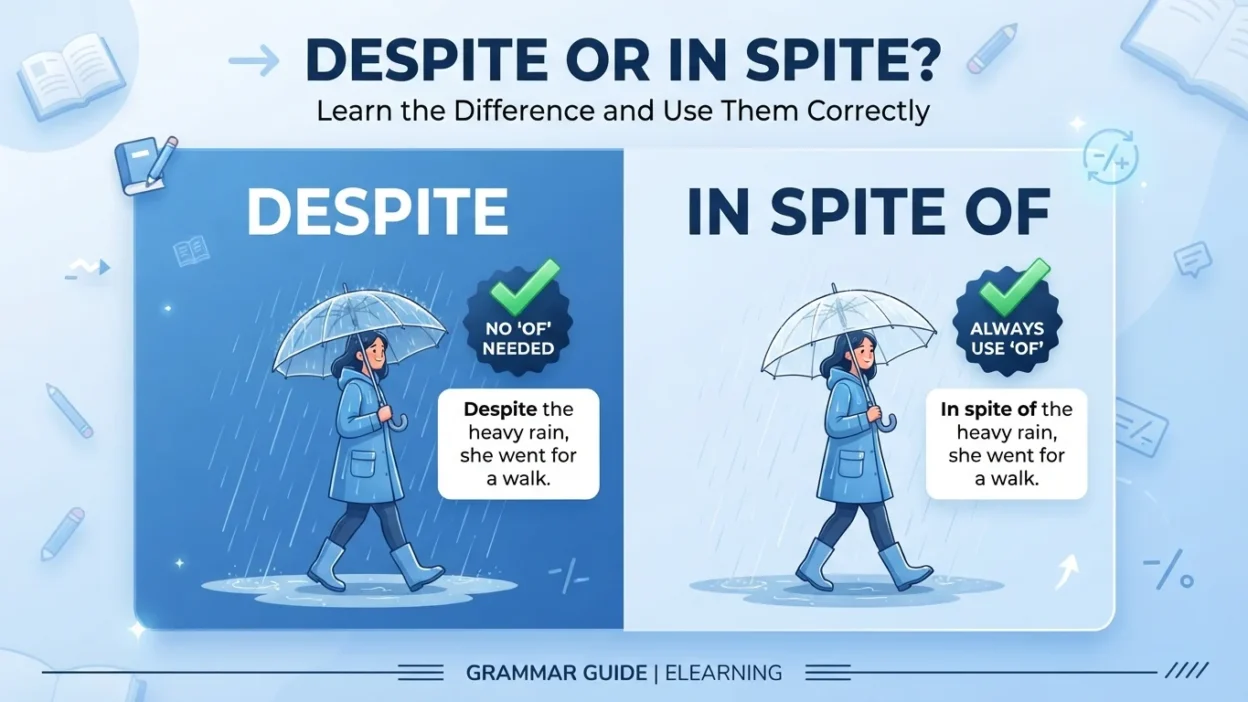
- Despite the rain, we went for a walk.
- In spite of the rain, we went for a walk.
What Does “Despite” Mean?
Despite is a preposition.
It means:
- regardless of
- even though
- without being prevented by
It is followed by:
- a noun
- a pronoun
- a noun phrase
- a gerund (ing form)
Examples of Despite in Sentences
- Despite the cold if , we went swimming.
- She smiled despite the bad news.
- Despite working late, he finished the project.
- They won despite the injuries.
- Despite his age, he runs marathons.
What Does “In Spite of” Mean?
In spite of is a prepositional phrase.
It has the same meaning as despite and is followed by the same types of words.
Examples of In Spite of in Sentences
- In spite of the heavy traffic, we arrived on time.
- She remained calm in spite of the pressure.
- In spite of being tired, he kept working.
- They enjoyed the holiday in spite of the rain.
- In spite of his experience, he made a mistake.
Despite vs In Spite of Comparison Table
| Feature | Despite | In Spite of |
|---|---|---|
| Means “regardless of” | ✅ Yes | ✅ Yes |
| One word preposition | ✅ Yes | ❌ No |
| Three word phrase | ❌ No | ✅ Yes |
| Formal and informal English | ✅ Yes | ✅ Yes |
| Standard English | ✅ Yes | ✅ Yes |
Word Comparison
When to Use Despite
Use despite when you want a shorter, more concise expression.
Examples
- Despite the storm, the flight departed.
- Despite the challenges, she succeeded.
- Despite being busy, he helped us.
- Despite the delay, everyone stayed positive.
When to Use In Spite of
Use in spite of when you prefer a slightly more conversational or emphatic expression.
Examples
- In spite of the snow, the match continued.
- In spite of the warnings, they continued hiking.
- In spite of feeling ill, she attended school.
- In spite of the cost, we bought the tickets.
Common Mistakes
Using “Despite Of”
Incorrect:
- Despite of the rain, we played outside.
Correct:
- Despite the rain, we played outside.
Forgetting “Of” After “In Spite”
Incorrect:
- In spite the rain, we went out.
Correct:
- In spite of the rain, we went out.
Using a Clause Without “The Fact That”
When despite or in spite of is followed by a full clause, use the fact that.
Incorrect:
- Despite he was tired, he worked.
Correct:
- Despite the fact that he was tired, he worked.
or
- Although he was tired, he worked.
Common Phrases
Despite
- despite the rain
- despite the difficulties
- despite the fact that
- despite being late
- despite everything
In Spite of
- in spite of the weather
- in spite of the odds
- in spite of the delay
- in spite of being tired
- in spite of the fact that
Synonyms
Both despite and in spite of can often be replaced with:
- regardless of
- notwithstanding
- even with
- irrespective of
Note: If you’re introducing a full sentence (subject + verb), use although, though, or even though instead.
American vs British English Differences
There is no significant difference.
Both American and British English use despite and in spite of interchangeably with the same meanings.
Why Correct Word Choice Matters
Choosing the correct expression helps you:
- write more naturally
- improve grammatical accuracy
- avoid common mistakes like despite of
- communicate contrast clearly
In formal writing, despite is often preferred because it is shorter and more concise.
Tips to Remember the Difference
Despite = No “Of”
Remember:
- Despite never takes of.
Example:
- Despite the rain…
In Spite = Always “Of”
Remember:
- In spite is always followed by of.
Example:
- In spite of the rain…
Easy Memory Trick
- Despite = No “of”
- In spite = Needs “of”
(FAQs)
What is the difference between despite and in spite of?
There is almost no difference in meaning. Despite is a one-word preposition, while in spite of is a three word phrase.
Which is more formal: despite or in spite of?
Both are acceptable in formal writing, but despite is often preferred because it is shorter and more concise.
Is “despite of” correct?
No. Despite of is grammatically incorrect. Use despite without of.
Can I use despite and in spite of interchangeably?
Yes. In most contexts, they have the same meaning and can replace each other.
Can they be followed by a sentence?
Not directly. If you’re using a full clause, write:
- despite the fact that…
- in spite of the fact that…
Or use although instead.
Is there a difference between British and American English?
No. Both varieties use despite and in spite of in the same way.
How can I remember the difference?
Think:
- Despite = No “of”
- In spite of = Always includes “of”
Final Summary
The difference between despite and in spite of is mainly one of form, not meaning. Both mean regardless of or even though and are usually interchangeable.
Despite is a single word preposition, while in spite of is a three word phrase.
To avoid mistakes, remember that despite is never followed by of, while in spite is always followed by of.
Actionable Takeaway
Use:
- despite ✅ for a concise, one-word expression.
- in spite of ✅ for the same meaning in a longer phrase.
- despite of ❌ because it is grammatically incorrect.
Memory trick:
- Despite = No “of”
- In spite = Needs “of”