Many English learners confuse plural and possessive nouns because they can look similar. The key difference is simple: plural shows more than one, while possessive shows ownership or belonging.
Understanding the difference between plural or possessive will help you use apostrophes correctly and avoid common grammar mistakes.
Quick Answer
- Plural = More than one person, place, thing, or idea.
- Possessive = Shows ownership or that something belongs to someone or something.
Correct Examples
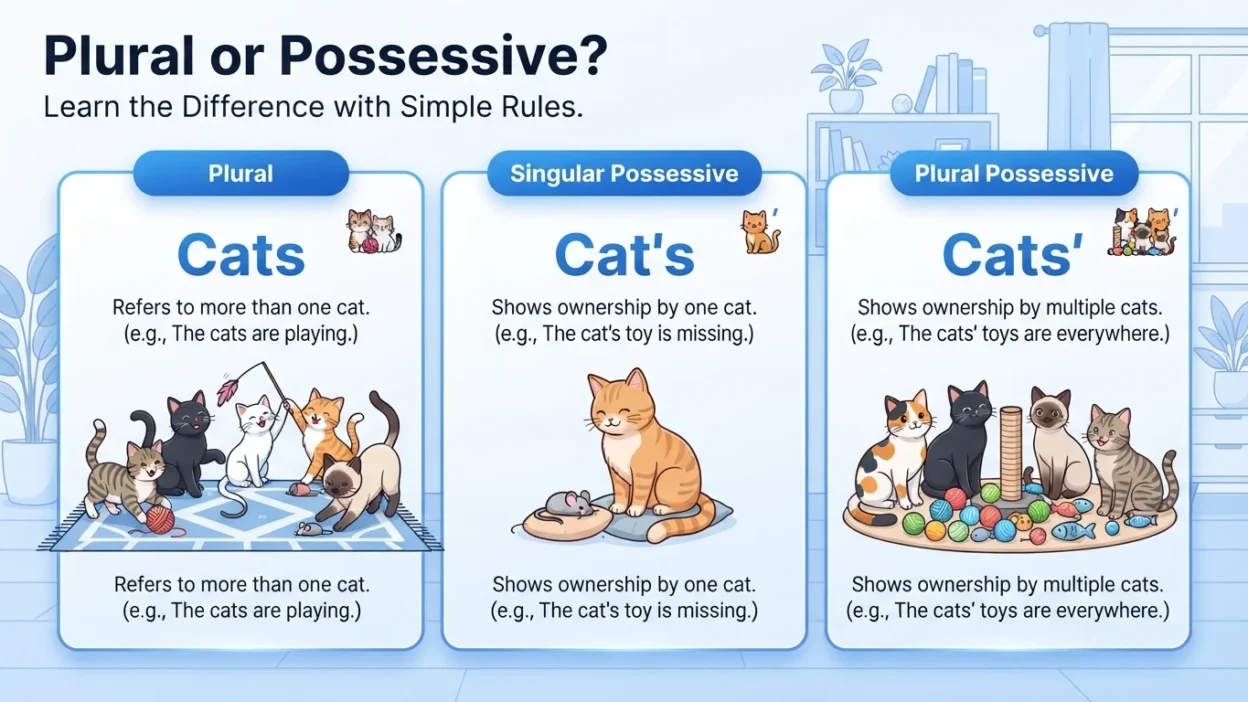
- The cats are sleeping. (Plural)
- The cat’s bed is by the window. (Singular possessive)
- The cats’ toys are scattered across the floor. (Plural possessive)
What Is a Plural?
A plural noun refers to more than one person, place, thing, or idea.
Most plurals are formed by adding s or es to the singular noun.
Examples of Plural Nouns
- One book → Two books
- One dog → Three dogs
- One box → Five boxes
- One child → Two children
- One man → Several men
Plural Examples in Sentences
- The students are studying.
- Three cars are parked outside.
- The children are playing in the garden.
- The women attended the conference.
What Is a Possessive?
A possessive noun shows that someone or something owns or is associated with something else.
Possessive nouns usually use an apostrophe.
Types of Possessive Nouns
Singular Possessive
Add ‘s to most singular nouns.
Examples:
- the girl’s bicycle
- the teacher’s desk
- the dog’s collar
Plural Possessive
- For plural nouns ending in s, add only an apostrophe (‘).
- For irregular plurals not ending in s, add ‘s.
Examples:
- the boys’ classroom
- the dogs’ owner
- the men’s shoes
- the children’s playground
Plural vs Possessive Comparison Table
| Feature | Plural | Possessive |
|---|---|---|
| Shows more than one | ✅ Yes | ❌ No |
| Shows ownership | ❌ No | ✅ Yes |
| Usually needs an apostrophe | ❌ No | ✅ Yes |
| Example | books | book’s |
| Example | boys | boy’s |
When to Use a Plural
Use a plural when talking about more than one person or thing.
Examples
- The dogs bark loudly.
- Two teachers arrived early.
- Several trees were planted.
- The players celebrated their victory.
When to Use a Possessive
Use a possessive when showing ownership, relationship, or association.
Examples
- The dog’s bowl is empty.
- The teacher’s lesson was interesting.
- The players’ uniforms are clean.
- The children’s books are on the shelf.
Common Mistakes
Adding an Apostrophe to Make a Plural
Incorrect:
- I bought three apple’s.
Correct:
- I bought three apples.
Forgetting the Apostrophe for Possession
Incorrect:
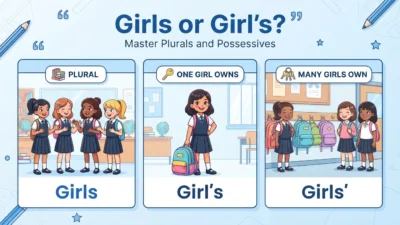
- The girls backpack is missing. (One girl owns it.)
Correct:
- The girl’s backpack is missing.
Confusing Plural Possessive
Incorrect:
- The boys locker room is upstairs. (If it belongs to several boys.)
Correct:
- The boys’ locker room is upstairs.
Common Examples
| Singular | Plural | Singular Possessive | Plural Possessive |
|---|---|---|---|
| boy | boys | boy’s bike | boys’ bikes |
| girl | girls | girl’s book | girls’ books |
| cat | cats | cat’s toy | cats’ toys |
| man | men | man’s hat | men’s hats |
| child | children | child’s game | children’s games |
American vs British English Differences
There is no difference between American and British English regarding plural and possessive forms.
Both follow the same grammar rules for:
- forming plurals
- using apostrophes for possession
- irregular plural nouns
Why the Difference Matters
Using plurals and possessives correctly helps you:
- improve grammar accuracy
- avoid punctuation mistakes
- communicate ownership clearly
- write more professionally
A missing or misplaced apostrophe can change the meaning of a sentence.
Tips to Remember the Difference
Plural = More Than One
If you’re simply talking about more than one, don’t add an apostrophe.
Example:
- Three cats slept on the sofa.
Possessive = Ownership
If something belongs to someone or something, use an apostrophe.
Example:
- The cat’s toy is under the sofa.
Easy Memory Trick
- Plural = Many
- Possessive = Owns
(FAQs)
What is the difference between plural and possessive?
A plural noun shows there is more than one person or thing, while a possessive noun shows ownership or belonging.
Does every plural noun need an apostrophe?
No. Most plural nouns do not use an apostrophe. Apostrophes are generally used only to show possession.
How do I make a singular noun possessive?
Add ‘s to most singular nouns.
Example:
- the student’s notebook
How do I make a plural noun possessive?
If the plural ends in s, add only an apostrophe.
Example:
- the teachers’ lounge
If the plural is irregular (such as men or children), add ‘s.
Example:
- the children’s toys
Is “boys” plural or possessive?
Boys is plural. Boy’s is singular possessive, and boys’ is plural possessive.
Is there a difference between British and American English?
No. Both follow the same rules for plural and possessive nouns.
Final Summary
The difference between plural and possessive is straightforward. A plural noun simply means more than one, while a possessive noun shows that something belongs to someone or something.
Remember:
- cats = more than one cat (plural)
- cat’s = one cat owns something (singular possessive)
- cats’ = more than one cat owns something (plural possessive)
Using the correct form makes your writing clear, accurate, and grammatically correct.
Actionable Takeaway
Use:
- Plural ✅ to show more than one.
- Possessive ✅ to show ownership or belonging.
Memory trick:
- No apostrophe = Usually plural
- Apostrophe = Usually possession