If you’ve ever wondered if “informations” or “information” is the correct word, you’re not alone. This is a common mistake for English learners because many languages allow information to be plural.
In English, however, information is an uncountable (mass) noun, so it does not normally have a plural form.
Information is the correct word in almost every situation. Informations is not standard English except in a few rare legal or historical contexts.
Understanding the difference between informations or information will help you avoid a common grammar error.
Quick Answer
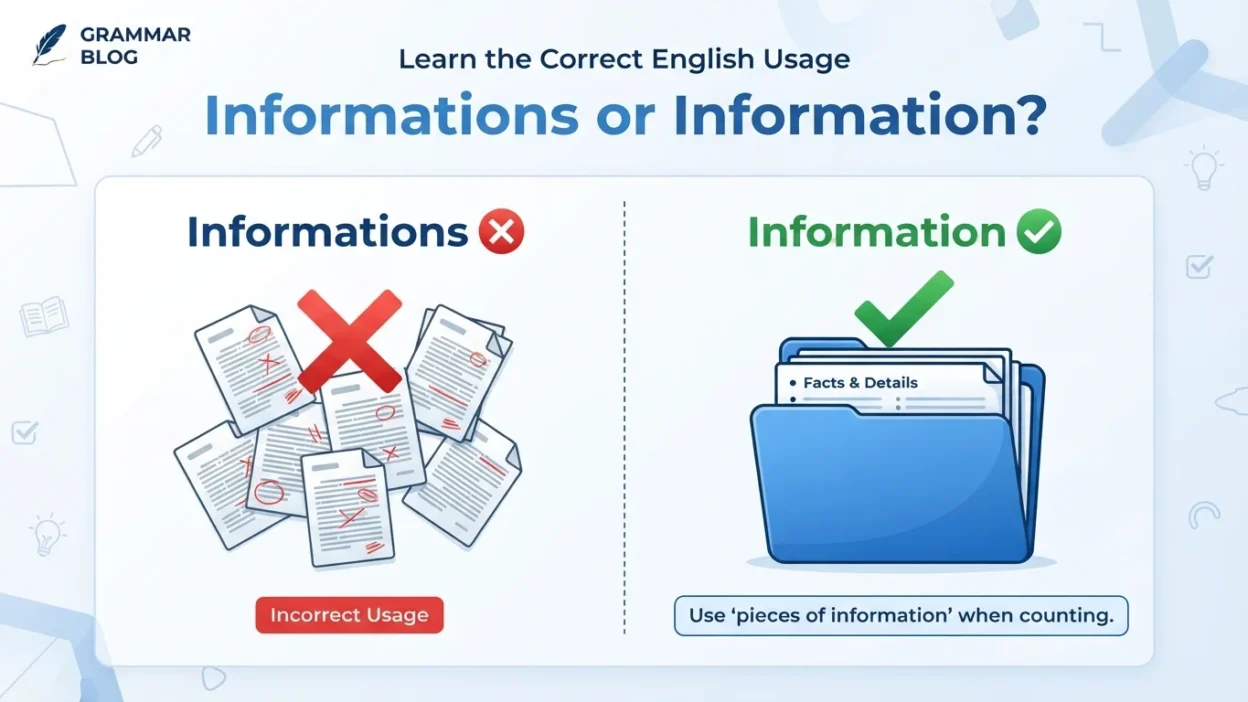
- Information = ✅ Correct. An uncountable noun meaning facts, details, or knowledge.
- Informations = ❌ Incorrect in standard English (except in rare legal or historical uses).
Correct Examples
- I need more information about the project.
- She gave us useful information.
What Does “Information” Mean?
Information is an uncountable noun that refers to:
- facts
- knowledge
- details
- data shared with others
Because it is uncountable, you do not add -s to make it plural.
Examples of Information in Sentences
- Can you give me some information?
- The website provides useful information.
- We collected information from several sources.
- I need more information before deciding.
- The information was accurate and helpful.
What About “Informations”?
In modern English, informations is generally incorrect.
However, in some legal or historical contexts, information can refer to a formal criminal charge, and informations may appear as its plural. This use is rare and not part of everyday English.
Example (Legal Context)
- The court received several informations against the defendant.
Note: Unless you’re writing about law or historical documents, use information, not informations.
Information vs Informations Comparison Table
| Feature | Information | Informations |
|---|---|---|
| Standard English | ✅ Yes | ❌ No (except rare legal use) |
| Uncountable noun | ✅ Yes | ❌ No |
| Means facts or knowledge | ✅ Yes | ❌ Not in everyday English |
| Used in everyday conversation | ✅ Yes | ❌ No |
Word Comparison
When to Use Information
Use information when referring to:
- facts
- knowledge
- advice
- details
- news
Examples
- Please send me the information.
- We found valuable information online.
- This information is confidential.
- She shared important information with the team.
How to Express a Plural Idea
Since information is uncountable, use expressions such as:
- pieces of information
- bits of information
- items of information
Examples
- She gave me three pieces of information.
- We received several items of information.
- The report contained many bits of useful information.
Common Mistakes
Using Informations in Everyday English
Incorrect:
- He gave me many informations.
Correct:
- He gave me a lot of information.
- He gave me many pieces of information.
Counting Information Directly
Incorrect:
- I have two informations.
Correct:
- I have two pieces of information.
Common Phrases
- useful information
- personal information
- contact information
- background information
- additional information
- detailed information
- more information
- confidential information
Synonyms for Information
Depending on the context, you can also use:
- details
- facts
- data
- knowledge
- evidence
- intelligence
- material
American vs British English Differences
There is no difference between American and British English.
Both varieties treat information as an uncountable noun and do not use informations in ordinary writing or speech.
Why Correct Word Choice Matters
Using information correctly helps you:
- improve grammar accuracy
- sound more natural
- avoid a common learner mistake
- write professionally
Many English learners incorrectly add s because similar words are countable in their native language.
Tips to Remember the Difference
Information = Uncountable
Think of information like advice, knowledge, or furniture it normally has no plural form.
Need to Count It?
Use:
- piece of information
- item of information
- bit of information
Easy Memory Trick
- Information = Never add s
- Count it with “pieces of information”
(FAQs)
Is “informations” a correct English word?
In standard English, no. It is only used in rare legal or historical contexts.
Which is correct: “more information” or “more informations”?
The correct phrase is more information.
Can I say “two informations”?
No. Say two pieces of information instead.
Why is information uncountable?
Because it refers to facts or knowledge as a whole rather than individual countable objects.
How do I make information plural?
You don’t. Instead, use expressions like pieces of information or items of information.
Is there a difference between British and American English?
No. Both treat information as an uncountable noun.
How can I remember the difference?
Think:
- Information = Uncountable
- Use “pieces of information” when counting
Final Summary
The difference between informations or information is simple. Information is the correct and standard English word for facts, knowledge, or details. It is an uncountable noun, so it does not normally take a plural -s. Although informations exists in a few specialised legal or historical contexts, it is not appropriate for everyday English.
Whenever you need to count separate facts, use phrases such as pieces of information or items of information instead of informations.
Actionable Takeaway
Use:
- information ✅ for facts, knowledge, or details.
- pieces of information ✅ when referring to individual facts.
- informations ❌ in everyday English.
Memory trick:
- Information = Uncountable
- Need a number? Say “pieces of information.