If you’ve ever wondered if “accept” or “except” is the correct word, you’re not alone. These two words are among the most commonly confused in English because they look and sound similar. However, they have completely different meanings.
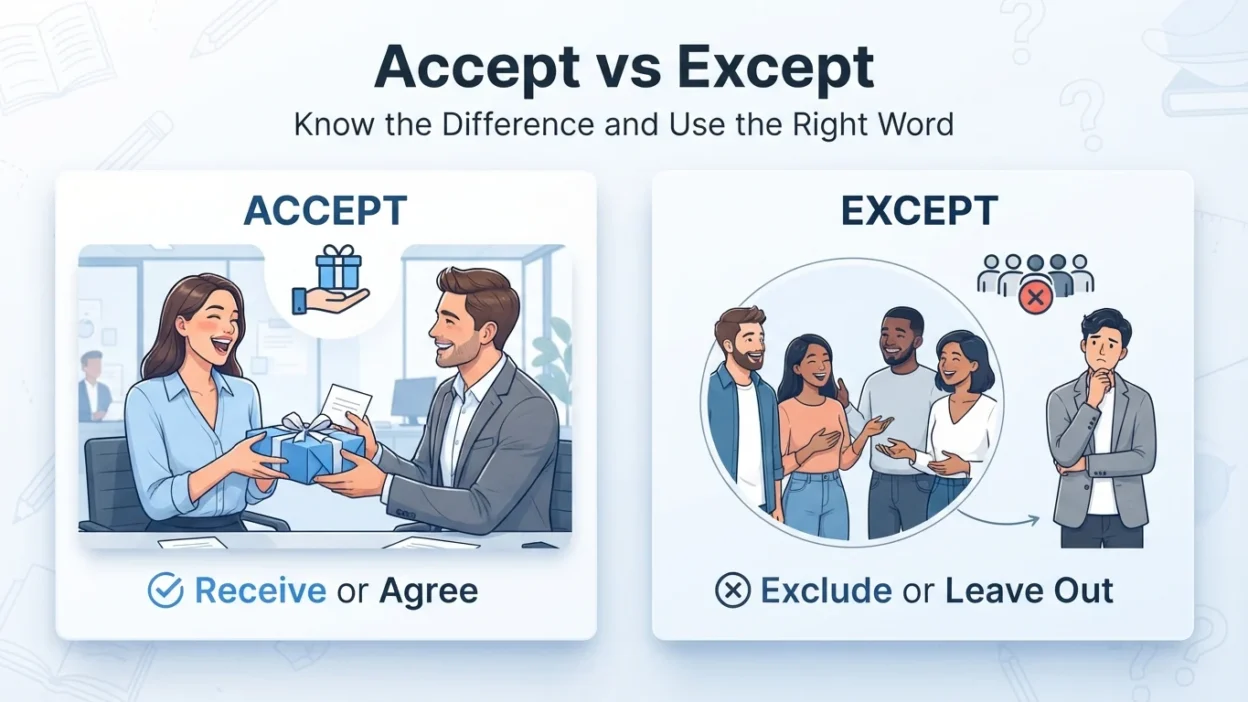
Accept is a verb meaning to receive, agree to, or approve of something, while except is usually a preposition meaning excluding or with the exception of.
Understanding the difference between accept vs except will help you avoid common grammar and spelling mistakes.
Quick Answer
- Accept = To receive, agree to, or approve.
- Except = Excluding or leaving out.
Correct Examples
- I gladly accept your invitation.
- Everyone attended the meeting except Sarah.
What Does “Accept” Mean?
Accept is a verb.
It means:
- to receive willingly
- to agree to
- to approve
- to believe or acknowledge
Examples of Accept in Sentences
- She accepted the job offer.
- We accept credit cards.
- He accepted responsibility for the mistake.
- I happily accept your apology.
- The university accepted her application.
What Does “Except” Mean?
Except is most commonly a preposition, though it can also be used as a conjunction or, less commonly, a verb.
It means:
- excluding
- apart from
- with the exception of
Examples of Except in Sentences
- Everyone arrived except Tom.
- The shop is open every day except Sunday.
- I like all vegetables except spinach.
- No one knew the answer except the teacher.
- Everything was finished except the final report.
Accept vs Except Comparison Table
| Feature | Accept | Except |
|---|---|---|
| Part of speech | Verb | Usually a preposition |
| Means receive or agree | ✅ Yes | ❌ No |
| Means exclude | ❌ No | ✅ Yes |
| Used for invitations and offers | ✅ Yes | ❌ No |
| Standard English | ✅ Yes | ✅ Yes |
Word Comparison
When to Use Accept
Use accept when talking about:
- receiving gifts
- accepting invitations
- agreeing to terms
- admitting responsibility
- approving an offer
Examples
- Please accept this award.
- They accepted our proposal.
- I accept your decision.
- She accepted the challenge.
When to Use Except
Use except when referring to:
- exclusions
- omissions
- things left out
- exceptions
Examples
- Every student passed except one.
- The museum is open daily except Mondays.
- Everyone except Lisa enjoyed the trip.
Common Mistakes
Using Except Instead of Accept
Incorrect:
- Please except my apology.
Correct:
- Please accept my apology.
Using Accept Instead of Except
Incorrect:
- Everyone accepted John came early.
Correct:
- Everyone except John came early.
Common Phrases
Accept
- accept an offer
- accept responsibility
- accept an invitation
- accept payment
- accept defeat
Except
- except for
- everyone except
- all except
- except that
- except when
Synonyms
Synonyms for Accept
- receive
- agree to
- approve
- acknowledge
- embrace
Synonyms for Except
- excluding
- apart from
- leaving out
- other than
- with the exception of
American vs British English Differences
There is no significant difference.
Both American and British English use accept and except with the same meanings and grammar rules.
Why Correct Word Choice Matters
Using the correct word helps:
- improve grammatical accuracy
- avoid misunderstandings
- strengthen professional and academic writing
- communicate clearly
Since accept and except differ by only one letter and have similar pronunciations, they are easy to confuse.
Tips to Remember the Difference
Accept = Receive
Think of accept whenever you’re receiving or agreeing to something.
Example:
- Accept a gift.
- Accept an invitation.
Except = Exclude
Think of except whenever you’re leaving something out.
Example:
- Everyone except me.
Easy Memory Trick
- Accept = Agree or receive
- Except = Exclude
(FAQs)
What is the difference between accept and except?
Accept means to receive or agree to something, while except means excluding or leaving something out.
Which is correct: “accept my apology” or “except my apology”?
The correct phrase is:
- Accept my apology.
Can except be used as a verb?
Yes, but it’s rare and mostly found in formal or legal writing. In everyday English, except is usually a preposition or conjunction.
Is “everyone except me” correct?
Yes. Everyone except me is grammatically correct.
How do I know which word to use?
If you’re talking about receiving or agreeing, use accept. If you’re talking about excluding, use except.
Is there a difference between British and American English?
No. Both varieties use these words the same way.
How can I remember the difference?
Think:
- Accept = Agree
- Except = Exclude
Final Summary
The difference between accept vs except is simple. Accept means to receive, agree to, or approve of something, while except means excluding or leaving something out.
Whenever you’re receiving an offer, invitation, or responsibility, use accept. When you’re excluding someone or something from a group, use except.
Actionable Takeaway
Use:
- accept ✅ when receiving or agreeing to something.
- except ✅ when excluding someone or something.
Memory trick:
- Accept = Agree or receive
- Except = Exclude