
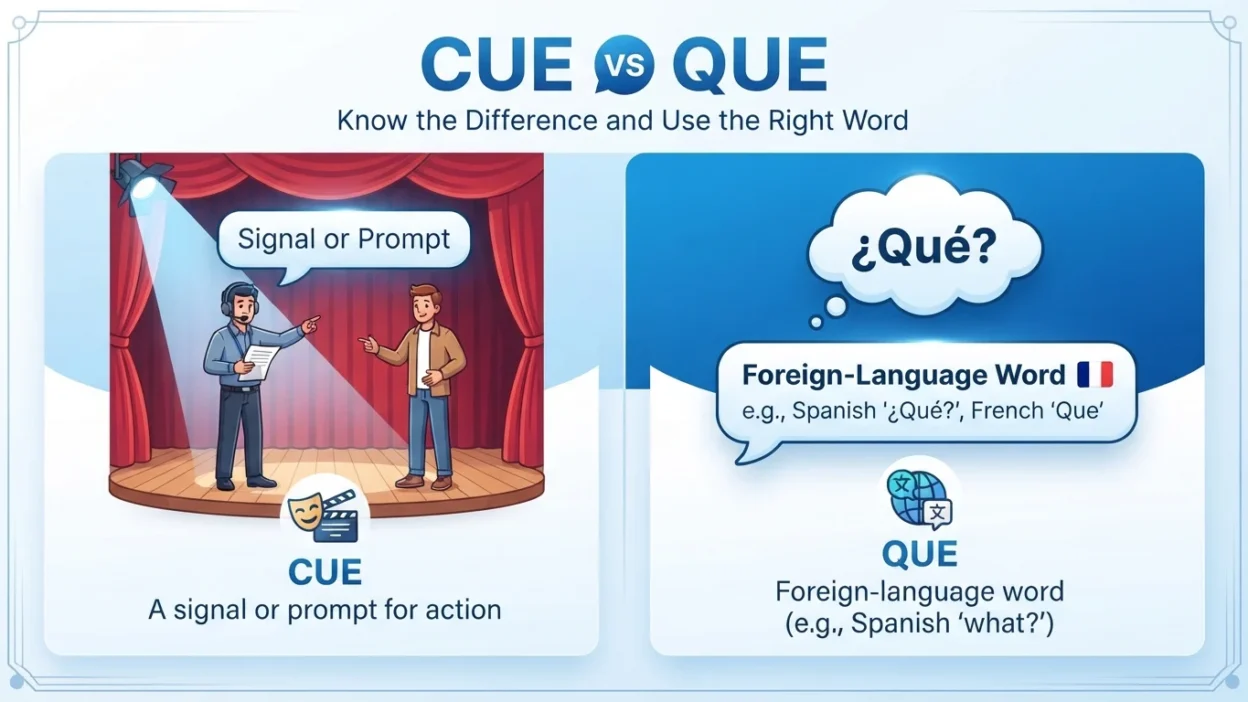
If you’ve ever wondered if “cue” or “que” is the correct word, you’re not alone. These two words are often confused because they look similar. However, they have very different meanings, and in most English writing, cue is the correct choice.
Cue is an English word meaning a signal, prompt, or indication to act, while que is not an English word.
It is a word used in other languages, such as Spanish (“that,” “which,” or “what”) and French (the feminine form of “that” or “which”). In English, people sometimes mistakenly write que when they mean cue or queue.
Quick Answer
- Cue = A signal, prompt, or indication to begin an action.
- Que = Not an English word; used in languages such as Spanish and French.
Correct Examples
- The actor waited for his cue before walking onto the stage.
- She took my smile as a cue to start the conversation.
Incorrect Example
- The actor waited for his que. ❌
What Does “Cue” Mean?
Cue can be a noun or a verb.
As a noun, it means:
- a signal
- a prompt
- an indication that it’s time to do something
As a verb, it means:
- to signal
- to prompt
- to prepare something to start
Examples of Cue in Sentences
- The director gave the cue to begin filming.
- Wait for your cue before speaking.
- Her expression was my cue to leave.
- The DJ cued the next song.
- The applause was the cue for the performers to return.
What Does “Que” Mean?
Que is not a standard English word.
Instead, it appears in several other languages.
For example:
- Spanish: ¿Qué? = “What?”
- Spanish: que = “that” or “which”
- French: que = “that” or “which”
Unless you’re writing in one of those languages or quoting foreign text, que should not be used in English.
Cue vs Que Comparison Table
| Feature | Cue | Que |
|---|---|---|
| Standard English word | ✅ Yes | ❌ No |
| Means signal or prompt | ✅ Yes | ❌ No |
| Used in theatre and music | ✅ Yes | ❌ No |
| Commonly used in Spanish/French | ❌ No | ✅ Yes |
| Correct in English writing | ✅ Yes | Only in foreign-language contexts |
Word Comparison
When to Use Cue
Use cue when referring to:
- a signal
- a prompt
- an indication
- theatre directions
- music playback
Examples
- That’s my cue to leave.
- The teacher cued the students to begin.
- The lighting change was the actors’ cue.
- Please cue the presentation video.
When to Use Que
Use que only when:
- writing in Spanish
- writing in French
- quoting text from those languages
Examples
- ¿Qué hora es? (Spanish: “What time is it?”)
- Je pense que tu as raison. (French: “I think that you’re right.”)
Common Mistakes
Using Que Instead of Cue
Incorrect:
- That was my que to speak.
Correct:
- That was my cue to speak.
Confusing Cue with Queue
Another common mistake is confusing cue with queue.
- Cue = signal
- Queue = a line of people waiting
Examples:
- Wait for your cue before entering.
- We stood in a queue for tickets.
Common Phrases
Cue
- on cue
- take the cue
- visual cue
- audio cue
- cue the music
Que
- ¿Qué pasa? (Spanish)
- que sera (part of foreign phrases)
- French and Spanish grammar examples
Synonyms
Synonyms for Cue
- signal
- prompt
- indication
- hint
- trigger
Synonyms for Que
There are no English synonyms because que is not an English word.
American vs British English Differences
There is no significant difference.
Both American and British English use cue with the same meaning.
Que is only used in English when quoting or writing in another language.
Why Correct Word Choice Matters
Using the correct word helps:
- improve spelling accuracy
- avoid confusion
- strengthen professional writing
- communicate clearly
Many spelling mistakes happen because cue, que, and queue have similar pronunciations or spellings.
Tips to Remember the Difference
Cue = Signal
Think of cue whenever someone receives a signal to begin.
Example:
- The lights dimmed that was our cue.
Que = Foreign Language
If you’re writing in English, que is usually not the word you want.
Easy Memory Trick
- Cue = Signal
- Que = Spanish/French word
(FAQs)
What is the difference between cue and que?
Cue is an English word meaning a signal or prompt, while que is a word used in languages such as Spanish and French.
Which is correct: “my cue” or “my que”?
The correct phrase is my cue.
Is que an English word?
No. Que is not a standard English word, although it appears in Spanish, French, and some other languages.
What does cue mean in theatre?
A cue is a signal telling an actor, musician, or technician when to perform an action.
Is cue the same as queue?
No.
- Cue = signal
- Queue = line of people or items waiting
Is there a difference between British and American English?
No. Both varieties use cue in the same way.
How can I remember the difference?
Think:
- Cue = Signal
- Que = Foreign-language word
Final Summary
The difference between cue vs que is simple. Cue is the correct English word for a signal or prompt, while que is not an English word and is mainly used in languages such as Spanish and French.
Whenever you’re writing in English about a signal, reminder, or prompt, always use cue.
Actionable Takeaway
Use:
- cue ✅ for a signal, prompt, or indication.
- que ✅ only when writing or quoting Spanish, French, or another language that uses it.
Memory trick:
- Cue = Signal
- Que = Foreign-language word