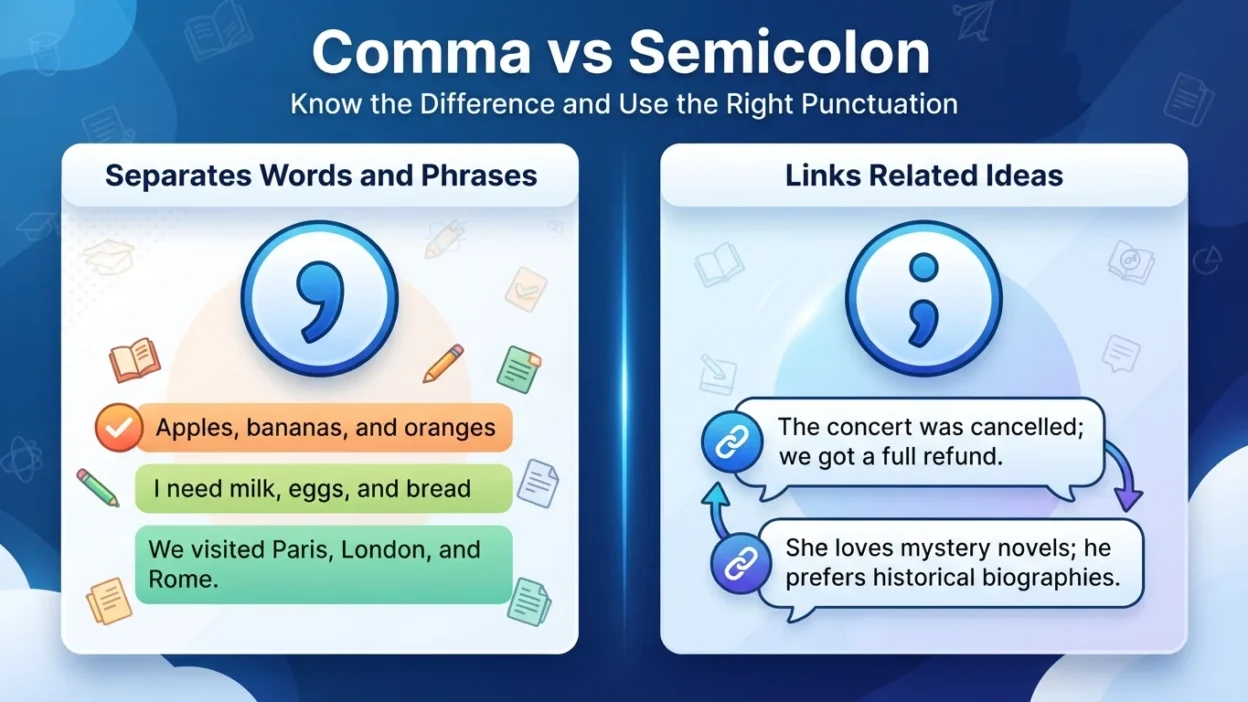
Choosing between a comma (,) and a semicolon (;) is one of the most common punctuation challenges in English. Although both marks create pauses, they have different purposes and cannot always be used interchangeably.
A comma separates words, phrases, clauses, or items in a list, while a semicolon connects closely related independent clauses or separates items in a complex list that already contains commas.
Learning the difference between comma vs semicolon will make your writing clearer, more accurate, and more professional.
Quick Answer
- Comma (,) = Separates words, phrases, clauses, or simple list items.
- Semicolon (;) = Joins closely related independent clauses or separates complex list items.
Correct Examples
- We bought apples, oranges, bananas, and grapes.
- She enjoys coffee; her brother prefers tea.
What Is a Comma?
A comma is a punctuation mark used to create a brief pause and organize a sentence. It helps readers understand how different parts of a sentence relate to one another.
Use a comma to:
- separate items in a list
- separate introductory words or phrases
- join two independent clauses with a coordinating conjunction (such as and, but, or so)
- set off nonessential information
Examples of Commas in Sentences
- I packed clothes, shoes, and toiletries.
- After the meeting, we went for lunch.
- She was tired, but she finished the report.
- My cousin, who lives in Canada, is visiting next week.
- Yes, I’d be happy to help.
What Is a Semicolon?
A semicolon is a punctuation mark that links ideas more closely than a full stop but more strongly than a comma.
Use a semicolon to:
- join two closely related independent clauses
- separate items in a list when the items themselves contain commas
- connect clauses followed by conjunctive adverbs such as however, therefore, moreover, or consequently
Examples of Semicolons in Sentences
- I finished the assignment; I submitted it before the deadline.
- She loves travelling; however, she dislikes flying.
- The conference welcomed guests from London, England; Paris, France; and Rome, Italy.
- It was getting late; we decided to leave.
- He trained every day; consequently, he improved quickly.
Comma vs Semicolon Comparison Table
| Feature | Comma (,) | Semicolon (;) |
|---|---|---|
| Separates items in a simple list | ✅ Yes | ❌ No |
| Joins two independent clauses by itself | ❌ No | ✅ Yes |
| Used before coordinating conjunctions | ✅ Yes | ❌ Usually no |
| Separates complex list items | ❌ No | ✅ Yes |
| Creates a pause | ✅ Short | ✅ Longer |
Word Comparison
When to Use a Comma
Use a comma when writing:
- simple lists
- introductory phrases
- compound sentences with coordinating conjunctions
- nonessential information
- direct addresses
Examples
- Bring notebooks, pens, and folders.
- Although it was raining, we went hiking.
- Emma, could you close the window?
- I was hungry, so I ordered dinner.
When to Use a Semicolon
Use a semicolon when:
- connecting two complete, closely related sentences
- separating complicated list items
- introducing conjunctive adverbs between independent clauses
Examples
- The weather improved; we went to the beach.
- She studied hard; therefore, she passed the exam.
- We visited York, England; Cardiff, Wales; and Belfast, Northern Ireland.
Common Mistakes
Using a Comma Instead of a Semicolon
Incorrect:
- I finished my homework, I watched television.
This is known as a comma splice.
Correct:
- I finished my homework; I watched television.
Or:
- I finished my homework, and I watched television.
Using a Semicolon Instead of a Comma
Incorrect:
- I bought apples; bananas; oranges.
Correct:
- I bought apples, bananas, and oranges.
Common Uses
Comma
- shopping lists
- introductory phrases
- direct address
- joining clauses with and, but, or, so
- nonessential information
Semicolon
- joining related independent clauses
- before conjunctive adverbs
- separating complex lists
American vs British English Differences
The grammatical rules for commas and semicolons are the same in both American and British English.
The main style difference involves the Oxford comma (also called the serial comma):
American English usually recommends it:
- We bought apples, oranges**,** and bananas.
British English often omits it unless it improves clarity:
- We bought apples, oranges and bananas.
Why Correct Punctuation Matters
Using commas and semicolons correctly helps you:
- improve readability
- avoid grammar mistakes such as comma splices
- make your writing more professional
- express ideas more clearly
Correct punctuation also helps readers understand your meaning without confusion.
Tips to Remember the Difference
Comma = Small Separator
Think of a comma as a divider between words or sentence parts.
Semicolon = Strong Connector
Think of a semicolon as a bridge joining two complete but closely related ideas.
Easy Memory Trick
- Comma = Separate
- Semicolon = Connect
(FAQs)
What is the difference between a comma and a semicolon?
A comma separates words, phrases, clauses, or list items, while a semicolon joins closely related independent clauses or separates complex list items.
Can a semicolon replace a comma?
Only in certain situations. A semicolon can connect two complete sentences, but it should not replace commas in ordinary lists.
What is a comma splice?
A comma splice happens when two independent clauses are joined with only a comma.
Incorrect:
- She smiled, he laughed.
Correct:
- She smiled; he laughed.
When should I use a semicolon in a list?
Use a semicolon when the list items already contain commas.
Example:
- We visited Oxford, England; Dublin, Ireland; and Edinburgh, Scotland.
Is a semicolon stronger than a comma?
Yes. A semicolon creates a stronger pause than a comma but a weaker break than a full stop.
Is there a difference between British and American English?
The punctuation rules are the same. The main style difference is the optional use of the Oxford comma.
How can I remember the difference?
Remember:
- Comma = Separate
- Semicolon = Connect
Final Summary
The difference between comma vs semicolon is straightforward. A comma separates words, phrases, and clauses within a sentence, while a semicolon joins two closely related independent clauses or separates items in a complex list.
If you’re listing items or adding a brief pause, use a comma. If you’re connecting two complete ideas without a coordinating conjunction, use a semicolon.
Actionable Takeaway
Use:
- Comma (,) ✅ for lists, introductory phrases, and clauses joined by coordinating conjunctions.
- Semicolon (;) ✅ to connect related independent clauses or separate complex list items.
Memory trick:
- Comma = Separate
- Semicolon = Connect