If you’ve ever wondered whether “either” or “neither” is the correct word, you’re not alone. These two words are closely related, but they express opposite meanings.
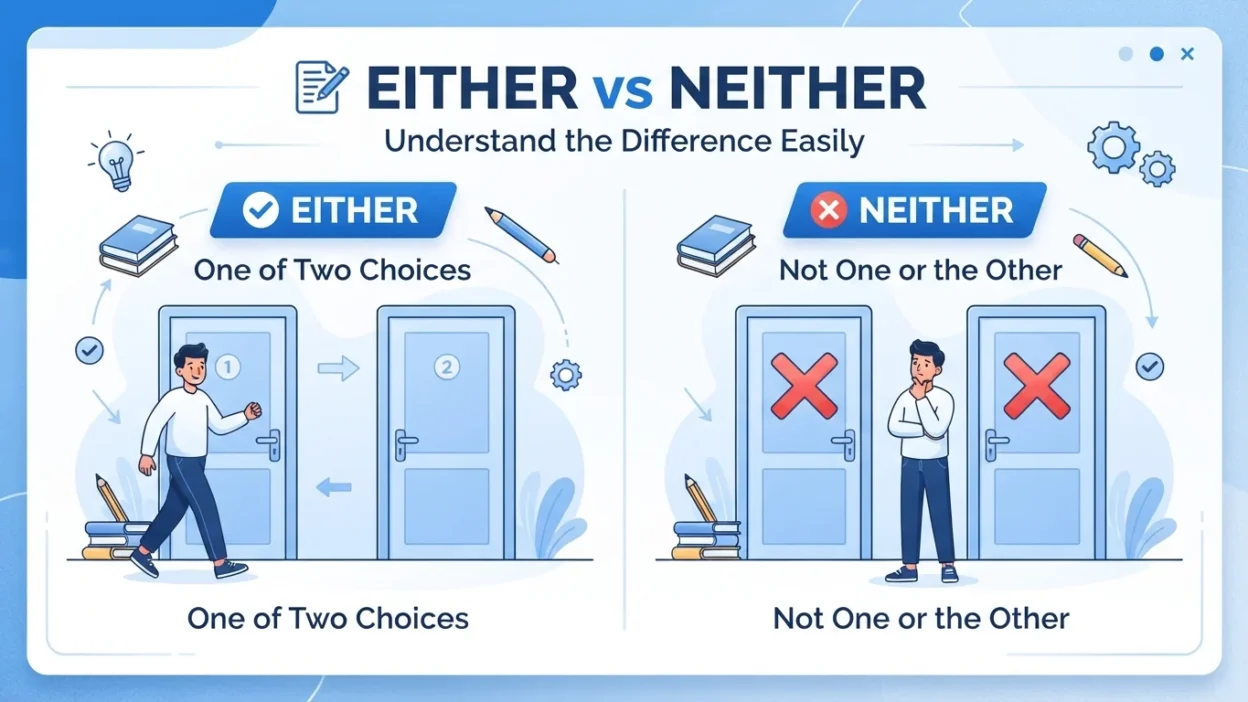
Either refers to one of two options, while neither means not one and not the other. Understanding the difference between either vs neither will help you avoid common grammar mistakes and communicate more clearly.
Quick Answer
- Either = One or the other of two choices.
- Neither = Not one and not the other.
Correct Examples
- You can choose either tea or coffee.
- Neither answer is correct.
What Does Either Mean?
Either is used to refer to one of two people, things, or choices.
It can function as:
- a determiner
- a pronoun
- an adverb
- a conjunction (in the phrase either…or)
Examples of Either in Sentences
- You may sit in either chair.
- Either option will work.
- I don’t like coffee, and my brother doesn’t either.
- We can leave either today or tomorrow.
- Either road leads to the same destination.
What Does Neither Mean?
Neither means not one nor the other.
Like either, it can function as:
- a determiner
- a pronoun
- a conjunction (in the phrase neither…nor)
Examples of Neither in Sentences
- Neither student passed the exam.
- Neither of the answers is correct.
- I like neither movie.
- Neither John nor Sarah attended the meeting.
- Neither solution solved the problem.
Either vs Neither Comparison Table
| Feature | Either | Neither |
|---|---|---|
| Meaning | One of two | Not one of two |
| Positive or negative | Positive | Negative |
| Common pair | Either…or | Neither…nor |
| Refers to two choices | Yes | Yes |
| Standard English | Yes | Yes |
Word Comparison
When to Use Either
Use either when:
- referring to one of two options
- offering a choice
- agreeing with a negative statement (using either at the end)
Examples
- Either dress looks beautiful.
- You can take either route.
- I don’t watch horror movies, and my sister doesn’t either.
When to Use Neither
Use neither when:
- both options are rejected
- neither option is true
- expressing a negative idea about two people or things
Examples
- Neither road is safe.
- Neither candidate won enough votes.
- Neither of my friends could attend.
Either…Or vs Neither…Nor
Either…Or
Use either…or when choosing between two possibilities.
Examples:
- You can either call me or send an email.
- Either Sam or Alex will lead the meeting.
Neither…Nor
Use neither…nor when both options are negative.
Examples:
- Neither rain nor snow stopped the event.
- Neither my parents nor my brother knew the answer.
Common Mistakes
Using Either in a Negative Meaning
Incorrect:
- Either student passed the exam. (when you mean none did)
Correct:
- Neither student passed the exam.
Double Negatives
Incorrect:
- I don’t want neither option.
Correct:
- I want neither option.
- I don’t want either option.
Common Phrases
Either
- either way
- either one
- either…or
- either side
- either choice
Neither
- neither…nor
- neither one
- neither of them
- neither side
- neither option
Synonyms
Synonyms for Either
- one of the two
- any one
- whichever
Synonyms for Neither
- not either
- none of the two
- not one
American vs British English Differences
There is no major difference in meaning or grammar.
Both American and British English use:
- either
- neither
The main difference is pronunciation:
- Either may be pronounced EE-thər or EYE-thər.
- Neither may be pronounced NEE-thər or NYE-thər.
Both pronunciations are correct.
Why Correct Usage Matters
Using the correct word helps:
- improve clarity
- avoid logical errors
- strengthen grammar
- communicate choices accurately
- enhance professional writing
Tips to Remember the Difference
Either = One Choice
Think:
- Either = One of Two
Neither = Zero Choices
Think:
- Neither = Not Either
Easy Memory Trick
- Either = One
- Neither = None
(FAQs)
What is the difference between either and neither?
Either means one of two choices, while neither means not one and not the other.
Is either positive or negative?
Either is generally positive because it presents a choice.
Is neither always negative?
Yes. Neither already has a negative meaning.
Should I say “either or” or “neither nor”?
Use either or when offering choices and neither nor when rejecting both options.
Can I say “I don’t like neither”?
No. That’s a double negative. Say:
- I don’t like either.
- I like neither.
Do either and neither always refer to two things?
Traditionally, yes. For more than two, any and none are often preferred, although modern English sometimes uses either and neither more broadly.
Is there a difference between British and American English?
No major difference. Only pronunciation varies slightly.
How can I remember the difference?
Think:
- Either = One of Two
- Neither = None of Two
Final Summary
The difference between either vs neither is simple. Either refers to one of two choices, while neither means not one and not the other.
Using the correct word will make your writing clearer, more accurate, and grammatically correct.
Actionable Takeaway
Use:
- either ✅ when choosing between two options.
- neither ✅ when rejecting both options.
Memory trick:
- Either = One